How to Use a Negative Oxygen Ion Detector
The Negative Oxygen Ion Detector is an essential device for both industrial sectors and residential areas that prioritize air quality. Designed to overcome the limitations of traditional electric plate-type monitors, this device utilizes Double Concentric Cylinder technology to ensure smooth airflow. This results in high-precision measurement of negative ions, taking your Air Quality IoT Monitoring System to the next level of efficiency.
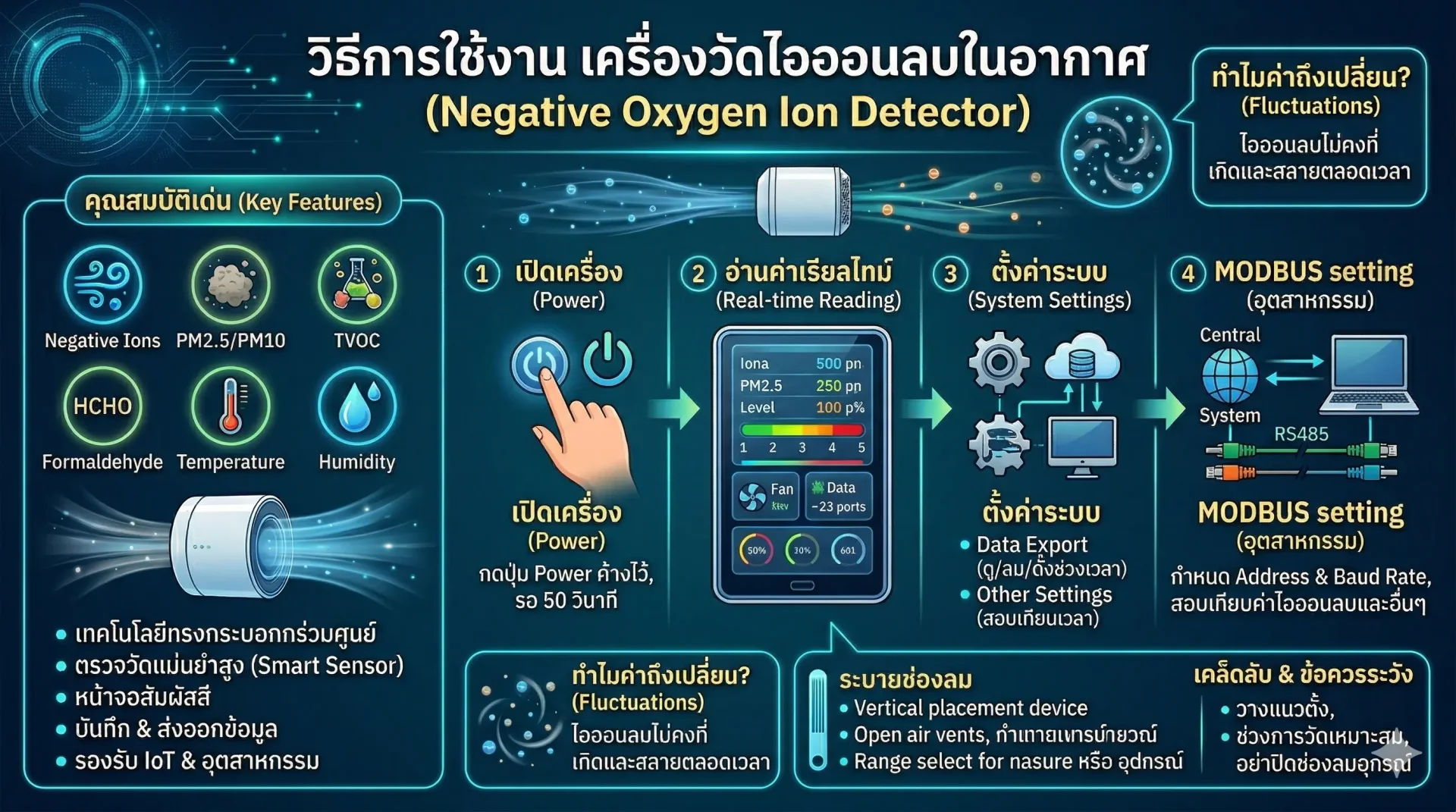
Equipped with world-class sensors, this unit is more than just a negative ion counter—it is a comprehensive Smart Sensor that integrates measurements for PM2.5 / PM10 dust, TVOC, Formaldehyde, temperature, and humidity. Users can monitor real-time values via a color touchscreen and manage data effortlessly through built-in Data Storage and Data Export systems, facilitating professional environmental analysis and seamless transmission to central computer systems.
Operating Steps for the Portable Negative Oxygen Ion Monitor
1. Power On: Press and hold the "Power" button to start. Wait approximately 50 seconds for the device to enter the "Detecting" state.
2. Real-time Monitoring: The touchscreen displays real-time values for negative ions, temperature, humidity, Formaldehyde, PM2.5 / PM10, and TVOC. It also indicates the date, time, operating status, and fan levels, using color-coded indicators for clarity.
3. System Settings: Click "System Settings" at the bottom of the screen to access:
- Data Export: View or delete stored data and set the storage time interval.
- Other Settings: Calibrate the current time and check the device version.
4. Industrial MODBUS Configuration: The "MODBUS setting" menu allows users to define the Address and Baud Rate, as well as calibrate sensors for negative ions, temperature, humidity, TVOC, Formaldehyde, and PM2.5 / PM10. This ensures readiness for connection with RS485 Modbus sensors to a central control system.
Why Do Negative Ion Readings Fluctuate?
During use, you may notice that the negative ion values are unstable and constantly changing. This is due to the natural instability of negative ions; they are constantly being generated and neutralized in the air. They do not increase indefinitely and do not remain stationary for long periods.
Applications and Installation Precautions
With its compact design and built-in battery, this Smart Sensor is highly portable and supports two primary monitoring modes:
- Fixed Monitoring: Ideal for tourist attractions or industrial zones, where data can be uploaded to the system via an RS485 bus network.
- Mobile Monitoring: The device can be carried for on-site inspections, with data later exported via configuration software or a USB Flash Drive.
Tips for Ensuring Accuracy
- Vertical Placement: Always operate the detector in a vertical position.
- Range Selection: Choose a measurement range that fits the environment. Standard ranges are suitable for homes or offices, while wide-range (high-concentration) monitors should be used for ion generator research or natural forest sites.
- Airflow Clearance: Ensure that the air inlets and outlets are not obstructed to maintain proper airflow and measurement precision.