How to Maintain Water Quality Sensors for Longevity and Accuracy in Harsh Environments
A Water Quality Sensor is the heart of monitoring, controlling, and managing wastewater treatment, potable water, and smart agriculture (Smart Farm) systems. In practice, however, these measuring instruments constantly face severe operating conditions. Whether exposed to highly corrosive industrial wastewater, grease, concentrated chemical agents, or the accumulation of algae and biofilm, these harsh environmental factors drastically accelerate probe degradation and trigger measurement drift. Understanding proper sensor maintenance is the ultimate key to extending equipment lifespan and maintaining peak accuracy.
Maintenance Strategies for Water Quality Probes in Critical Conditions
Operating sensors continuously without preventive maintenance is a primary cause of automated control loop failures, which disrupts production processes and leads to long-term hardware damage. To prevent these costly issues, engineers and plant operators should strictly follow these proactive maintenance procedures:
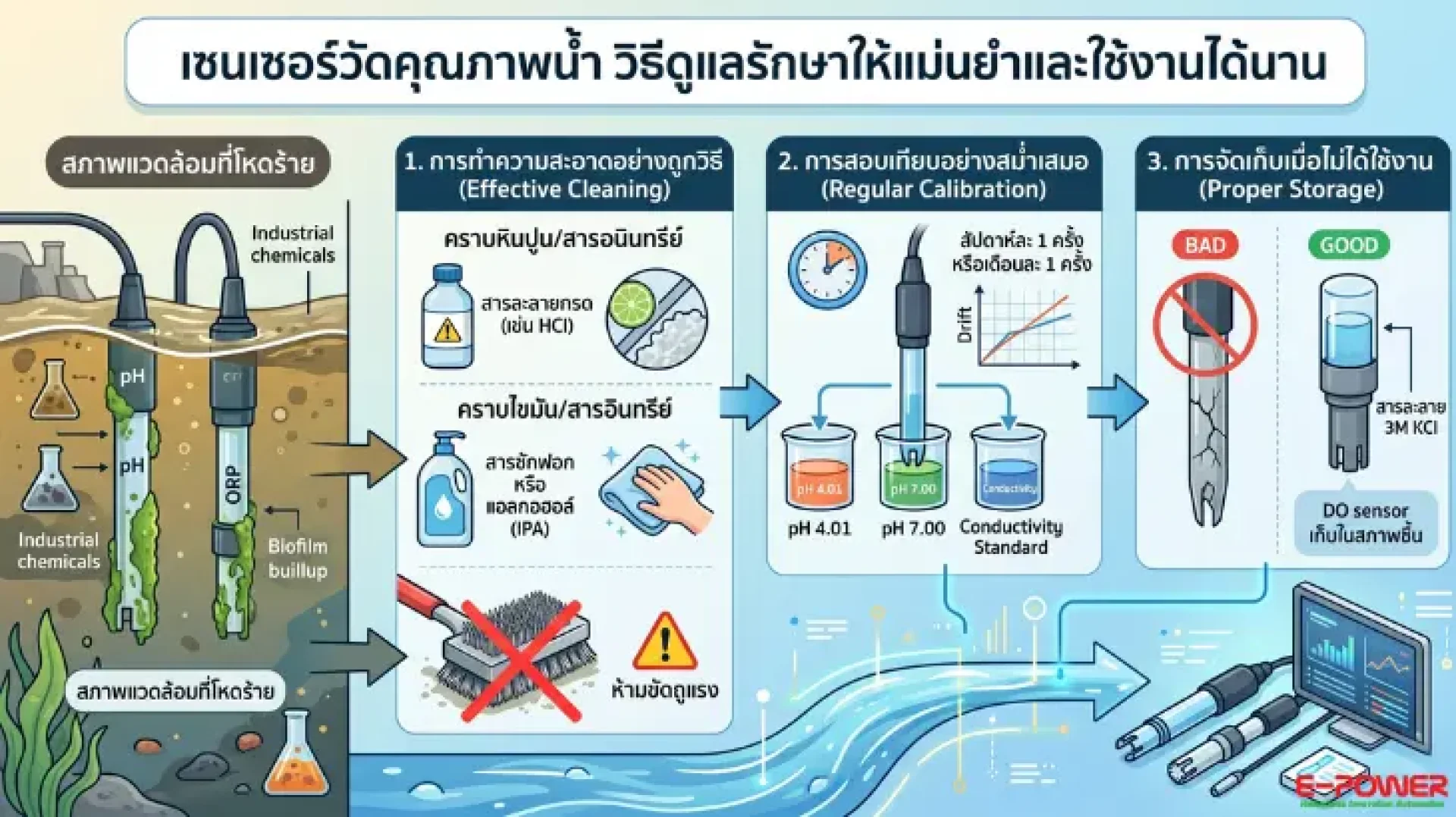
1. Effective Cleaning Techniques
Contaminants coating the sensor's measurement interface or membrane act as barriers that block electrochemical reactions and signal reception. Cleaning solutions must be selected carefully based on the type of fouling:
- Scale or Inorganic Fouling: Rinse the probe with a low-concentration Hydrochloric Acid (HCl) solution of approximately 0.1M, or a diluted vinegar/citric acid solution.
- Grease or Organic Matter: It is recommended to use a mild detergent solution or Isopropyl Alcohol (IPA) to wipe away residues gently.
- Critical Caution: Never use sharp objects or stiff-bristled brushes to scrub glass bulbs or gold amalgam surfaces, as this will cause permanent, irreversible damage to the protective coatings.
2. Regular Calibration
Even robust, industrial-grade sensors naturally experience measurement drift over time. Regular calibration using standard buffer solutions with verified, stable values—such as pH 4.01 and 7.00 buffers, or standard conductivity solutions—is absolutely mandatory. Calibration should be performed at least once a week or once a month, depending on the severity of the process water.
3. Proper Storage During Downtime
Several types of water quality sensors, especially pH and ORP sensors, must never be allowed to dry out. Dry environments cause the hydration gel layer on the glass surface to lose its structural properties. Always store the probe with its protective cap filled with a Potassium Chloride (3M KCl) solution to maintain moisture. For Dissolved Oxygen (DO) sensors, certain models require storage in a humid environment without being fully submerged in liquid.
Frequently Asked Questions About Water Treatment & Probe Maintenance (FAQ)
Q: How should I clean a pH and ORP Sensor contaminated with oil or grease?
A: Submerge the probe in a diluted liquid soap or dishwashing detergent solution for about 5 to 10 minutes. Next, use a soft cloth or a cotton swab moistened with Isopropyl Alcohol (IPA) to gently wipe away the grease layer. Rinse thoroughly with Pure Distilled Water (DI Water).
2. Q: Can I calibrate the sensor immediately after wiping away oil contamination?
A: No, you should not calibrate it immediately. After rinsing away the cleaning agents, it is essential to soak the probe in a 3M KCl solution for at least 1 hour. This allows the sensor to rehydrate, re-stabilize, and restore the glass interface equilibrium before proceeding with standard calibration and normal operations.
3. Q: What is the most critical precaution when removing dirt from a sensor's measurement interface?
A: You must absolutely avoid using sharp materials, wire brushes, or aggressive force to scrub the glass bulbs or gold amalgam surfaces. Doing so will permanently destroy the sensitive coatings or shatter the sensor structure. Only use soaking solutions and soft materials like cotton swabs for gentle cleaning.
Secure Professional Measurement Solutions and Sensors from E-Power
If you are experiencing frequent measurement drift, rapid probe degradation, or require an exceptionally durable analytical water setup, E-Power Service Co., Ltd. is ready to consult and deliver the ideal engineering solutions. We are a specialized distributor of industrial instrumentation, control meters, and a wide array of water quality sensors, including Digital ORP Sensors, pH Sensors, DO Sensors, and high-concentration turbidity sensors.
Products recommended by E-Power are constructed from premium-grade, heavy-duty materials designed to perform reliably in hostile environments. They seamlessly support standard industrial output signals, including 4-20mA and Modbus RTU (RS485), ensuring perfect integration into your automated PLC or IoT networks. Partnering with us minimizes your maintenance overhead and maximizes the uptime of your wastewater treatment systems.
Extend your instrument lifespan and optimize your industrial controls with products and services from E-Power. Explore more details today at www.epower.co.th.