TSS Sensor : Real-Time Total Suspended Solids Tracking for the Food and Beverage Industry
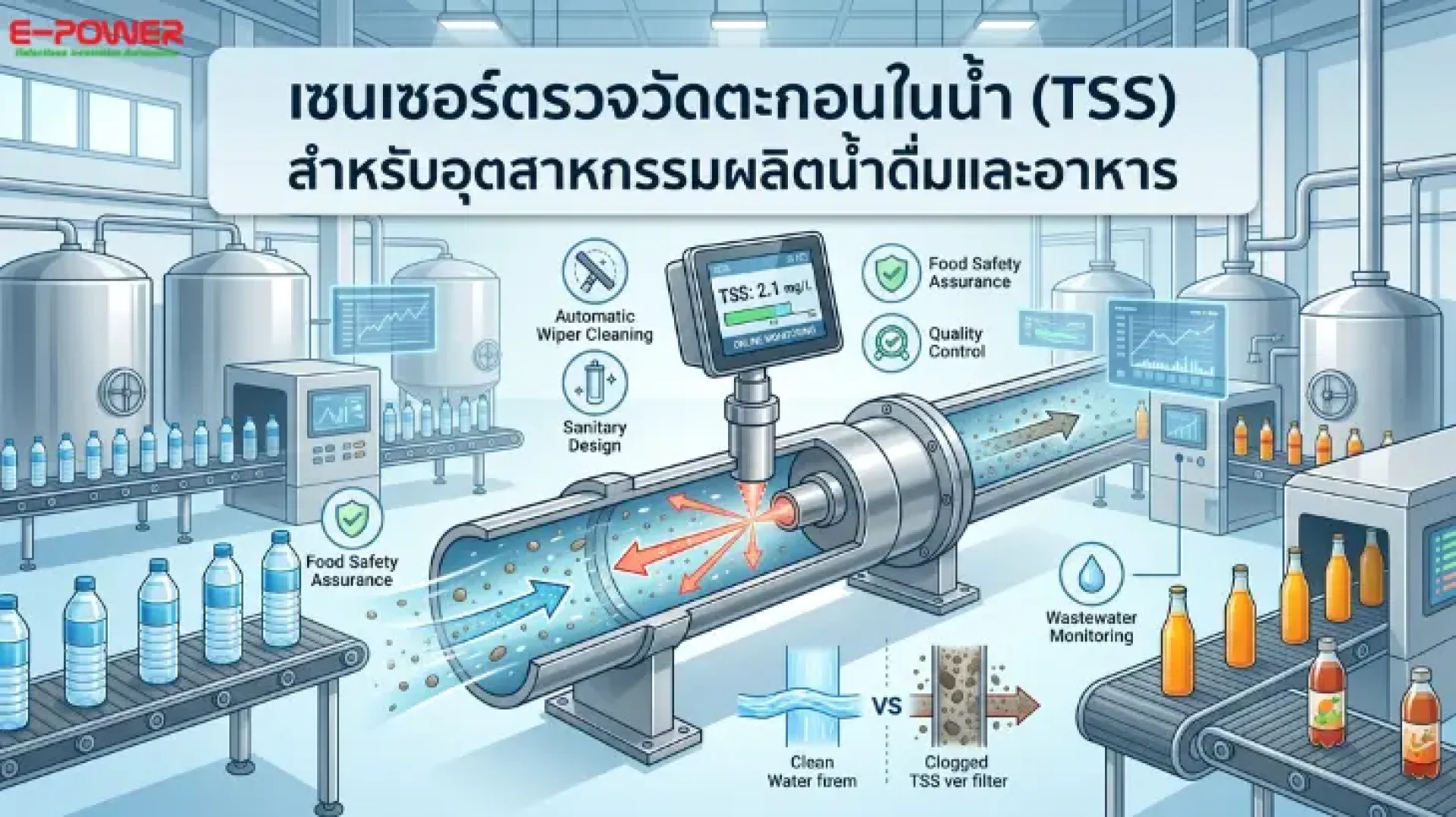
An online TSS Sensor (เซนเซอร์ตรวจวัดตะกอนในน้ำ) for continuous monitoring has become the heart of second-by-second water quality checks. This technology directly answers the needs of the food and beverage industry, where water serves as much more than just a primary ingredient in the product. It also acts as a critical fluid for washing raw materials, cooling equipment, and executing Clean-in-Place (CIP) cycles. Consequently, keeping water pure and free from dirt and suspended matter is a core metric you cannot afford to ignore when it comes to maintaining high Food Safety standards. Traditional manual sampling and waiting on laboratory (Lab) reports simply cannot keep pace with modern digital processing lines, nor can they prevent product damage before goods ship out to consumers.
Why Total Suspended Solids (TSS) Matter in Food and Beverage Plants
TSS, or Total Suspended Solids, refers to the dry weight of insoluble particles suspended in water that are large enough to be trapped by a filter and can eventually settle to the bottom. This includes things like fine dust, organic matter, yeast, or wild microorganisms. Letting TSS levels run too high in your factory water supply harms business in multiple ways:
- Damaged Product Image: For bottling lines producing drinking water, soda, or juices, microscopic particles cause visible turbidity and unwanted sediment at the bottom of the bottle, immediately hurting brand trust.
- Shortened Filter Lifespan: Heavy solids quickly clog up delicate filter cartridges and membrane sheets in filtration systems (such as RO or Ultrafiltration setups), forcing plants to purchase replacement parts frequently and driving up operating costs.
- Overloaded Wastewater Treatment: Processing effluent from food production often carries a heavy sludge burden. Without dependable TSS and sludge blanket monitoring, plants risk discharging water that breaks local laws, resulting in civil fines and environmental liability.
3 Pillars of Choosing a Safe and Cost-Effective TSS Sensor
Deploying a TSS Sensor in food-grade or beverage processing requires a balance of high-precision optics and clean sanitary design. Here are the top features industrial engineers look for:
1. Reliable Optical Scattering Method
High-end industrial sensors utilize an infrared light-emitting diode (IR LED) to shine a beam into the fluid, measuring the angle of scattered light when it strikes suspended particles. Because infrared light is completely unaffected by the natural color of water, the digital data stream stays incredibly accurate.
2. Rugged Sanitary Design
Since the hardware makes direct contact with process water, the sensor housing must be built from non-corrosive, food-safe materials like 316L stainless steel or premium engineered plastics, paired with an IP68 dust- and waterproof rating to eliminate contamination risks.
3. Integrated Self-Cleaning Wiper
The biggest challenge for factory maintenance teams is bio-film buildup, algae, or sticky grime blinding the sensor lens. Selecting a model with a built-in automatic mechanical wiper eliminates manual cleaning chores, saving field maintenance hours while ensuring steady 24/7 readings.
High-Quality TSS Sensors Available on the E-Power Website
If your facility requires a tough, highly accurate water purity instrument, E-Power Service Co., Ltd. recommends the premium instrumentation lineup from the global industrial brand Supmea:
Featured Model: Supmea SUP-PTU100 Suspended Solids Meter
This premium controller and sensor package is explicitly designed to monitor both Turbidity and Total Suspended Solids (TSS) in demanding industrial water applications.
- Dual-Precision Measurement: Uses a 90-degree light scattering method paired with infrared technology to read particle density with exceptional clarity.
- Smart Controller Display: Features a large, clear, and easy-to-read screen that can display live turbidity scores and TSS values simultaneously.
- Standard Factory Interface: Out of the box, it supports standard industrial outputs, including RS485 (Modbus RTU) and 4-20mA, making it easy to transmit raw data over long distances straight to your central control room with zero signal drops.
FAQ: TSS Sensors
Q: What is the difference between Turbidity and Total Suspended Solids (TSS)?
A: While related, they use different metrics. Turbidity (measured in NTU) reads how effectively particles scatter or block light passing through water. TSS (measured in mg/L or ppm) tracks the actual physical weight of the dry solids suspended in the fluid. However, modern heavy-duty instruments like the Supmea SUP-PTU100 feature smart internal software that can compute and display both values from a single sensor probe.
Q: Outside of food factories, how can a TSS Sensor support a Smart Farm?
A: In a Smart Farm or commercial aquaculture environment (Smart Aquaculture), high sediment levels block sunlight and drop dissolved oxygen paths in fish or shrimp ponds. Wiring a TSS sensor into your pond array allows the automation loop to read murky water conditions instantly, automatically triggering water-exchange pumps or filtration systems to clear the pool without needing human intervention.
Q: How does real-time TSS tracking lower operational costs in a factory?
A: It eliminates massive hidden expenses over time. By monitoring TSS levels around the clock, engineers can program automation loops to activate sludge pumps or backwash filtration cycles only when particle counts breach a specific limit. This stops equipment from running non-stop unnecessarily, saving significant water and power while extending the lifespan of expensive reverse-osmosis filters.