Industrial Metrology Guide : What is Calibration, Why Do Sensors Require It, and How Often?
In modern industrial automation, Industry 4.0 manufacturing processes, and advanced Smart Farm environments, sensors serve as the absolute baseline for data collection. Whether tracking pressure, temperature, humidity, or chemical fluid balances, sensors act as the "eyes" of the system. However, over extended periods of operation, even the most premium hardware experiences structural performance decay—technically categorized as Sensor Drift.
This drift highlights why Sensor Calibration is a critical engineering requirement. In precision automation control loops, a single-digit decimal error can cascade into catastrophic product defects, compromised factory safety, or severe crop stress.
What is Calibration? Understanding the Core Principles
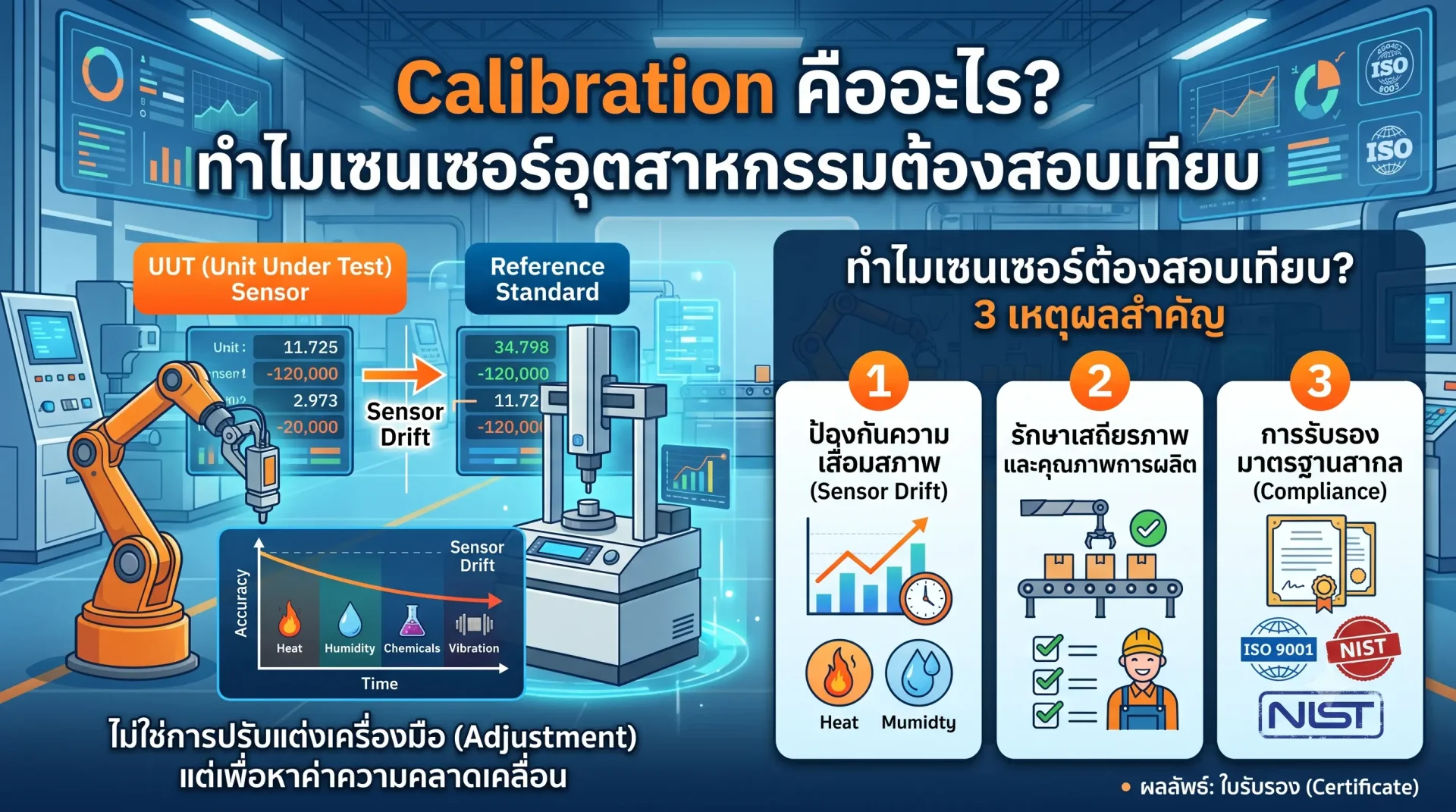
Calibration is a formal metrological process that verifies the accuracy of a measuring instrument or sensor. It functions by comparing the real-time readings of a target device against a "Standard Reference Instrument" that holds higher certified accuracy, directly traceable to international metrology standards (such as NIST or ISO/IEC 17025).
- Crucial Distinction: Calibration is purely the process of identifying and documenting measurement errors. It does not encompass the physical "adjustment" or restructuring of the hardware. The variance captured during testing is documented within a Calibration Certificate, allowing automation engineers to program calibration offsets inside a master controller or PLC network.
Why Do Sensors Require Calibration? 3 Primary Engineering Reasons
- Mitigating Sensor Drift Over Time: Environmental variables—such as cumulative thermal strain, humidity exposure, chemical residues, and mechanical vibration—gradually degrade sensor accuracy over time.
- Securing Product Quality & Process Stability: In closed-loop systems like an automatic irrigation system or a chemical dosing plant, inaccurate data triggers improper chemical or fluid cycles, leading directly to reduced output quality.
- Regulatory and Quality Compliance: Facilities maintaining international quality certifications (e.g., ISO 9001, ISO 14001, or GMP) must present formal, traceable calibration logs for every instrumentation point.
Calibration Frequency: How Often Should You Calibrate?
There is no universal operational interval for sensor calibration; schedules depend on risk factors and environmental severity. Standard industrial parameters include:
| Sensor Application Category | Recommended Frequency | Engineering Rationale |
| Critical Process Control Loops | Every 3 to 6 Months | Direct correlation to product integrity and facility safety. |
| Environmental & Open-Field Agricultural Applications | Every 6 to 12 Months | High vulnerability to external particulate matters, moisture, and dust. |
| Portable Testing Instruments | Every 3 Months / Major Project Launch | Elevated risk of structural internal misalignment due to impact drops. |
| Post-Incident Validation | Immediately following an event | Mandatory after power surges, thermal overloads, or system spikes. |
Selecting High-Stability Hardware Minimizes Calibration Overhead
Investing in heavy-duty, industrial-grade components characterized by low-drift architecture dramatically lowers long-term maintenance costs. E-Power Service Co., Ltd. distributes high-stability field sensors designed for continuous integration:
- Renke Soil Moisture & EC Sensor: Built with a 304 stainless steel probe assembly and IP68 hermetic seal. Its RS485 Modbus-RTU output allows technicians to deploy calibration offsets digitally inside the control loop without needing physical hardware extraction. Product Link: Renke Soil Moisture Sensor
- Renke Soil Tensiometer (RS-TRZL-1-EX): An industrial-grade water potential tracking device featuring a resilient porous ceramic tip and low signal attenuation. This minimizes field maintenance and recalibration schedules. Product Link: Renke Soil Tensiometer
Summary
Calibration is not an operational burden; it is a necessary insurance policy for your automation data matrix. If you are developing control panels, factory automation, or agricultural IoT applications that require robust instrumentation, contact the engineering team at E-Power Service for absolute technical guidance.