Precision Agriculture Blueprint: Smart Farm vs Traditional Farming
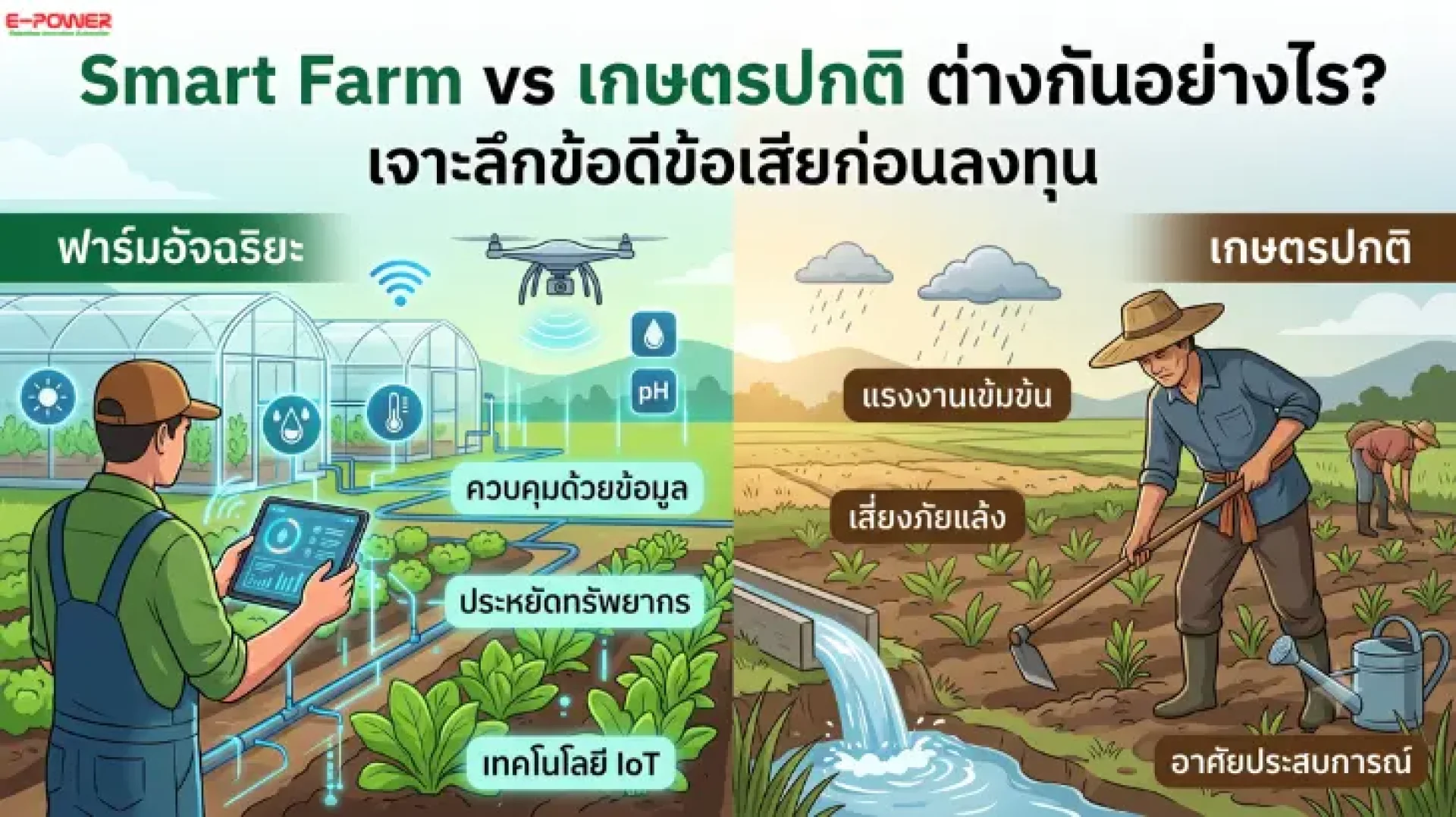
Driven by global shifts in food security and volatile climate conditions, the agricultural industry is standing at a critical evolutionary point. Modern developers, automation engineers, and growers face a strategic choice: expand operations via legacy traditional farming methodologies or transition into a data-driven Smart Farm infrastructure.
Understanding the functional differences, operational advantages, and engineering limitations of both paradigms is essential for deploying a high-ROI precision agriculture topology under custom budget bounds.
Core Structural Distinctions: Smart Farm vs Traditional Farming
- Traditional Farming: Heavily relies on localized manual labor, ancestral knowledge, and seasonal climate speculation. Resource distribution for irrigation and fertilization is scheduled based on manual calculations or fixed timers, exposing crops to unnoticed waterlogging or critical moisture stress.
- Smart Farm: Driven by precision data analytics. It integrates IoT hardware, edge-computing automation controllers, and industrial sensor networks to continuously track field conditions, enabling closed-loop feedback systems to execute exact resource allocations.
Comparative Matrix: Advantages & Disadvantages Breakdown
| Farming System | Advantages | Disadvantages |
| Traditional Farming | • Minimal initial capital investment required. | • High variance in final crop yield uniformity and quality. |
| • High agility for localized, small-scale plots. | • Labor-intensive operations with significant water/fertilizer waste. | |
| • Independent of electrical grid reliability or internet coverage. | • Extremely vulnerable to flash droughts and climate shocks. | |
| Smart Farm | • Saves 30% to 50% on water and energy overheads via an automatic irrigation system. | • Higher upfront integration costs for advanced equipment catalogs. |
| • Standardizes premium crop grades and accelerates growth cycles. | • Requires specialized engineering for installation and software tuning. | |
| • Provides real-time early anomaly detection to mitigate crop failure. | • Mandates planned calibration and field validation intervals. |
Execute a Lean Technical Transition with E-Power Service
Scaling up from traditional systems to an intelligent automated configuration does not require an immediate total system overhaul. Implementing a modular setup with high-impact core instrumentation ensures maximum return. E-Power Service Co., Ltd. delivers robust, industry-proven hardware nodes:
- Renke Soil Moisture Sensor: Engineered with a rugged 304 stainless steel probe and IP68 hermetic scaling, replacing subjective physical assessments with precision volumetric data to automate main water valves. Product Link: Renke Soil Moisture Sensor
- Renke Soil Tensiometer (RS-TRZL-1-EX): An industrial-grade water potential transmitter that tracks plant root suction stress, providing early indicators of plant water stress long before physical wilting begins. Product Link: Renke Soil Tensiometer
- Rika RK510-01 & Modbus Connectivity Solutions: High-linearity agricultural sensors supporting RS485 Modbus-RTU telemetry, allowing operators to bind diverse diagnostic inputs straight into a central industrial PLC loop. Product Link: Rika RK510-01 Soil Moisture Sensor
Engineering Conclusion
The boundary defining smart agriculture is not the elimination of human input, but the reinforcement of operations through precision analytics. Transitioning into automated telemetry balances upfront costs by drastically slashing long-term overheads. For customized PLC assembly, smart farm panel design, and instrumentation sourcing, consult the engineering department at E-Power Service.