What is a CT (Current Transformer) and Why Must It Be Used with a Power Meter?
CT (Current Transformer) and Power Meter configurations represent the essential architecture within industrial energy management platforms. In electrical engineering, safely assessing enormous current flows running through main facility distribution lines—often scaling into hundreds or thousands of Amperes—cannot be accomplished by wire-matching directly into a digital display. Doing so would instantaneously vaporize the delicate internal monitoring circuitry.
The core question plant engineers and managers ask is: "What is the actual operational function of a CT, and why is it fundamentally required alongside a modern digital power meter?" Today, E-Power Service (epower.co.th) will break down the mechanics behind this vital power monitoring alliance.
What is a CT (Current Transformer)?
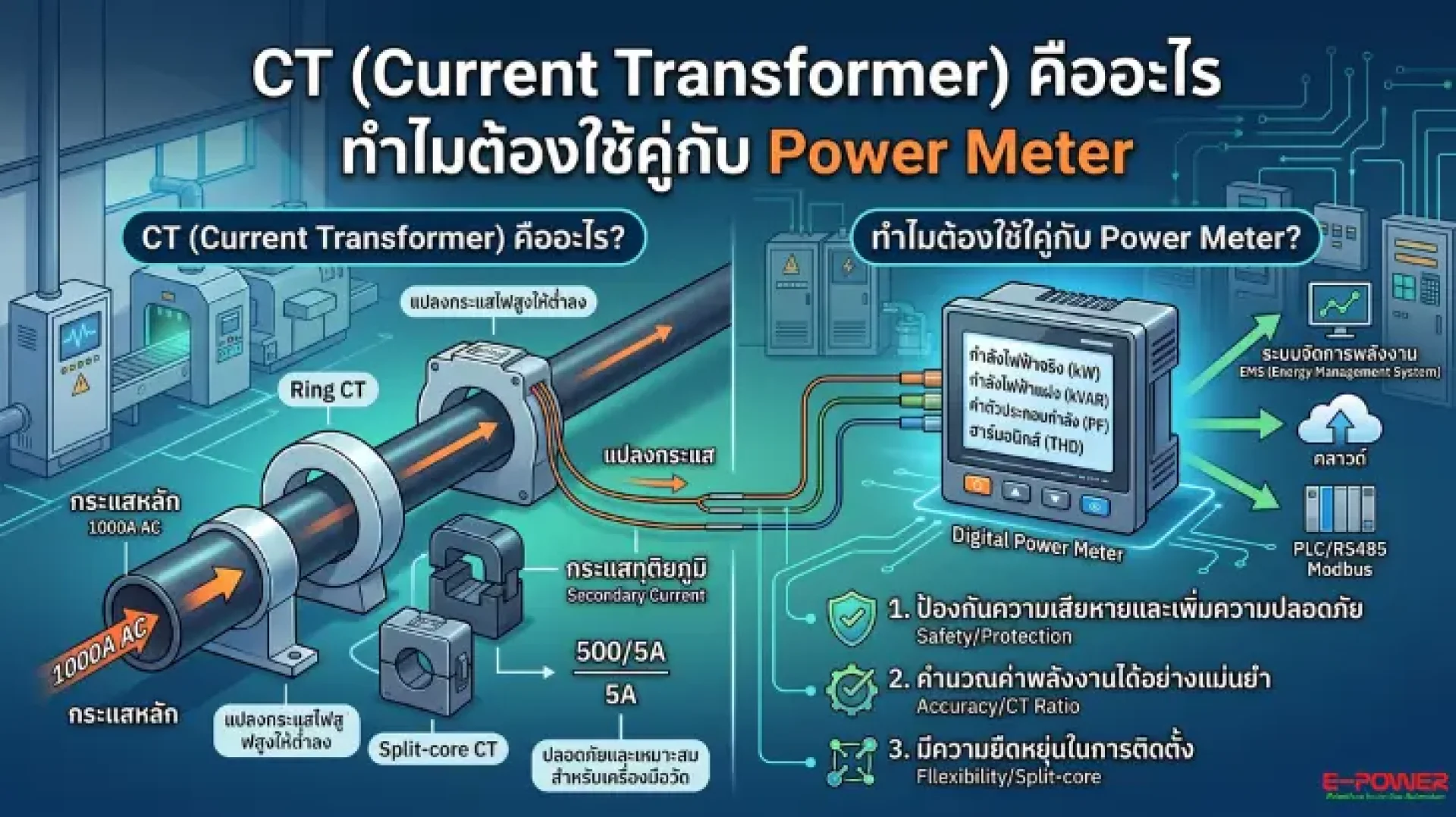
A CT (Current Transformer) is a specialized instrument transformer engineered to step down high-magnitude alternating current (AC) flowing within primary conductors (Primary Current) to a proportional, standardized low-value output (Secondary Current). This output is reduced to a safe, universally measurable scale—typically 1 Ampere (1A) or 5 Amperes (5A).
- Operational Example: If a factory exhibits a peak load demand of 500A, implementing a 500/5A rated CT means that when a full 500A streams through the core main line, the transformer step-down delivers an isolated, safe 5A signal straight to the receiving instrumentation meter.
Why a CT (Current Transformer) is Crucial for Power Meters
Uncompromising Safety and Circuit Protection
Standard digital power meters inside main distribution boards (MDB) are optimized exclusively for low-current signal registers. Positioning a CT as a non-contact buffer isolates the high-voltage primary bus bar away from the instrument panel. This galvanic isolation shields maintenance crews and technicians from catastrophic arc flashes or high-voltage shock faults during routine operation.
Driving High-Precision Energy Calculations
Once the CT pipes the scaled analog current (e.g., 5A) into the power meter, the smart meter (such as top-tier brands like Acrel) applies the predefined CT multiplier ratio programmed into its configuration logic. This allows the meter to dynamically compute and display genuine facility-wide variables: Active Power (kW), Reactive Power (kVAR), Power Factor (PF) trends, and Total Harmonic Distortion (THD) balances.
Seamless Retrofit and Deployment Flexibility
Modern diagnostics favor Split-core CT designs. These split configurations clip open cleanly around active primary conductors, allowing swift integrations into older factories without cutting copper busbars or forcing a plant-wide power shutdown (Zero Downtime). This makes them the ultimate asset for launching IoT cloud energy arrays.
The Verdict: Configuring Your Energy Data Bus
When selecting a Current Transformer (CT), ensuring the appropriate accuracy class (such as Class 0.5 or 0.2) is critical to maintaining high-fidelity energy telemetry. The parsed energy profiles are typically streamed via RS485 Modbus-RTU loops directly into plant PLCs or cloud EMS environments to optimize factory power conservation strategies.
Deploy Professional Power Monitoring: Source international hardware configurations with ease. Explore high-performance Acrel power meters and compatible CT components natively at epower.co.th.
Ready to implement a robust sub-metering dashboard or deploy an enterprise-grade Power Meter and CT combination? E-Power Service (epower.co.th) provides complete system automation logic, hardware distribution, and certified engineering consultations. Contact our technical team today to maximize your energy infrastructure intelligence!