Pyranometer Solar Radiation Sensor : Selection Guide for Solar Energy and Meteorology Systems
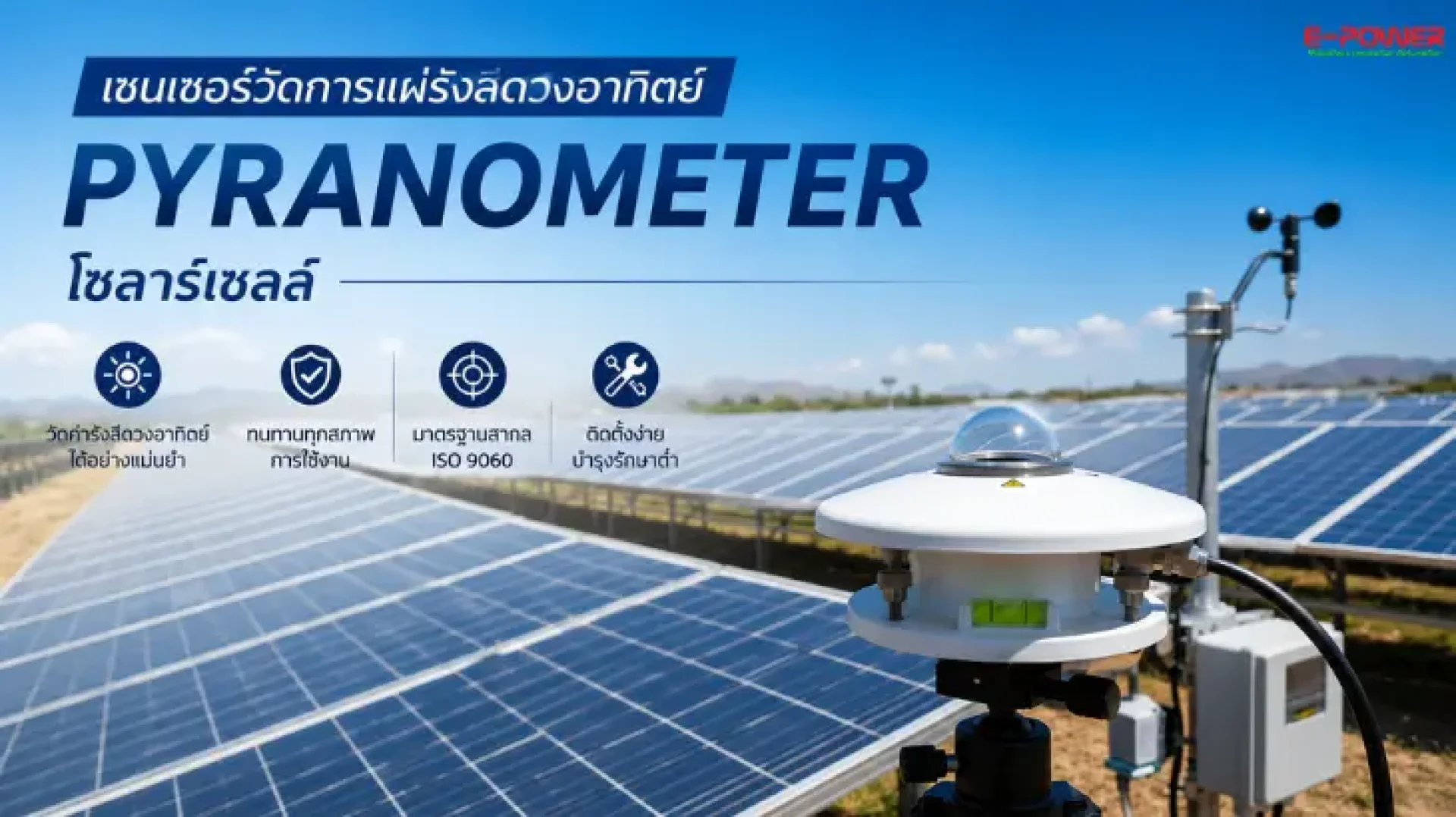
A pyranometer (solar radiation sensor) is a critical measuring device used heavily in solar energy assessment and environmental monitoring. If you are considering using a pyranometer in your project, understanding its working principles and the differences between sensor types will help ensure you select the model most suitable for your data requirements.
What is Global Solar Radiation?
The sun releases radiant energy across wavelengths ranging from 0.15 to 4.0 µm, known as the solar spectrum. Measuring the sun's radiation on the earth's surface is referred to as global solar radiation, often called short-wave radiation.
Global solar radiation consists of both direct radiation traveling straight from the sun and diffuse radiation scattered by the atmosphere onto the pyranometer's receptor. Because nearly all environmental processes on earth are driven directly or indirectly by solar energy, global solar radiation data is a vital variable in almost every research and industrial analysis.
Who Needs a Pyranometer and Why?
Global solar radiation measurements are applied across diverse industries, including:
- Solar Energy Systems: Used to evaluate how efficiently photovoltaic panels convert solar energy into electricity and to determine panel cleaning schedules. Pyranometers for this purpose are typically installed in the plane of the solar array.
- Utilities: Used to forecast gas and electricity energy consumption patterns.
- Scientific Research: Used as a key parameter to predict or quantify plant growth and agricultural yields.
- Agriculture & Landscape Maintenance: Used to estimate plant water use and schedule efficient irrigation systems.
- Meteorology: Used as a core factor in weather forecasting models.
What Is a Pyranometer and How Does It Work?
A pyranometer is a sensor that converts received global solar radiation into measurable electrical signals, targeting specific portions of the solar spectrum (for example, the CMP21 model measures wavelengths from 0.285 to 2.8 µm).
Pyranometers do not respond to long-wave radiation. If long-wave radiation (4 to 100 µm) needs to be measured, a pyrgeometer must be used instead.
Cosine Response
The angle of solar radiation significantly impacts measurements, making an accurate cosine response essential. For instance, 1000 W/m² received perpendicularly (0° from zenith) is measured as 1000 W/m², but 1000 W/m² received at a 60° angle from zenith is measured as 500 W/m². Units utilizing diffusers instead of glass domes require precision-engineered diffusers to maintain correct cosine response.
Differences Between Pyranometer, Net Radiometer, and Pyrheliometer
Solar radiation sensors come in several types tailored for specific purposes:
- Net Radiometer: Measures incoming/outgoing short-wave radiation (using two thermopile pyranometers) and incoming/outgoing long-wave radiation (using two pyrgeometers) across 4 measurement points to calculate energy budgets and water evaporation rates.
- Pyrheliometer: Encloses a radiation-sensing element inside a collimation tube with a small aperture, allowing only direct solar rays to enter. Reflected light from clouds or particles cannot reach the detector. It requires continuous alignment with the sun using a solar tracker.
How Pyranometers Measure Global Solar Radiation
The most common pyranometer technologies used today are thermopiles and silicon photocells.
Connection Tip: You must connect your pyranometer to a data logger or a multimeter to read millivolt DC (mV DC) signals.
- When using an analog voltage output, you must manually convert mV readings to W/m² based on the sensitivity factor.
- Modern models feature standard digital outputs such as Modbus RS485, instantly returning W/m² values to integrate smoothly with PLC automation & SCADA systems or the RK200-05 Solar Radiation Station.
1.Thermopile Pyranometers
Thermopile pyranometers utilize thermoelectric junctions (connecting multiple dissimilar metals based on the thermocouple principle) to generate a signal of several µV/W/m² proportional to the temperature difference between a black absorbing surface and a reference base.
- Key Features: The specialized black surface uniformly absorbs short-wave radiation across a wide spectrum (0.285 to 2.800 µm). For example, the RK200-03 Pyranometer (Thermopile Sensor) can accurately measure reflected solar radiation, greenhouse canopy radiation, and albedo when deployed as an up-facing/down-facing pair.
- Limitations: Significantly more expensive than silicon photocells.
2. Silicon Photocell Pyranometers
Silicon photocell pyranometers generate an output current in microamps (µA) similar to how solar panels convert sunlight into electricity. This current passes through a shunt resistor to convert into a voltage signal, using a plastic diffuser for proper cosine response.
- Key Features: Several times more affordable than thermopiles. They measure a limited spectrum from 0.4 to 1.1 µm. Models like the RK200-04 Solar Radiation Sensor (Silicon-Cell) offer sufficient accuracy (typical errors under ±3% under clear skies) for agricultural farms and general environmental monitoring.
- Limitations: Performance drops outside of clear skies. They should not be used under vegetation canopies, inside greenhouses, or for measuring reflected radiation.
For inquiries or equipment specifications:
- Website: www.epower.co.th
- LINE Official Account: @epower