Automatic Fertigation System with EC and pH Control for Hydroponics: Precise in Every Drop, Across Every Greenhouse
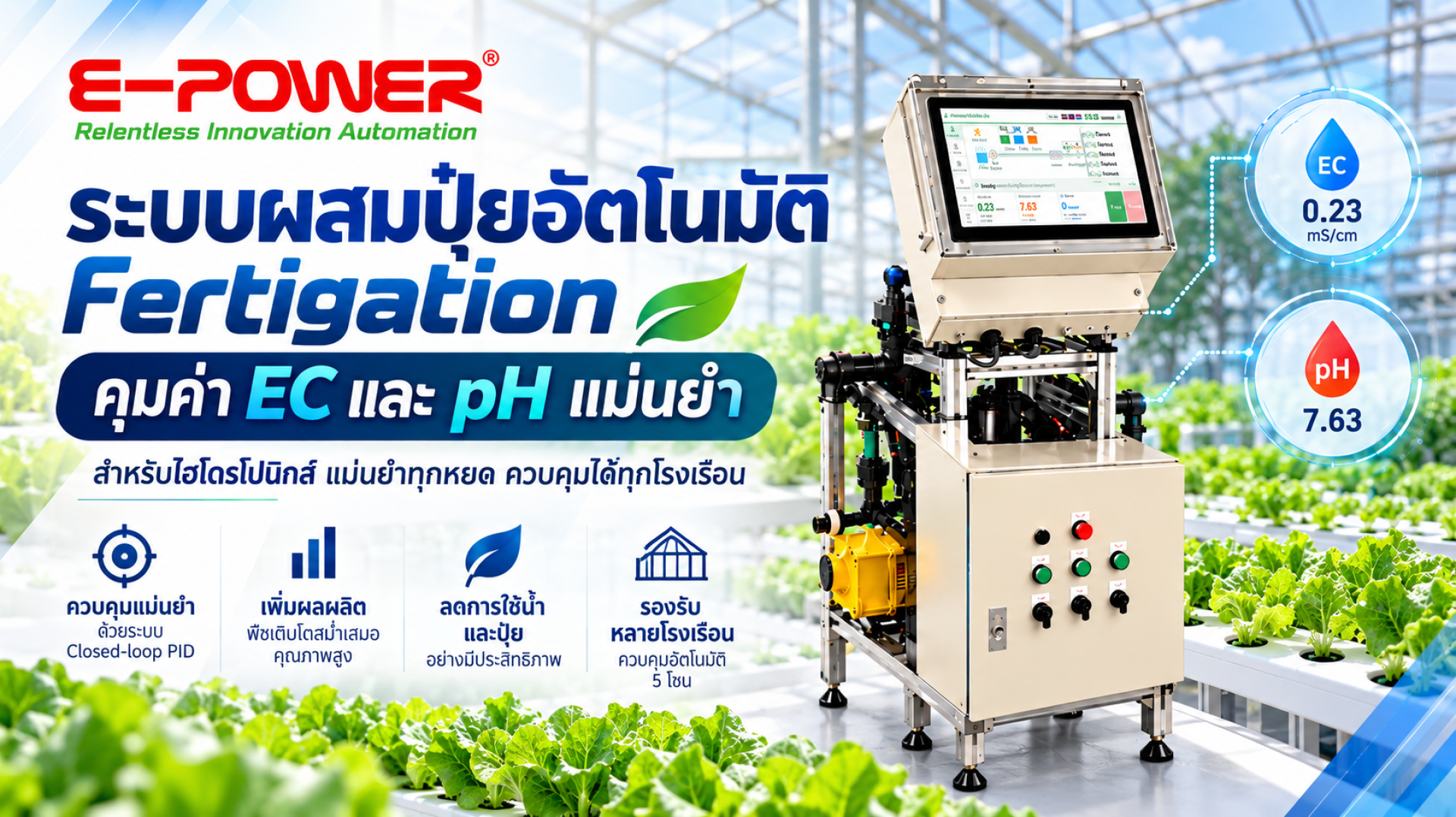
E-POWER In-Line Fertigation automatic fertilizer mixing system with EC and pH control for hydroponics across 5 greenhouses
Hydroponic crops grow fast, look great, and yield consistently only when the nutrient solution is at the right strength and the pH lets roots absorb it. Mixing by hand, measuring fertilizer A and B and adding acid bit by bit, takes a lot of time, and values tend to drift throughout the day. An automatic fertigation system solves this by measuring and adjusting EC and pH continuously. This article explains what EC level hydroponics needs and how the E-POWER In-Line Fertigation System delivers precise control in every drop.
What EC should a hydroponic nutrient solution have? (In short)
The right EC depends on the crop and growth stage. In general, lettuce and leafy greens need about 1.02.0 mS/cm, while fruiting crops such as tomatoes and cucumbers need about 2.03.5 mS/cm. pH should be kept at 5.56.5, the range in which roots absorb nutrients best. An automatic fertigation system measures EC and pH continuously and adjusts fertilizer and acid dosing to match your setpoints without manual work.
Why do EC and pH matter in hydroponics?
EC (Electrical Conductivity)
EC shows the concentration of fertilizer in the water. The more dissolved nutrients, the higher the EC. Too low, and plants go hungry, turn pale, and grow slowly. Too high, and roots struggle to take up water, leaf edges burn, and plants become stressed.
pH
pH determines whether plants can absorb the nutrients. Even with a complete fertilizer, if pH is too high, iron and manganese uptake drops, causing yellowing between leaf veins. The ideal range for most crops is 5.56.5.
Recommended EC and pH for hydroponic crops
| Crop | EC (mS/cm) | pH |
|---|---|---|
| Lettuce (green oak, red oak, cos) | 1.01.8 | 5.86.2 |
| Other leafy greens and herbs | 1.22.0 | 5.56.5 |
| Strawberries | 1.02.0 | 5.56.2 |
| Cucumbers and melons | 1.72.5 | 5.56.0 |
| Tomatoes and peppers | 2.03.5 | 5.56.5 |
These values are general guidelines. Adjust them for variety, growth stage, and weather. In very hot conditions, plants transpire heavily and often benefit from a slightly lower EC to reduce stress.
What is an automatic fertigation system?
Fertigation combines fertilizer and irrigation: nutrients are delivered together with water through drip or hydroponic systems. An automatic fertigation system uses EC and pH sensors to measure the solution, while a controller drives pumps that dose concentrated fertilizer and acid in the right proportions, so plants get consistent nutrition in every irrigation cycle.
Why are fertilizers split into A and B?
Hydroponic fertilizers come in two tanks because calcium in part A reacts with sulfates and phosphates in part B and precipitates when concentrated. This wastes nutrients and clogs lines, so the two must be stored separately and only combine once diluted in water.
In-line dosing vs batch tank mixing
| Topic | Batch tank | In-line fertigation |
|---|---|---|
| Mixing method | Fertilizer mixed in a large tank before delivery | Fertilizer injected directly into the flowing water line |
| Footprint | Requires large holding tanks | Compact, no mixed-solution tank needed |
| Changing recipes | Must use up the current tank first | Change instantly, greenhouse by greenhouse |
| Multiple houses, multiple recipes | Separate tanks for each recipe | One system delivers different recipes per zone |
| Algae and sediment | Solution sits in tanks, risking algae growth | Freshly mixed every time |
Meet the E-POWER In-Line Fertigation System
The E-POWER In-Line Fertigation System is an automatic fertilizer and water mixing system designed and built by E-POWER engineers. It doses fertilizer A, fertilizer B, and pH-adjusting acid directly into the water line as it flows, controlled by a closed-loop PID that continuously adjusts dosing based on actual readings, with independent water and nutrient delivery to 5 greenhouses.
Key features
7" HMI touch screen
Operate the system, set fertilizer recipes, and view real-time EC and pH graphs at the cabinet. Easy to use even without IT skills.
Closed-loop EC/pH control
Sensors measure after the mixing point and the PID adjusts dosing instantly, holding nutrient concentration within ±0.2 mS/cm.
Precision dosing pumps
Fine-resolution pumps adjustable from 0100%, controlled over Modbus RTU for smooth, precise dosing.
5-zone automatic control
Independent nutrient delivery to 5 greenhouses, each with its own recipe and schedule.
Constant pressure VFD
An inverter adjusts pump speed to hold water pressure at 2.0 bar automatically, giving even flow at every emitter while saving energy.
Radiation-based irrigation
Irrigates according to measured accumulated sunlight: more often on sunny days, less on cloudy ones, saving both water and fertilizer.
How does the system work?
| 1 | Irrigation is triggered by schedule or when accumulated sunlight reaches the setpoint |
| 2 | The pump delivers water at constant pressure, with the inverter holding 2.0 bar throughout the cycle |
| 3 | Fertilizer A, B, and acid are injected according to the recipe for the greenhouse being irrigated |
| 4 | EC and pH are measured and corrected instantly, as the PID raises or lowers each pump's dosing rate to hit the target |
| 5 | Nutrient solution is delivered to the greenhouse in the set volume, and every cycle is logged for later review |
Why is radiation-based irrigation better than a timer?
A fixed timer delivers the same amount of water every day, but plants transpire more or less depending on sunlight. On bright days they may run short of water; on cloudy days excess water and fertilizer drain away. Radiation-based irrigation uses a solar radiation sensor (pyranometer) and starts a cycle when accumulated light energy reaches a set value, so watering matches what plants actually need. Learn more about solar radiation sensors in our RIKA RK200-03 Pyranometer article.
Benefits of automatic fertigation
Plants get exactly the nutrients they need every cycle, with no losses from drifting values
Doses only what is needed, with no over-mixing or leftover solution
No daily weighing, mixing, or manual measuring
Each greenhouse can run its own recipe from a single system
Who is this system for?
- Commercial hydroponic vegetable farms supplying supermarkets and restaurants with consistent quality
- Melon, tomato, and strawberry greenhouses that adjust recipes by growth stage
- Farms with multiple greenhouses and crops wanting centralized nutrient management
- Universities and agricultural research centers needing precise variable control and data from every cycle
Frequently asked questions (FAQ)
What EC should hydroponic nutrient solution have?
About 1.02.0 mS/cm for lettuce and leafy greens, and about 2.03.5 mS/cm for fruiting crops such as tomatoes and cucumbers, adjusted for growth stage and weather.
What is the ideal pH for hydroponics?
Most crops absorb nutrients best at pH 5.56.5, with lettuce usually kept around 5.86.2.
What is fertigation?
Fertigation is delivering fertilizer together with irrigation water through drip or hydroponic systems. An automatic system measures EC and pH and doses fertilizer and acid in the right proportions by itself.
Does an in-line system need a mixing tank?
No mixed-solution tank is needed. The system injects concentrate from the A, B, and acid tanks straight into the flowing water line, so recipes can change instantly.
How many greenhouses can the E-POWER system control?
It independently controls nutrient delivery to 5 greenhouses, each with its own fertilizer recipe and schedule.
Interested in automatic fertigation for your farm?
E-POWER engineers can advise, design a system for your number of greenhouses and crops, install it, and provide after-sales support. Contact us for details or a quotation.
Request a quote on LINE: @epower info@epower.co.thTel. +66 81-559-5145 | YouTube: Epower Service | TikTok: epowerservice_
Related articles: Smart farming vs conventional farming, EC & Salinity water quality sensors, Water pH sensor guide, RIKA RK200-03 Pyranometer, Soil water potential vs soil moisture