10 IoT Sensors and Actuators : The Core of Automation and Smart Farming
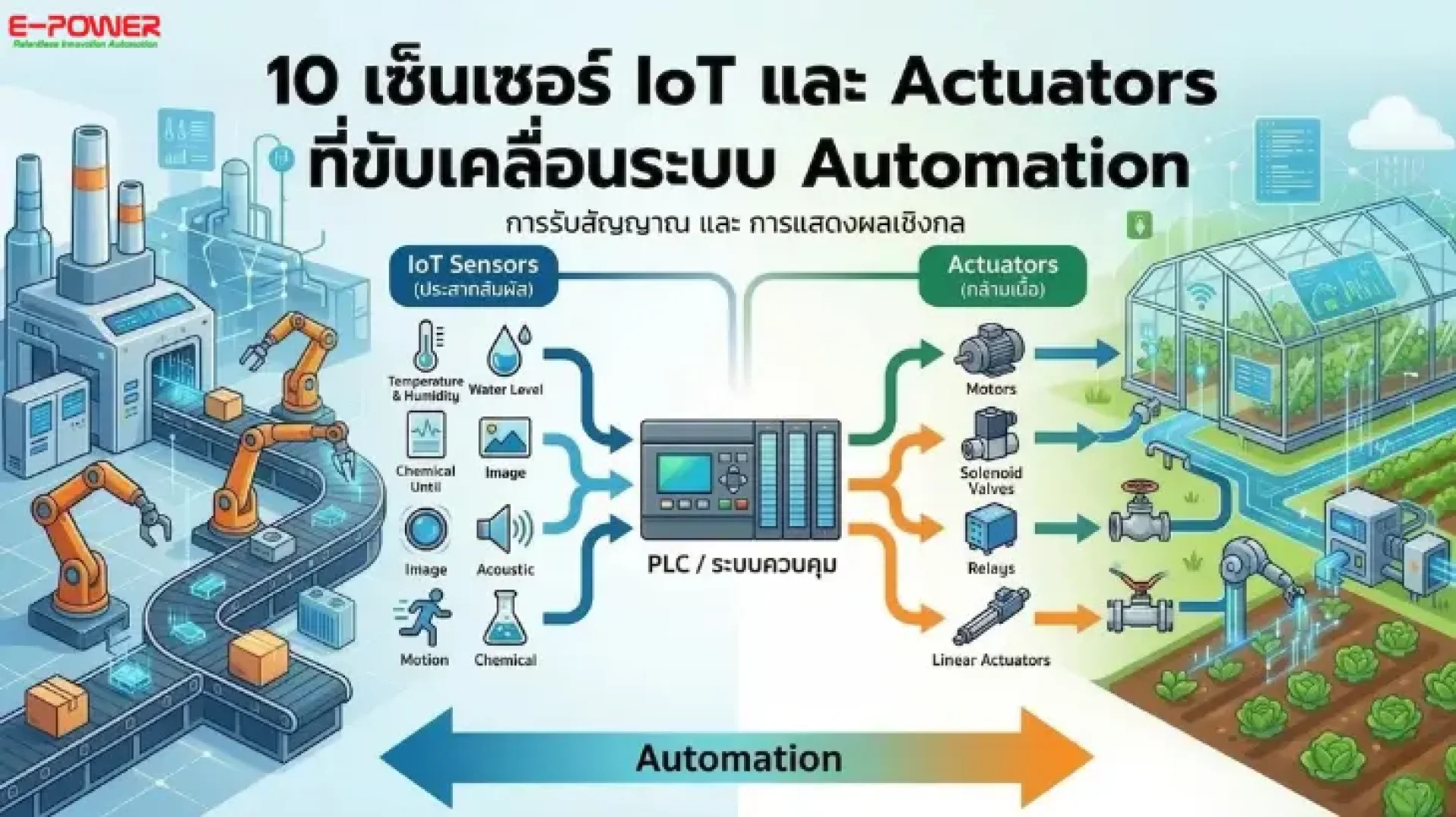
IoT Sensors and Actuators function as the signal-receiving and mechanical-output components essential for driving the Internet of Things (IoT) toward systematic operation. In today's landscape, as the industrial sector fully transitions into the digital era, these devices are the primary variables determining the success of automation. E-Power Service, a provider of solutions in Automation, AI, and Smart Farming, presents key insights into 10 IoT devices that play a pivotal role in transforming industrial and agricultural processes into intelligent systems with international precision standards.
What are IoT Sensors and Actuators?
- IoT Sensors : Act as the "senses," monitoring environmental changes—such as temperature, humidity, chemicals, and water levels—and converting them into digital data for processing.
- Actuators : Act as the "muscles," receiving commands from control systems, such as a PLC, to create mechanical movement like opening/closing valves, rotating motors, or controlling machinery on a production line.
Top 10 IoT Sensors in Industry and Smart Farming
Selecting precise sensors is the starting point for effective automation. Here are the 10 most common types:
- Tempera ture Sensor : The heart of environmental control, whether in industrial control cabinets or Smart Farming greenhouses, ensuring optimal climates for plant growth.
- Humidity Sensor : Works alongside temperature sensors; vital in smart agriculture for irrigation assessment and evaporation control, as well as in humidity-controlled warehouses.
- Water Level Sensor : Crucial for water resource management, used in storage tanks, smart irrigation, and significantly in Biological Wastewater Treatment to control water volume before sludge is processed by a Smart Fertilizer Machine.
- Chemical Sensor : Monitors water and air quality in factories, including pH, Dissolved Oxygen (DO), or ammonia in wastewater ponds to ensure biological processes meet standards.
- Light Sensor : Used in automated lighting systems for energy saving in factories and for calculating daily light absorption in Smart Farming.
- Motion Sensor : Enhances factory safety and manages automated energy systems, such as turning off lights or stopping conveyors when no operators or workpieces are detected.
- Displacement Sensor : Utilizes electromagnetic or radar technology to precisely measure distances and object positions, essential for automated machinery and robotics.
- Acoustic Sensor : Used for machine noise monitoring and Predictive Maintenance by detecting changes in motor or pump sound patterns.
- Gyroscope Sensor : Measures angular velocity and direction, commonly used in industrial robotics, agricultural drones, and machinery navigation systems.
- Image Sensor : Transforms cameras into "Machine Vision" or intelligent eyes for quality control (QC) on production lines or high-speed agricultural sorting.
Actuators: The Driving Force of Automation
When sensors send data to a processor (programmed via CODESYS on a PLC), the system triggers these Actuators:
- Motors: Create precise rotational movement for conveyors, fertilizer presses, or robotic arms.
Solenoid Valves: Essential for opening/closing water and gas, such as in smart fertilizer dispensing or automated irrigation. - Relays: Control the electrical switching of large-scale equipment.
- Linear Actuators: Create movement in a straight line, such as pushing workpieces or operating greenhouse ventilation vents.
Elevate Your Industry and Agriculture with IoT Solutions
These IoT sensors and actuators are the gears that turn the concepts of Smart Farming and Industrial Automation into reality. Whether you are developing an end-to-end smart fertilizer system, upgrading wastewater management, or requiring PLC control programming via CODESYS.
E-Power Service is ready to provide consultation, design, and installation of Automation and AI systems to increase efficiency and sustainably reduce costs for your business.