Types of Soil Water and How to Measure Moisture with a Soil Moisture Sensor
What is Soil Water?
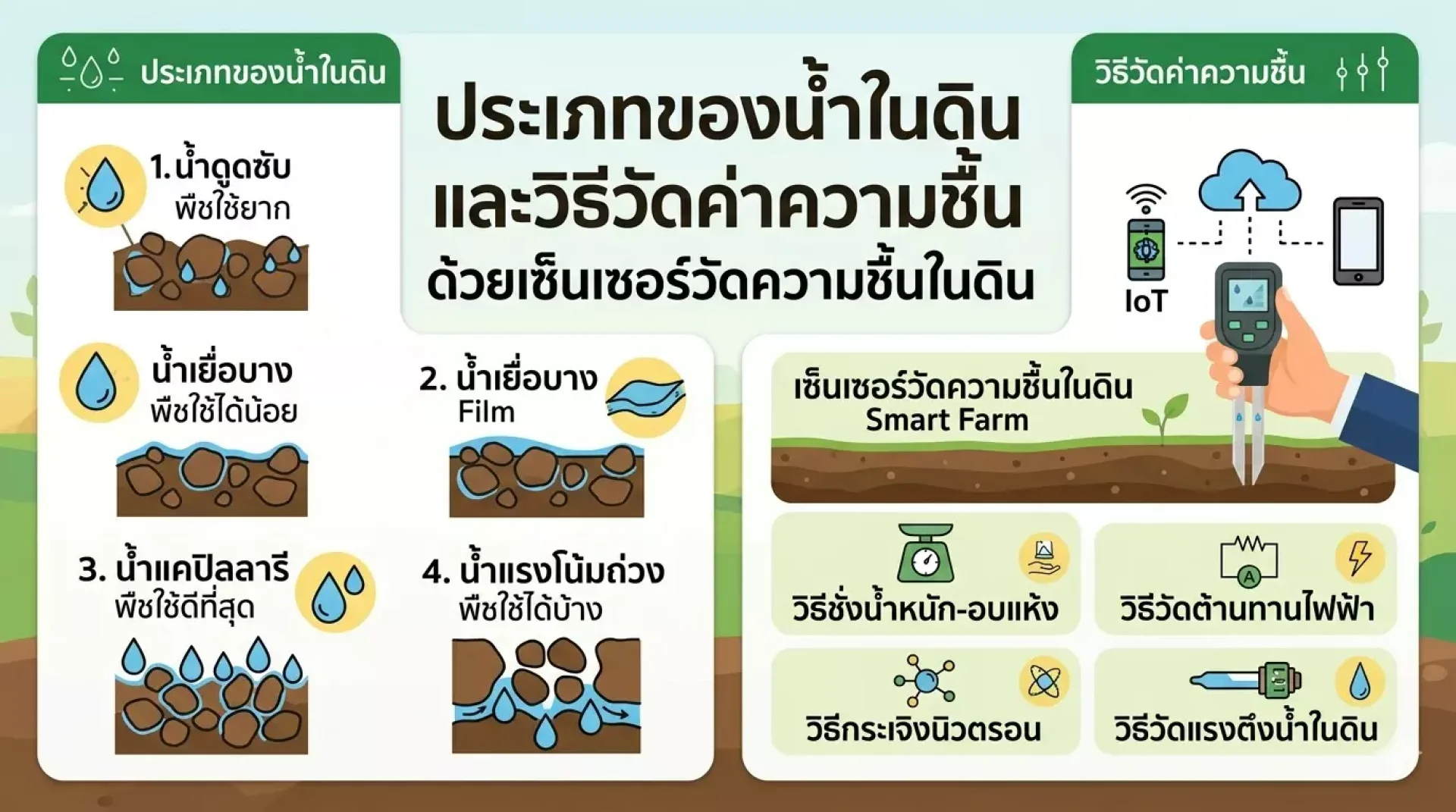
Soil water is a general term used for all forms of water present in the soil, including water trapped in soil pores and water adsorbed by soil particles. Soil water is the primary source of water absorbed by plants. It exists in three main states: gas (vapor), liquid, and solid. The primary sources of soil water are rainfall and irrigation water. Additionally, the upward seepage of groundwater and the condensation of atmospheric water vapor are also sources of soil moisture. In the soil, water is subjected to various physical forces such as gravity, capillary force, intermolecular attraction, and molecular attraction on the surface of soil particles. These forces create different types of soil water with distinct properties:
- Solid water: Ice crystals that form when soil water reaches the freezing point.
- Vapor water: Water vapor mixed in the air within soil pores.
- Bound water: Includes hygroscopic water and film (membrane) water.
- Free water: Includes capillary water, gravitational water, and groundwater.
- Gravity water: Water that percolates downward through the soil layers due to gravity.
What are the types of soil water?
1. Hygroscopic water
This is a thin film of water formed when solid soil particles directly absorb moisture from the air. Its thickness and quantity depend on the level of water vapor saturation in the air. In completely dry air, hygroscopic water is near zero, but in saturated conditions, it reaches its maximum. This type of water is tightly bound to soil particles and cannot move freely, making it very difficult for plants to utilize.
2. Film water
Once soil particles have absorbed water vapor to their maximum capacity, they can absorb additional liquid water, creating an interconnected water film surrounding the hygroscopic water. This is called "film water." It is held by weaker forces than hygroscopic water, allowing it to move between films (from thicker to thinner areas). Plants can absorb film water, but only in very small amounts.
3. Capillary water
When soil moisture exceeds the molecular water-holding limit, water fills the small pores in the soil (capillary pores). This water, held by capillary forces, is the most important water source for plants. Because the binding force is relatively weak, it moves freely, allowing plants to absorb it fully. It also acts as a solvent for chemicals and soil nutrients, transporting them to plant roots.
4. Gravitational water
When the amount of water in the soil exceeds what capillary forces can hold, the excess water flows down into large soil pores due to gravity. Although plants can absorb this type of water, it usually drains rapidly past the root zone, meaning most plants do not have the opportunity to use it.
Effects of soil water on plants
Soil water plays a crucial role even before seeds germinate. Soil moisture softens the seed coat and stimulates the germination process. Furthermore, soil moisture levels directly affect root system development. In dry conditions, plants develop deep roots to find water sources, whereas, in highly moist soil, roots tend to spread shallowly near the surface. Each plant species requires different optimal water levels. If water is too low, plants will wilt; if too high, roots will lack oxygen and rot. For example, dune grass requires about 60% soil moisture, while water spinach growing in wetlands may require up to 110% or more.
Soil Water VS Soil Moisture
- Soil Moisture: Refers to the relative amount of water in the soil, usually expressed as a percentage (e.g., 25% soil moisture). This value constantly fluctuates based on weather conditions and soil type. It can be measured accurately using a Soil Moisture Sensor.
- Soil Water: Refers to the total amount of water in the soil covering all states (liquid, solid, gas). It is usually expressed in units of volume or mass (e.g., cubic meters or kilograms) and can be measured by weighing.
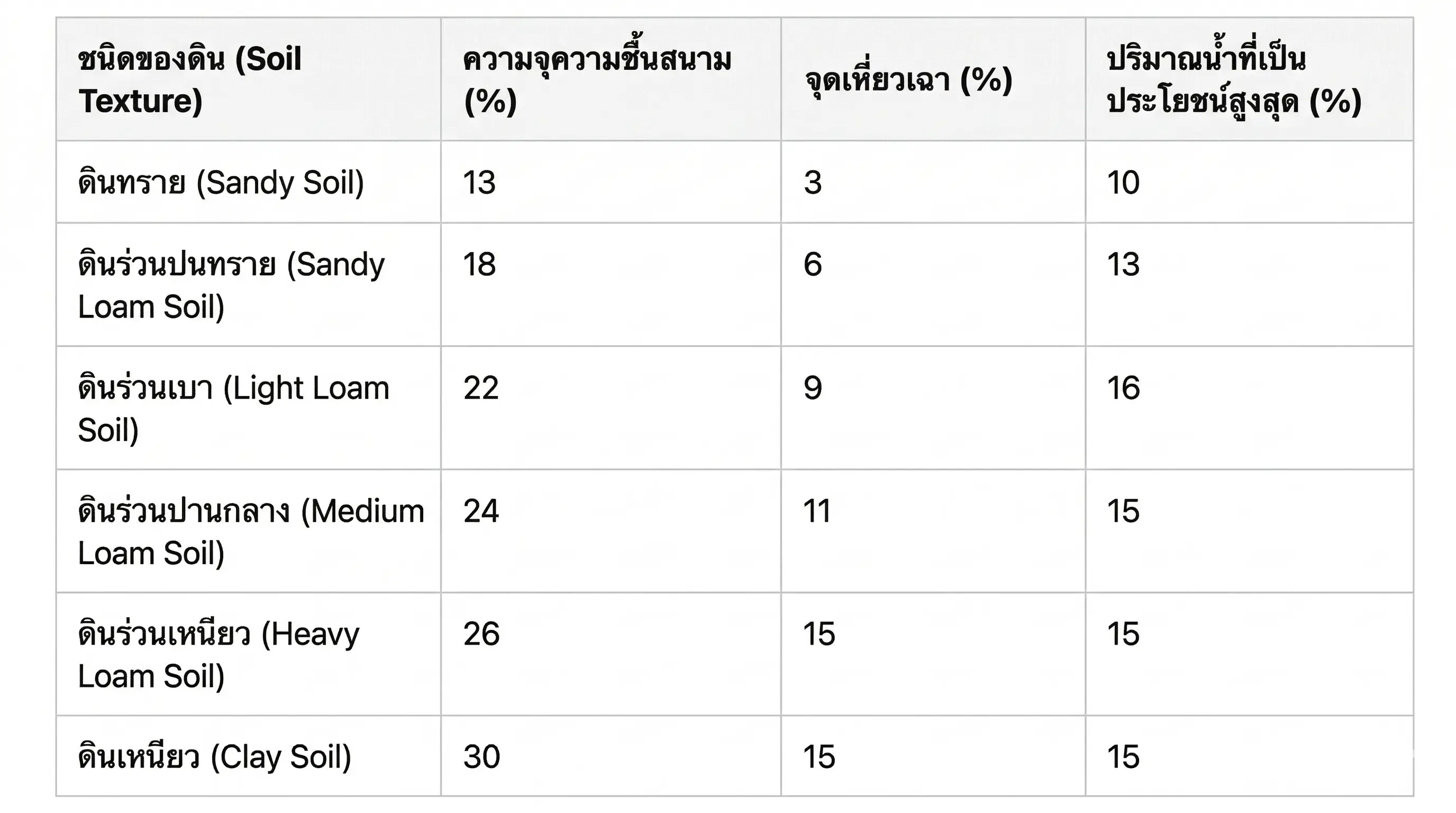
Table: Water Holding Properties by Soil Texture
How to measure soil moisture content?
1. Weighing method
A basic method involving weighing a collected soil sample, drying it in an oven at 105°C until completely dry, and weighing it again. The lost weight represents the soil moisture content.
2. Soil Moisture Sensors
The most popular solution for Smart Farms in the modern era. The sensor emits electromagnetic waves into the soil to measure the dielectric constant, which directly correlates with moisture levels. Installing a Soil Moisture Sensor from Epower allows you to integrate data with an IoT system to create an Automatic Irrigation System. It triggers the water pump to operate only when soil moisture drops below a set threshold, saving massive amounts of water and electricity.
3. Resistance method
Uses porous materials like gypsum or nylon blocks with embedded electrodes buried in the soil. When the block absorbs moisture and reaches equilibrium, its electrical resistance changes according to the water content in the soil.
4. Neutron scattering method
Uses a neutron moisture meter to shoot high-speed neutrons into the soil. When they collide with hydrogen atoms (in water), the neutrons lose energy and slow down. Moisture content is estimated from the number of slowed neutrons.
5. Tensiometer method Measures
moisture by evaluating the soil's "suction force." When a porous ceramic tip is inserted into the soil, water in the tube interacts with soil water until equilibrium is reached. The tension value read from the Tensiometer indicates how hard plant roots have to work to extract water from the soil.