Pyranometer Grades : What Are the Differences? A Guide to Choosing the Right Solar Radiation Sensor
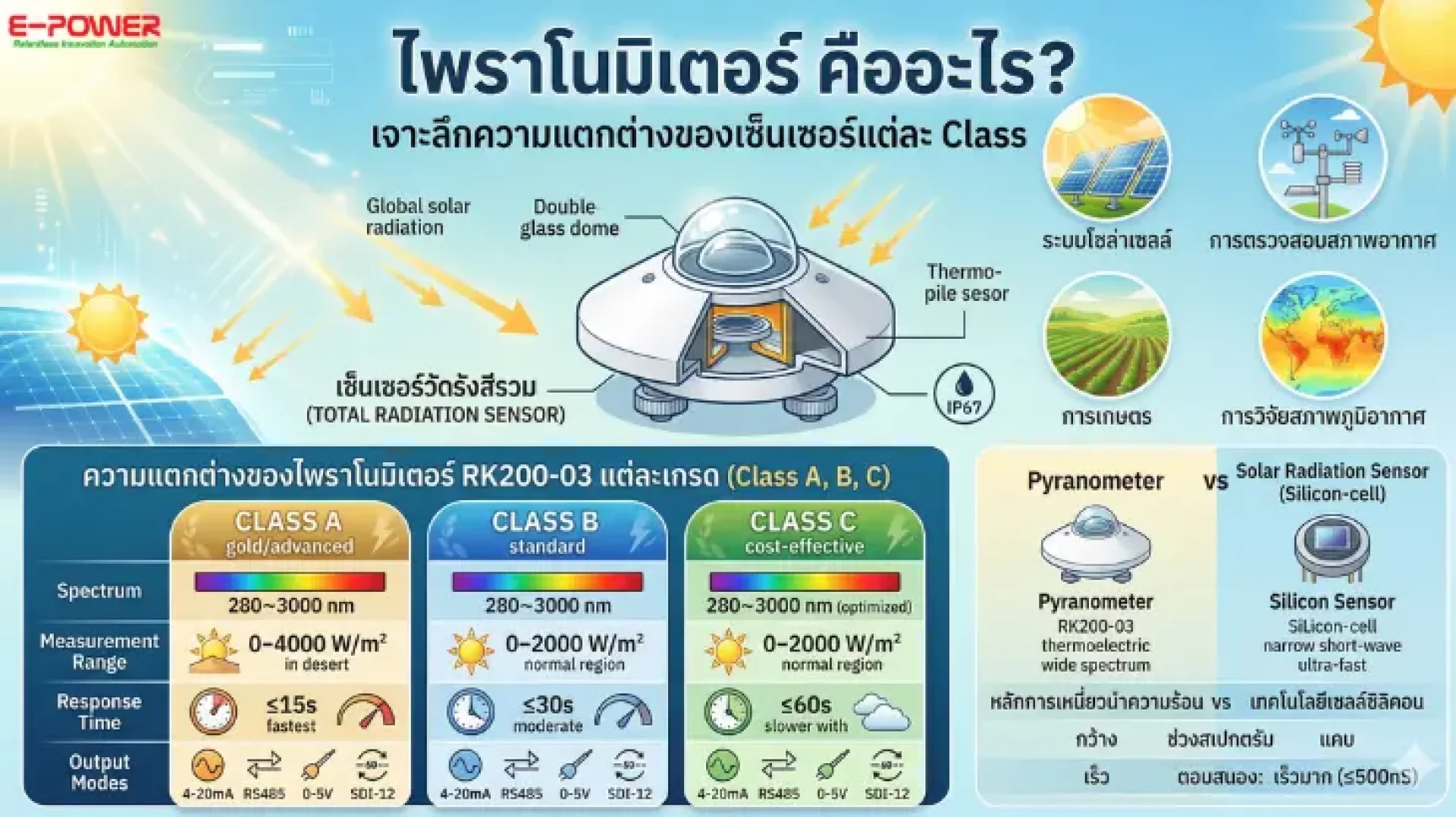
A Pyranometer, or Total Radiation Sensor, is an industrial measurement instrument designed to measure the intensity of Global Solar Radiation reaching a horizontal surface. One of the most popular models is the RIKA SENSOR RK200-03, which is available in various grades (Class A, B, and C) to meet the needs of diverse applications.
In addition, the RK200-04 Solar Radiation Sensor is another specialized device for measuring solar energy. However, it differs significantly from the pyranometer in both design and performance.
These meteorological instruments and sensors play a vital role in Photovoltaic (PV) Power Generation, weather monitoring, agriculture, and climate research. Choosing the right pyranometer grade depends on specific performance parameters to ensure the highest accuracy for your specific environment.
Differences Between RK200-03 Pyranometer Grades (Class A, B, C)
The RK200-03 solar radiation sensor grades differ in terms of spectral range, measurement capacity, response speed, and output signals:
1. Spectral Range
- Class A & B: Covers a wavelength range of 280–3000 nm. It captures a wide spectrum, including Ultraviolet (UV), Visible Light, and Near-Infrared, which is essential for high-precision total irradiance measurements.
- Class C: Also operates within 280–3000 nm but is optimized for general sensitivity, balancing performance and cost-effectiveness.
2. Measurement Range
Class A: Supports a range of 0–4000 W/m², making it ideal for extreme environments like deserts or high-altitude areas.
Class B & C: Supports up to 0–2000 W/m², which is sufficient for temperate regions with moderate solar intensity.
3. Response Time
- Class A: The fastest response at ≤15 seconds (95% response). This is critical for tracking rapid changes in light intensity, such as moving clouds.
- Class B: Moderate response at ≤30 seconds, suitable for standard meteorological monitoring.
- Class C: Slower response at ≤60 seconds, designed for long-term measurements with low dynamic changes, such as agricultural research.
4. Output Modes
- Class A & B: Supports 0–20mV, 4–20mA, and RS485, integrating seamlessly with industrial control systems.
- Class C: Adds 0–5V and SDI-12 outputs, enhancing compatibility with low-power systems or remote installations.
Pyranometer RK200-03 vs. Solar Radiation Sensor RK200-04
While both models are designed to measure solar energy, their working principles and applications are distinct:
- RK200-03 (Pyranometer): Uses the Thermoelectric Induction principle with a multi-contact thermopile. It detects a broad spectral range (280–3000 nm), making it perfect for measuring Global Solar Radiation. Its stainless steel structure with a white finish prevents rust and corrosion, while the double-layer glass ensures 95% light transmission and minimizes air convection interference.
- RK200-04 (Solar Radiation Sensor): Utilizes Silicon-cell technology with a photodiode detector. It is limited to a narrower spectral range (300–1100 nm), focusing on shortwave radiation. Its standout feature is an ultra-fast response time of ≤500nS (95%), making it ideal for tracking high-speed fluctuations in solar performance. It features a lightweight aluminum alloy shell (420g) and very low power consumption (0.2W).
Both models boast an IP67 rating, ensuring they are dustproof and waterproof for harsh outdoor environments.
Summary
Choosing the right solar radiation sensor depends on your specific application. The RK200-03 (Pyranometer) offers various grades for precision and range; Class A is best for high-end accuracy, while Classes B and C are cost-effective for general use. Meanwhile, the RK200-04 excels in rapid shortwave measurements for dynamic solar systems. Selecting the correct meteorological equipment ensures your solar data collection is as efficient as possible.