What is a Soil Moisture Sensor? Working Principles and Usage Guide
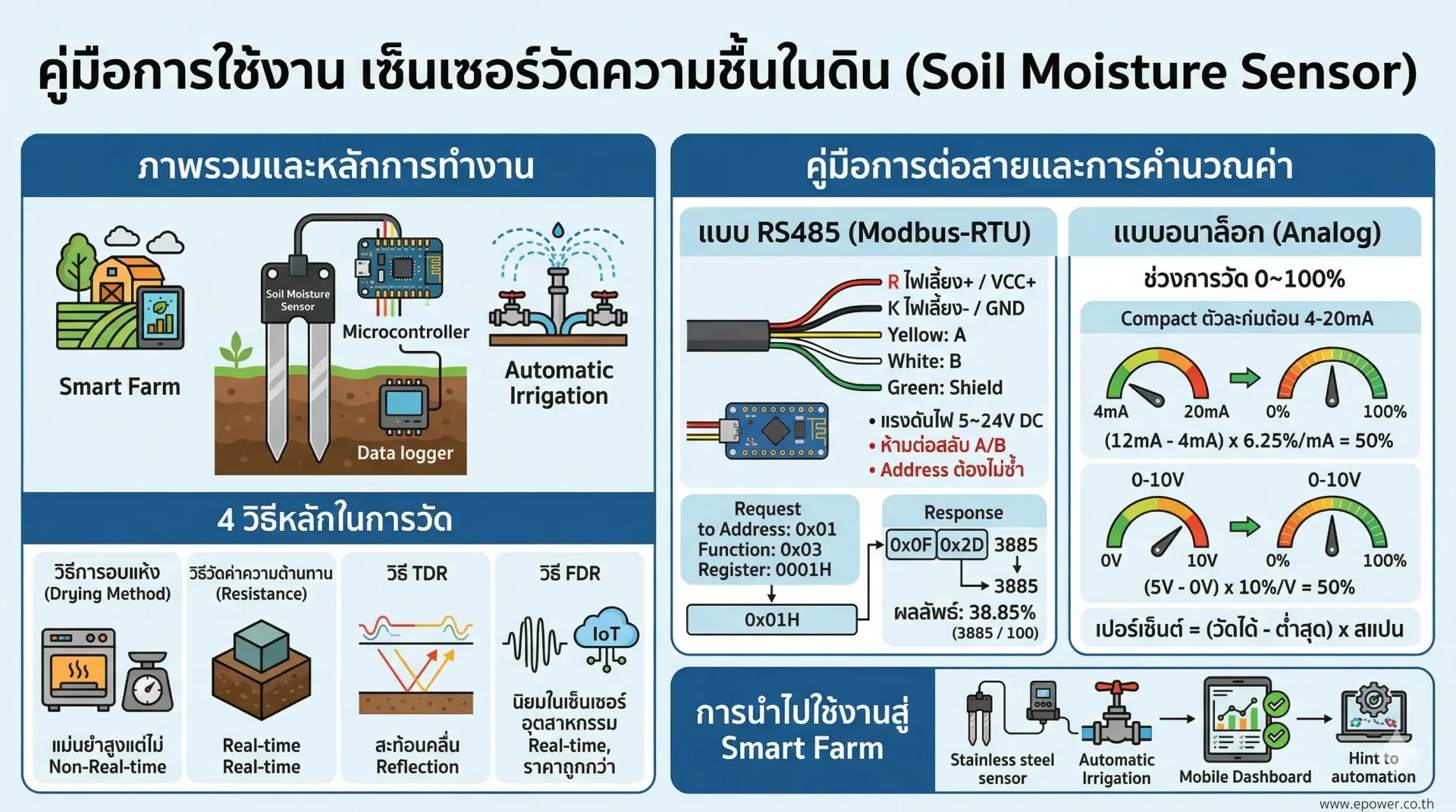
A Soil Moisture Sensor is a specialized device featuring stainless steel and waterproof probes, designed for long-term burial in soil or dam structures. It performs fixed-point monitoring and online measurements of both surface and deep soil moisture. When integrated with a Data Collector or PLC control system, it becomes a vital tool for precise irrigation, Smart Farming, and Automatic Irrigation Systems.
Working Principles of Soil Moisture Sensors
There are several methods for measuring soil moisture, each with distinct advantages for different applications:
1. Drying Method
The traditional standard for high accuracy. Soil samples are heated in an oven at 180°C until the weight stabilizes. The moisture lost is calculated as follows:
$$text{Soil Moisture Content} = frac{W}{M} times 100%$$
2. Resistance Method
Uses gypsum blocks, nylon, or glass fiber buried in the soil. As moisture in these materials equilibrates with the soil, electrical resistance is measured and converted into a moisture percentage.
Developed in the 1980s, this technology uses electromagnetic wave reflection in a transmission line. It is highly independent—unaffected by soil type, density, or temperature—and can measure moisture in frozen soil while simultaneously monitoring water and salt content.
4. FDR (Frequency Domain Reflectometry)
Wiring and Calculation
Supports a wide voltage range of 5-24V DC. Ensure A/B lines are not reversed and the device address is unique.
- Red: Power (+)
- Black: Power (GND)
- Yellow: 485-A
- White: 485-B
- Green: Shield
Modbus-RTU Reading Example:
If the host sends a read command to Address 0x01 (Function Code 0x03, Register 0001H) and receives the response 0x0F 0x2D:
- Convert Hex to Decimal: 0x0F2D = 3885
- The actual moisture value (divide by 100) = 38.85%
2. Analog Output
- 4-20mA Current Conversion: For a 0-100% range, the 16mA span (20-4) equals 6.25%/mA.
If the signal is 12mA: Moisture = (12mA - 4mA) x 6.25 = 50% - 0-10V Voltage Conversion: For a 0-100% range, the 10V span equals 10%/V.
If the signal is 5V: Moisture = (5V - 0V) x 10 = 50%
Conclusion
Choosing a high-standard Soil Moisture Sensor is the foundation for upgrading to a Smart Farm. Integrating this data with automated control systems significantly reduces water costs and increases crop yields. If you are looking for industrial measurement solutions or expert IoT and Automation system design, E-Power Service Co., Ltd. is ready to provide consultation and tailored solutions at www.epower.co.th.