Introduction to Water Sensors for Smart Water Quality and Level Management
Water Sensor (Water Quality and Level Sensor) is a crucial tool that guarantees the safety, cleanliness, and purity of the bottled drinking water we consume daily. These products undergo rigorous inspection processes before reaching consumers. Such devices have become the heart of various industries, ranging from municipal water treatment systems and environmental monitoring to industrial manufacturing processes, especially amidst today's increasingly strict environmental standards.
Importance of Water Sensors
Water is one of the world's most vital resources but is easily contaminated by hazardous substances. Water sensors detect and measure various parameters—such as chemical concentrations, physical characteristics, and biological components—in real-time to ensure water is safe and meets standards.
- Public Health: Detects bacteria, heavy metals, and dangerous chemicals in drinking water systems.
- Environment: Monitors water quality in rivers and oceans to protect ecosystems and biodiversity.
- Industry: Maintains water standards for factories, agriculture, and food processing to prevent equipment damage and ensure product quality.
- Regulatory Compliance: Provides businesses with accurate data to comply with water quality regulations and avoid legal issues.
Types of Water Sensors and Recommended Models
Sensors are categorized into two main groups: Water Quality Sensors and Water Level Sensors.
1. Water Quality Sensors
These sensors measure the chemical, physical, and biological characteristics of water.
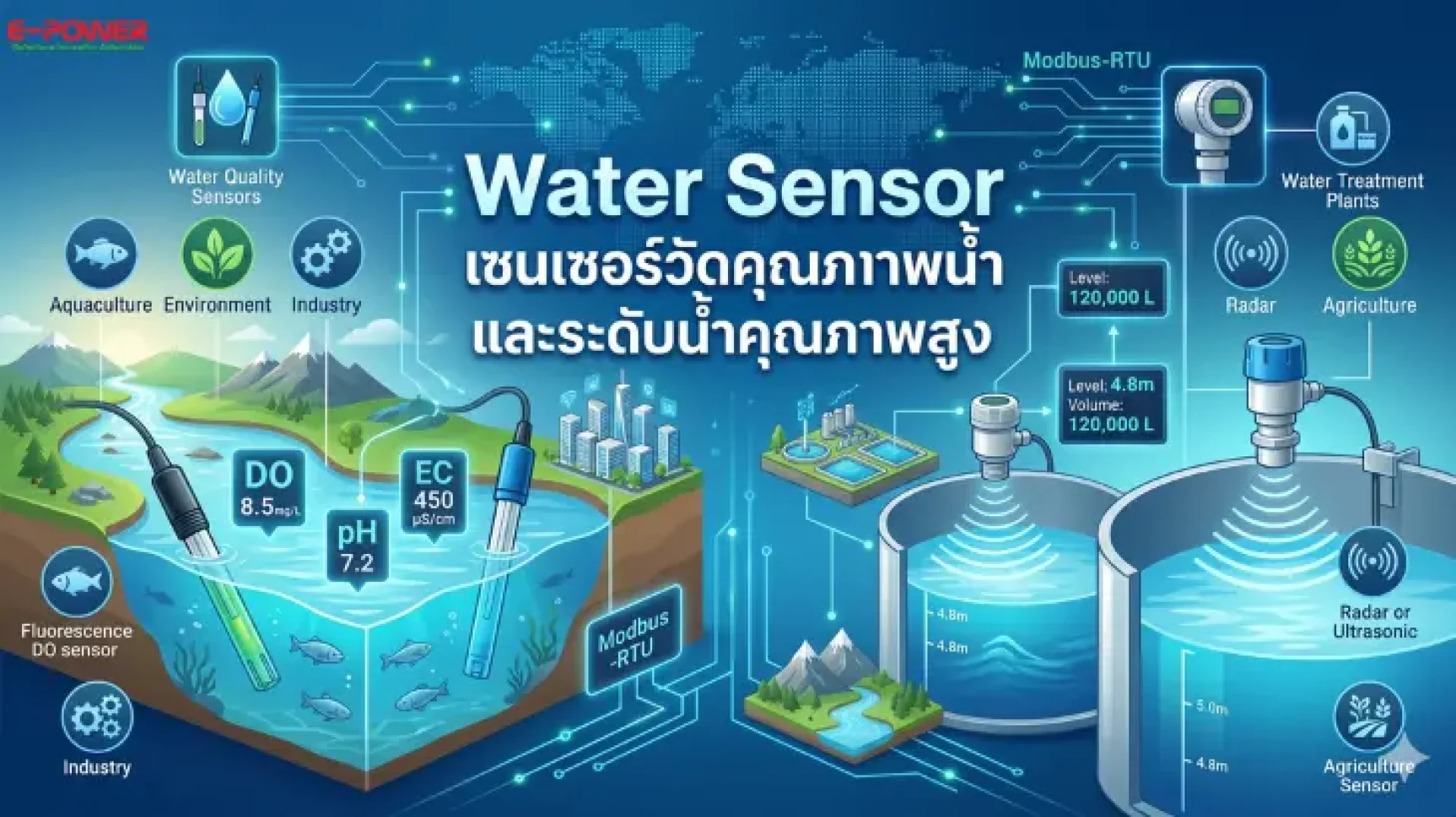
Dissolved Oxygen (DO) Sensor: Measures dissolved oxygen, a critical parameter for aquatic ecosystems, aquaculture, and wastewater engineering.
- Recommended Model: Rika RK500-04 Dissolved Oxygen (DO) Sensor. This high-performance sensor uses fluorescence principles to provide accurate, fast-responding, and stable continuous measurements.
pH Sensor: Measures acidity or alkalinity, which affects chemical reactions and pollutants.
- Recommended Model: RK500-02 pH Sensor.
Conductivity (EC)/Salinity Sensor: Measures electrical conductivity related to dissolved salt concentrations.
Turbidity Sensor: Measures water cloudiness caused by suspended particles.
COD Sensor: Measures Chemical Oxygen Demand to check for organic pollution in wastewater.
ORP, Ammonium, Nitrate, and Chlorophyll Sensors: Specialized sensors for monitoring chemicals and algae.
2. Water Level Sensors
These sensors measure the height of liquids in storage tanks or natural water sources.
Radar Liquid Level Transmitter: Uses non-contact microwave waves for high accuracy even under high pressure or temperature.
- Recommended Model: Radar Liquid Level Transmitter (Radar Product Group).
Ultrasonic Liquid Level Transmitter: Uses sound waves to calculate liquid levels; easy to install and maintain.
Recommended Model: Ultrasonic Level Transmitter (Ultrasonic Product Group).
Radar Flowmeter & Velocity Sensor: Measures water flow rate and velocity in pipes or open channels.
Recommended Model: Radar Velocity & Flowmeter.
Applications
- Municipal Water Treatment: Controls safe drinking water production.
- Environmental Monitoring: Inspects pollution in natural water sources.
- Industrial: Controls water quality used in cooling or heating systems.
- Agriculture and Aquaculture: Manages moisture, nutrients, and water quality for optimal plant and animal growth.
Summary
Choosing an accurate and durable Water Sensor is the key to reducing risk and increasing sustainable profit. At E-Power, we offer industrial-standard sensor solutions supporting Modbus-RTU for efficient data analysis.
Explore our Environmental Sensors and consult on quality solutions at www.epower.co.th.