Reducing Electricity Costs in Wastewater Treatment: Pump and Motor Control Techniques Using PLC and Inverter
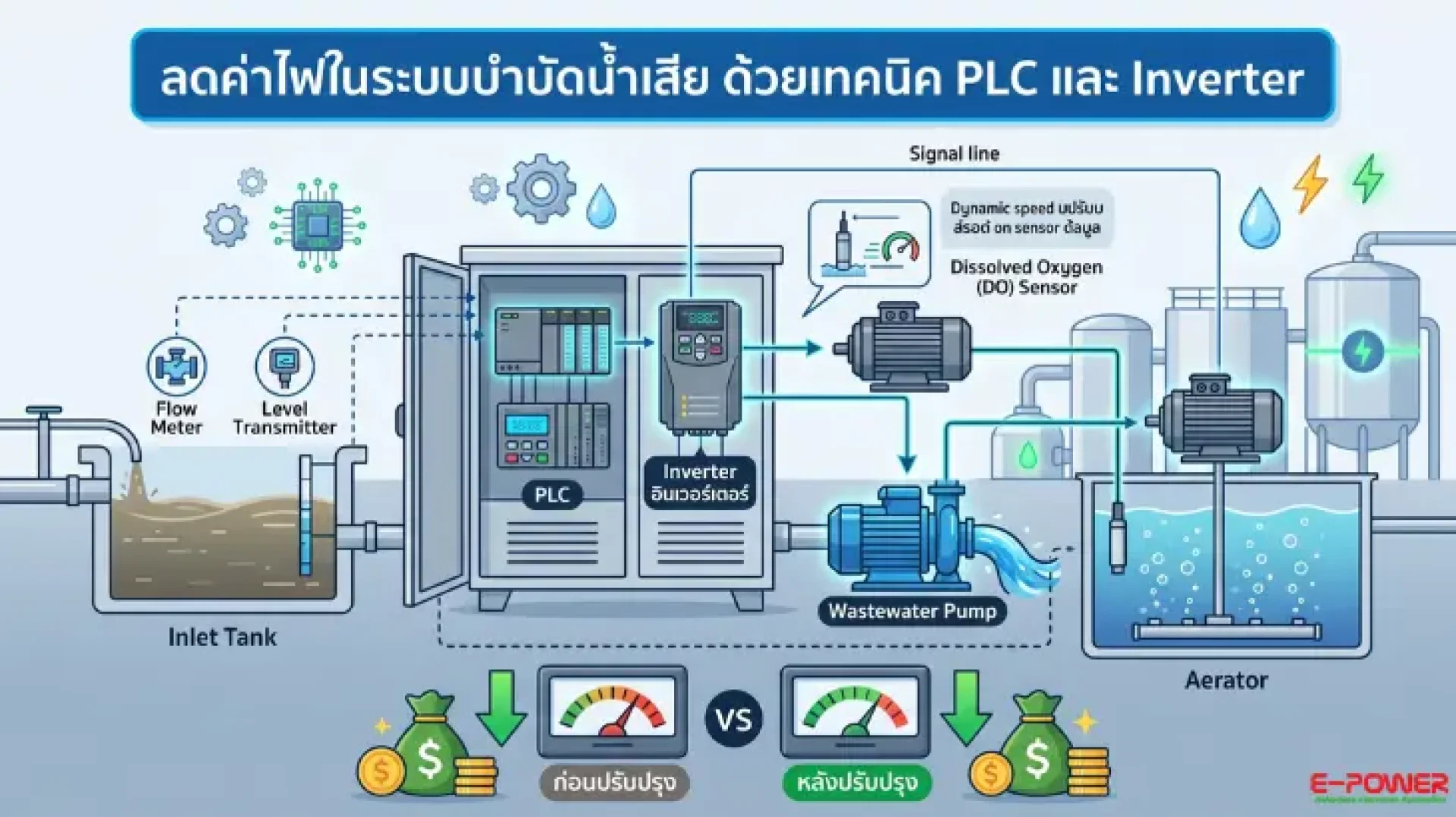
Reducing electricity costs in wastewater treatment is a primary objective for cost management in industrial sectors and large commercial buildings. Because a wastewater treatment system is a process that must run 24/7, its machinery—particularly wastewater pumps, aerator motors, and sludge pumps—consumes up to 40-60% of the system's total electrical power. Allowing these motors to operate at full speed continuously not only results in unnecessary energy waste but also accelerates equipment wear and tear. Implementing an automated control system that integrates the functionality of PLCs and Inverters is a critical technique that ensures a rapid and sustainable return on investment (ROI).
Energy-Saving Mechanism: How PLCs and Inverters Reduce Electricity Bills
In traditional wastewater treatment systems, motors and pumps are commonly regulated via standard on-off control using magnetic contactors. This setup triggers massive current surges during startup and forces pumps to operate at full capacity continuously, even when the incoming wastewater volume (influent) significantly decreases.
Transitioning to an Inverter (VFD - Variable Frequency Drive) paired with PLC (Programmable Logic Controller) automation allows motor speeds to modulate dynamically based on real-time demand. According to the physics of centrifugal pumps (Affinity Laws), reducing a pump's speed by just 20% can lower its electrical power consumption by up to nearly 50%.
3 Critical Techniques for High-Efficiency Pump and Motor Control
1. Flow Proportional Control
- The PLC receives input signals from industrial instrumentation, such as level transmitters or flow meters, to calculate the exact volume of wastewater entering the sump pit. The PLC program then processes this data and transmits an analog signal (e.g., 4-20mA) or utilizes industrial communication protocols to command the Inverter. The Inverter adjusts the wastewater pump speed to match the actual flow, reducing dry-running cycles and lowering electricity consumption during off-peak hours.
2. Dissolved Oxygen (DO) Loop Control for Aeration
- Aerators are the most power-hungry components in a wastewater treatment plant. A highly precise energy-saving technique involves installing a dissolved oxygen sensor (DO Sensor) inside the aeration tank. The sensor feeds real-time DO values back to the PLC, which runs a closed-loop PID control program. If the DO level exceeds the threshold required by the microorganisms, the PLC immediately commands the Inverter to ramp down the aerator motor speed. This method effectively prevents over-aeration and significantly drops power costs.
3. Soft Start / Soft Stop Systems for Surge Reduction
- Starting heavy industrial motors directly across the line (Direct On Line) generates a massive current spike—up to 6-8 times the normal running current. This spike heavily impacts the factory's peak demand charges on utility bills. Routing the motor startup commands through an Inverter slowly ramps up the frequency and voltage, allowing the motor to accelerate smoothly. This eliminates peak demand spikes on electricity bills and mitigates hydraulic shock (water hammer) within the piping network.
Frequently Asked Questions About Power Savings in Wastewater Systems (FAQ)
Q: What engineering precautions should be taken when retrofitting an Inverter to lower the speed of a wastewater pump motor?
A: The most critical precaution is establishing the "Minimum Acceptable Speed (Minimum Frequency)" of the wastewater pump. Raw wastewater contains high levels of solids, sludge, and debris. If the motor speed drops too low (e.g., below 30-35 Hz), the flow rate will fall to a point where the pump cannot generate enough head pressure to overcome system resistance. This causes sediment drop-out and pipe blockages. Therefore, programmers must configure a strict minimum speed limit within the PLC software logic to guarantee safe and continuous system operation.
Elevate Energy-Saving Wastewater Treatment with Solutions from E-Power
If your factory or facility is struggling with high electricity bills from water treatment infrastructure, or if you aim to upgrade to full industrial automation, E-Power Service Co., Ltd. is fully equipped to design, source, and install comprehensive energy-saving solutions. We are trusted experts in automated control systems and a premier distributor of standard industrial hardware.
We supply elite controllers fully compatible with world-class CODESYS PLC software and integrated with our secure cloud architecture, the E-power IoT Platform. This enables engineering teams to monitor real-time pump operations, track energy-saving metrics, and receive instant emergency alerts directly on smartphones. Combined with top-tier Inverters and analytical sensor technologies, we transform traditional wastewater treatment plants into highly efficient, smart solutions that maximize profitability.