Turbidity Sensor : How to Choose for Industrial Wastewater Treatment Systems
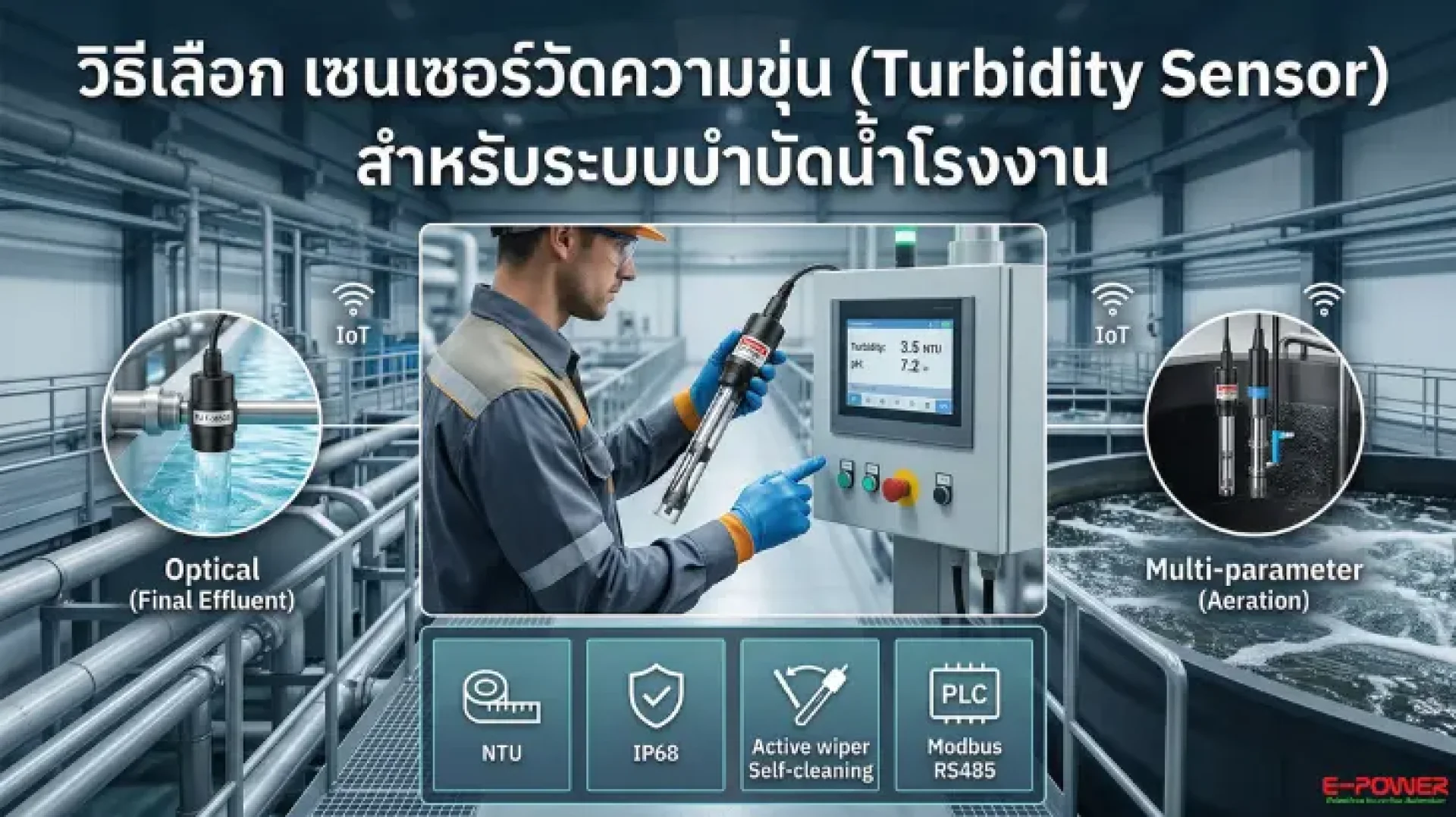
Turbidity Sensor is a crucial device that helps industrial wastewater treatment systems meet environmental standards and operate sustainably. It functions by accurately measuring the amount of suspended solids in water, sending command signals for automated systems to operate efficiently. In this article, E-Power Service will dive deep into how to select a sensor that meets industrial demands, along with recommending the best types for your system.
Why Do Industrial Factories Need a Turbidity Sensor?
Relying on human eyesight to evaluate water turbidity is not accurate enough for Automation control. A Turbidity Sensor steps in to assist in the following areas:
- Real-time Water Quality Monitoring: Inspects the clarity of effluent before discharging it into public water sources.
- Enhance Treatment Efficiency: Helps control chemical dosing or machinery operation in Biological Wastewater Treatment, reducing resource waste.
- IoT Technology Support: Transmits data into the Smart Factory system for instant analysis and abnormality alerts.
5 Ways to Choose a Turbidity Sensor for Factory Wastewater Systems
Selecting the wrong sensor specification can lead to inaccurate measurements and a shortened lifespan. Here are the factors to consider:
1. Measurement Range and Accuracy
Wastewater in different industries has varying turbidity levels. You should choose a sensor with a measurement range (measured in NTU, FNU, or mg/L) that covers your factory's water characteristics, such as heavily concentrated sludge or treated clear water.
2. Material and Durability Wastewater is often corrosive.
Choose a sensor head made of chemically resistant materials, such as 316L Stainless Steel, Titanium, or specialized engineering plastics, and ensure it meets the IP68 waterproof and dustproof standard.
3. Self-Cleaning System
For wastewater systems with heavy biological sludge or debris, it is recommended to choose a Turbidity Sensor equipped with a Wiper or automatic air blower system. This prevents sludge buildup on the lens, reduces maintenance burdens, and maintains measurement accuracy.
4. Output Signal and Connectivity
A good sensor must communicate with the central control system. Opt for a sensor that supports industrial standard signals like 4-20mA or RS485 (Modbus RTU) for easy integration with PLCs or IoT devices for cloud-based data monitoring.
5. After-Sales Service and Installation
Setting up a sensor to work seamlessly with an Automation system requires expertise. Purchasing from an experienced provider like E-Power Service ensures that the sensor will be perfectly integrated into your wastewater treatment system.
Recommended Turbidity Sensors for Industrial Applications
To maximize wastewater treatment efficiency, here are the most popular sensor types in the industry, capable of connecting with Automation systems and directly transmitting data to the Ecloud IoT Platform:
Online Self-Cleaning Turbidity Sensor
An online turbidity sensor equipped with an automatic wiper. It is highly suitable for treatment ponds containing sludge or biological wastewater systems, helping to eliminate inaccuracies caused by dirt or biofilm accumulation.
- Recommended Model: SUPMEA SUP-PTU8011 Turbidity Sensor. Highly durable and ideal for industrial wastewater applications requiring minimal maintenance.
Optical Turbidity Sensor (90-Degree Scattered Light Technology)
Operates by projecting light and measuring the scattered light at a 90-degree angle. It offers high precision and resistance to external light interference, making it perfect for final effluent monitoring points before discharge.
- Recommended Model: Desun Uniwill TUF-3850S Online Digital Turbidity Sensor for high accuracy and stability. For ultra-clear treated water, the SUP-PTU8012 Low Turbidity Sensor is ideal for measuring extremely low turbidity levels.
Multi-parameter Water Quality Sensor
For factories looking to upgrade to a Smart Factory and reduce installation space, a multi-parameter sensor can measure Turbidity, pH, and Dissolved Oxygen (DO), or other values, all in a single probe.
- Recommended Model: Desun Uniwill Online Multi-parameter Water Quality Sensor. Perfect for connecting with PLC systems (like Haiwell PLC) via Modbus RS485 to transmit real-time data seamlessly.
End Sub-standard Wastewater Problems: Upgrade Your Factory's Treatment System with Turbidity Sensors and IoT
Put an end to substandard wastewater quality control! Whether you need a new turbidity sensor or want to upgrade your water treatment system to full automation, the team at E-Power Service is ready to advise. We specialize in control systems, measurement instruments, and IoT to curate the most suitable solutions for your industry. Contact us today for a free consultation.