Salinity Sensor : Measuring Water Salinity for Shrimp Farms and Brackish Water
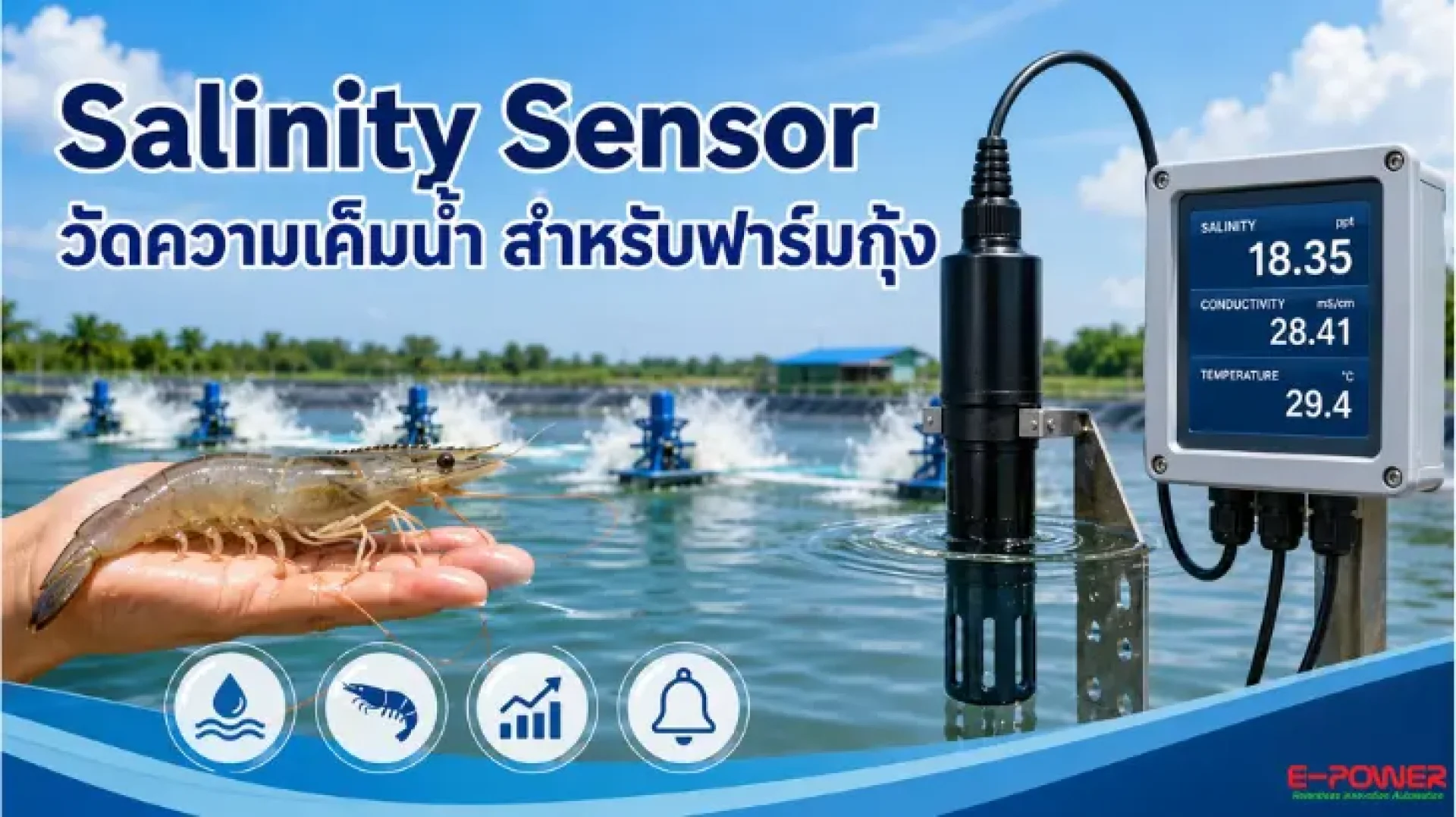
A Salinity Sensor is a device used to measure the amount of dissolved salt in water. It works by measuring electrical conductivity (Conductivity) and then converting that reading into a salinity value, expressed in ppt (parts per thousand) or PSU. This type of sensor is critically important for shrimp farms and brackish-water aquaculture, because it helps keep salinity within the optimal range, reducing stress and lowering the risk of shrimp mortality in real time.
Water salinity is one of the factors that directly affects the growth, molting, and overall health of shrimp. If salinity changes suddenly—for example, after heavy rainfall or when freshwater flows into the pond—shrimp can become stressed and more vulnerable to disease. Installing a salinity sensor to continuously monitor the value has therefore become an essential tool for the modern shrimp farm. This article explains how the sensor works, what salinity levels are appropriate, and which model you should choose.
How a Salinity Sensor Works
Salinity is not measured directly; instead, it is measured through the electrical conductivity (EC) of the water. Because dissolved salts conduct electricity, the saltier the water, the higher its conductivity. The sensor measures the EC value, applies temperature compensation, and then calculates the result as a salinity value.
There are two main types of salinity/conductivity sensors commonly used: the 4-electrode type, which measures over a wide range and resists fouling from dirt and buildup well, and the inductive (toroidal) type, designed for heavily contaminated water. Most transmit a digital signal via Modbus RS485 or a 4-20mA signal, allowing them to connect to a PLC, HMI screen, or cloud-based IoT system to view readings and receive alerts remotely.
Suitable Salinity Levels for Shrimp Farming
Water can be classified by salinity level as follows (general reference values):
| Water Type | Approximate Salinity |
| Freshwater | Less than 0.5 |
| Brackish Water | 0.5 – 30 |
| Seawater | Around 35 |
For shrimp farming, the optimal salinity depends on the species and growth stage (these are general reference values and should be adjusted according to farm-specific guidance):
| Shrimp Type | Common Salinity Range |
| Whiteleg Shrimp (Vannamei) | Highly adaptable, around 10 – 25 (can be raised at low salinity if adjusted gradually) |
| Black Tiger Shrimp | Around 15 – 25 |
What matters is not only the salinity value itself but also its stability, because rapid fluctuations are a primary cause of stress in shrimp.
Why Shrimp Farms Need a Salinity Sensor
- Real-time monitoring — know the salinity value 24 hours a day without manually collecting samples to measure
- Prevent sudden changes — especially after rainfall, when salinity drops quickly.
- Plan water exchange precisely — maintain a stable salinity level.
- Reduce risk and losses — control the environment to suit growth and molting.
- Connect to an alert system — set up mobile notifications when salinity moves outside the defined range.
What Else Is It Suitable For?
Besides shrimp farms, salinity sensors are also used in coastal aquaculture, hatcheries, monitoring saltwater intrusion in water sources and estuaries, recirculating aquaculture systems (RAS), and industrial applications that require water-quality control, such as cooling water and RO systems.
How to Choose a Salinity Sensor
- Measurement range — covers the salinity actually in use (e.g., brackish water 0.5–30 ppt).
Temperature compensation — should be built in for accuracy. - Signal output — RS485 (Modbus) or 4-20mA, matching the PLC/HMI/IoT you use.
Fouling resistance — choose a 4-electrode or inductive type if the water has heavy sediment. - Application format — online (continuous immersion) or portable (spot measurement).
Recommended Sensors
- Supmea SUP-TDS7002 (4-Electrode Conductivity Sensor) — measures electrical conductivity (EC) and TDS in a single unit. A durable, cost-effective 4-electrode design that supports brackish water, treated water, and RO systems, and transmits a digital signal that connects to a PLC/HMI.
- AQUALABO Probe TRIPOD — a digital multiparameter probe that measures salinity, conductivity, and TDS along with other values such as DO, pH, and temperature. It supports RS485/SDI-12 and is ideal for aquaculture ponds that need to monitor multiple parameters simultaneously.
- Remond RMD-1008A Multiparameter Controller — an online controller that monitors 24 hours a day and connects up to 12 sensors, including Conductivity, TDS, Salinity, DO, and pH, with RS485 and relay outputs.
- Take it further with an automated control system: By combining a salinity sensor with DO measurement and an aerator control system through a PLC, HMI screen, or a cloud-based IoT platform such as E-Power's ecloud, a shrimp farm can monitor water quality and receive alerts from anywhere.
Frequently Asked Questions (FAQ)
How does a Salinity Sensor measure salinity?
It measures through the water's electrical conductivity (Conductivity) with temperature compensation, then converts it into a salinity value in ppt or PSU—because salts dissolved in water allow it to conduct electricity.
What salinity is suitable for raising whiteleg shrimp?
Whiteleg shrimp (Vannamei) are highly adaptable, commonly raised at around 10–25 ppt, and can be raised at low salinity if adjusted gradually—though this depends on species and growth stage.
How is salinity different from electrical conductivity (EC)?
EC is the value the sensor measures directly, while salinity is a value calculated from EC. A salinity sensor is therefore a conductivity sensor that displays results as a salinity value.