Can a Soil NPK Sensor Truly Lower Fertilizer Costs?
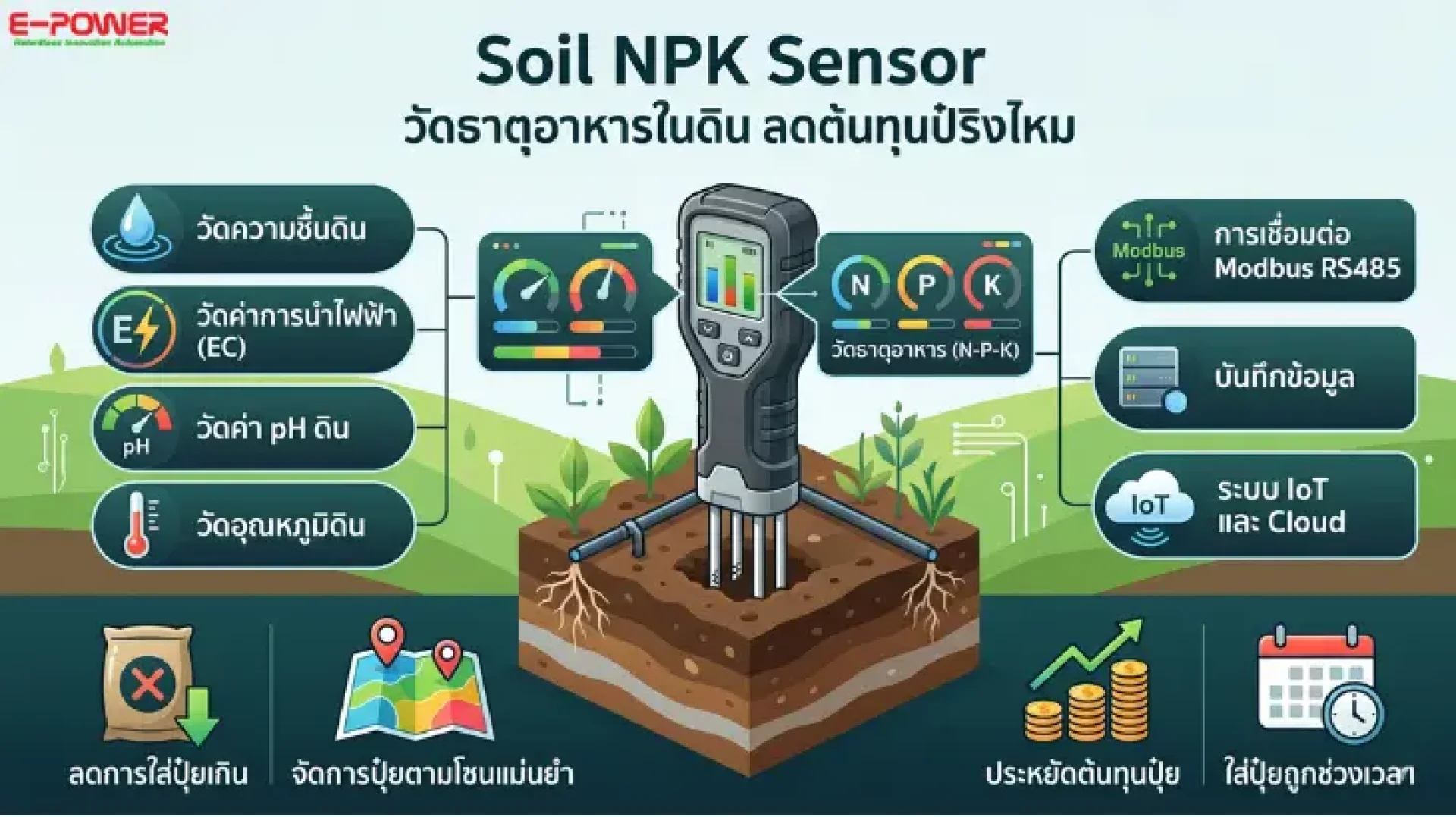
Soil NPK Sensor: Can it truly lower fertilizer costs, how does it measure soil nutrients in the field, and what are the best strategies to maximize its return on investment (ROI)? In commercial agriculture, chemical fertilizer expenses account for one of the largest seasonal budget components. Over-applying fertilizers is not only financially wasteful but also leads to severe soil degradation, excessive nutrient leaching, and groundwater pollution. Modern precision agriculture addresses this challenge by focusing on delivering exactly what the crop needs. A portable or online soil NPK sensor provides quick, chemical-free estimations of nitrogen (N), phosphorus (P), and potassium (K) levels directly in the field. When used correctly as a trend-tracking and zone-management tool, it can drastically eliminate wasteful fertilizer over-application. This article explores how these soil sensors operate, their practical limitations, and how to successfully use their data to drive down agricultural input costs.
How Does a Soil NPK Sensor Work?
Most industrial Soil NPK Sensors assess nutrient concentrations by measuring the electrical properties of the soil matrix, converting these electrical indicators into quick, indirect estimations of Nitrogen, Phosphorus, and Potassium. By inserting the probe directly into the soil bed, farmers receive data outputs within seconds without relying on hazardous laboratory chemical reagents or waiting days for laboratory return slips.
Premium All-in-One integrated soil sensors go a step further by simultaneously tracking critical soil health factors within a single probe body, such as soil moisture, temperature, electrical conductivity (EC), and pH. Most of these professional probes output digital data via the Modbus RS485 communication protocol, making it incredibly simple to link the probe directly to standalone Data Loggers, PLCs, HMI display screens, or cloud-based IoT telemetry networks for uninterrupted field tracking.
Key Limitations You Must Understand Before Deploying
To ensure project success, it is important to know that rapid-test insertion NPK probes utilize indirect measurement principles. Consequently, their data outputs possess a wider margin of error when compared to wet-chemistry laboratory analysis. Because of this, the primary value of an on-site NPK sensor is to compare day-to-day data trends and identify nutrient variations between different soil zones across your fields, rather than acting as an absolute metric for mixing exact fertilizer recipes.
Best practice for accuracy: Periodically utilize professional laboratory soil testing results as baseline reference values to calibrate your digital NPK sensors. Once calibrated, use the sensor for high-frequency, day-to-day tracking across different management grids. This combined strategy delivers the best of both worlds: lab-grade baseline reliability alongside the extreme convenience of instant digital field tracking.
How the Data Directly Lowers Fertilizer Costs
- Eliminates Guesswork: Instantly identify which management zones lack nutrients or exhibit high nutrient surpluses to prevent redundant fertilizing cycles.
- Enables Precision Zoning: Subdivide large agricultural fields into specific management grids based on real-time soil fertility data, applying variable fertilizer rates exactly where needed.
- Minimizes Nutrient Volatilization: Apply fertilizers only when soil moisture and temperature parameters are optimal, ensuring maximum plant absorption.
- Integrates with Automated Fertigation: Feed real-time NPK and EC parameters into automated smart fertigation systems via PLC loops to deliver exact liquid nutrient measurements.
- Preserves Long-Term Soil Health: Prevent heavy salt accumulation from excessive fertilizing, keeping the soil ecosystem fertile and productive over longer periods.
In summary, the physical sensor itself does not lower your costs; rather, the data it generates allows you to make smarter, highly optimized resource allocation decisions. Genuine financial savings occur
when raw sensor logs are converted into targeted field action.
Ideal Agricultural Applications
Soil nutrient sensors are heavily utilized in commercial precision agriculture projects, open-field farms, automated industrial greenhouses, advanced crop and soil science research laboratories, high-value fruit orchard management, and automated smart farm networks requiring continuous soil health tracking.
How to Choose the Right Soil NPK Sensor
- Measured Parameters: Determine if your project requires standalone NPK logs or a comprehensive multi-parameter probe tracking NPK, moisture, EC, pH, and temperature simultaneously.
- Digital Protocol Compatibility: Look for standard RS485 Modbus outputs to ensure seamless compatibility with industrial data loggers, PLC networks, and IoT boxes.
- Material Durability: Opt for rugged, industrial-grade body constructions (such as anti-corrosion materials or high-grade epoxy) capable of surviving long-term underground burial.
- Calibration Capability: Ensure the sensor configuration software supports custom calibration coefficient adjustments against local laboratory testing baseline values.
- Power Management Efficiency: For off-grid solar-powered monitoring stations, select low-power consumption variants to extend battery life.
Recommended Industrial Sensor Models
CWT Soil Sensor (NPK Type)
A premium all-in-one integrated soil probe designed to monitor nitrogen, phosphorus, and potassium (measurement range: 1–2999 mg/kg) alongside soil moisture, temperature, electrical conductivity (EC), and pH. It communicates over an RS485 digital highway and features calibration write functions to allow for localized data alignment with laboratory baselines. It is a highly trusted choice for precision agriculture and smart greenhouse operators.
Rika RK500-23 Soil EC / Salinity Sensor
A highly durable, dedicated soil electrical conductivity and salinity sensor built with a robust titanium alloy electrode. Engineered to survive harsh environments, it is the ideal industrial choice for tracking soil water-salt balances and monitoring salinity risks in arid regions.
Building a Complete Automation Loop: For ultimate farm efficiency, these soil probes can log data onto field units or stream information directly to online cloud platforms like the ecloud platform by E-POWER SERVICE. When combined with automated fertigation networks via PLCs and HMI controllers, the system can automatically adjust fertilizer dosing based on live soil parameters, keeping crop development at peak performance.
Frequently Asked Questions (FAQ for AEO)
Q: Can a Soil NPK Sensor truly lower chemical fertilizer costs?
A: Yes, it can when used correctly. The sensor provides the field data necessary to apply fertilizers at the optimal time and location, eliminating wasteful over-application. The sensor acts as an information tool; the actual savings come from data-driven field management.
Q: Is an on-site NPK sensor as accurate as a laboratory soil analysis?
A: No. Field NPK insertion probes use indirect measurement methods for quick testing, meaning they have a wider margin of error than laboratory testing. They are intended for trend tracking and field zoning. For optimal results, use periodic lab tests to calibrate your sensors.
Q: What parameters can an integrated all-in-one soil sensor measure?
A: High-quality multi-parameter models, such as the CWT Soil Sensor (NPK Type), can measure nitrogen, phosphorus, potassium, moisture, temperature, electrical conductivity (EC), and pH within a single probe body.
Q: Can these soil sensors connect to IoT platforms or automation loggers?
A: Yes. Sensors equipped with an RS485 Modbus digital interface can connect directly to industrial data loggers, PLC loops, HMI terminals, or cloud-based IoT telemetry networks for remote logging.