What is a UV Sensor? Real-Time Ultraviolet Radiation and UV Index Monitoring for Greenhouses and Environmental Stations
UV Sensor: What is it, how does it measure ultraviolet radiation intensity, and why is it essential for smart greenhouses and environmental monitoring? Ultraviolet (UV) radiation is a high-energy component of sunlight that is invisible to the human eye but has a profound impact on living organisms and material durability. Monitoring UV exposure is crucial for advanced agriculture, public healthcare, and climate change research. A professional UV Sensor detects the intensity of solar ultraviolet rays—specifically targeting the UVA and UVB wavebands—and reports data either as raw irradiance intensity in Watts per square meter (W/m²) or as an easily understandable international UV Index rating. This article delivers a comprehensive guide on how UV photodiode sensors operate, the importance of the UV Index, and how to successfully deploy these instruments to protect crops and track environmental shifts.
Understanding UV Radiation and the UV Index
Ultraviolet radiation from the sun is structurally divided into three primary wavebands based on wavelength:
- UVA (315–400 nm): Possesses the lowest energy level among UV rays but makes up the vast majority of solar UV radiation reaching the Earth's surface.
- UVB (280–315 nm): Carries higher energy levels and serves as the primary biological cause of sunburns and cellular tissue damage.
- UVC (100–280 nm): Holds the highest energy potential but is almost entirely filtered out by the Earth's ozone layer, making ground-level environmental tracking unnecessary.
Because UVC rarely reaches the surface, commercial outdoor UV sensors focus explicitly on measuring the combination of UVA and UVB rays that actively interact with biology. The UV Index is a standardized international metric that translates raw solar ultraviolet irradiance levels into a simplified numerical scale ranging from Low (0–2) to Extremely High and Dangerous (11+). Higher numbers indicate a sharper risk of skin damage and biological stress.
How Does a UV Sensor Work?
An industrial-grade UV Sensor operates utilizing a solid-state photodiode that is chemically optimized to react exclusively to light within the ultraviolet spectrum. When solar UV radiation hits the active window of the sensor, it excites the photodiode, converting light energy into a proportional electrical signal (photocurrent) directly tied to the radiation intensity. Internal microcircuitry processes this current and retransmits the data as standard analog outputs (4-20mA or 0-5V) or digital communication streams (Modbus RS485). Because these optical instruments contain no moving parts, they are virtually maintenance-free, exhibit low power consumption, and provide an exceptionally long service life in harsh field environments.
Critical Applications in Modern AgTech and Greenhouses
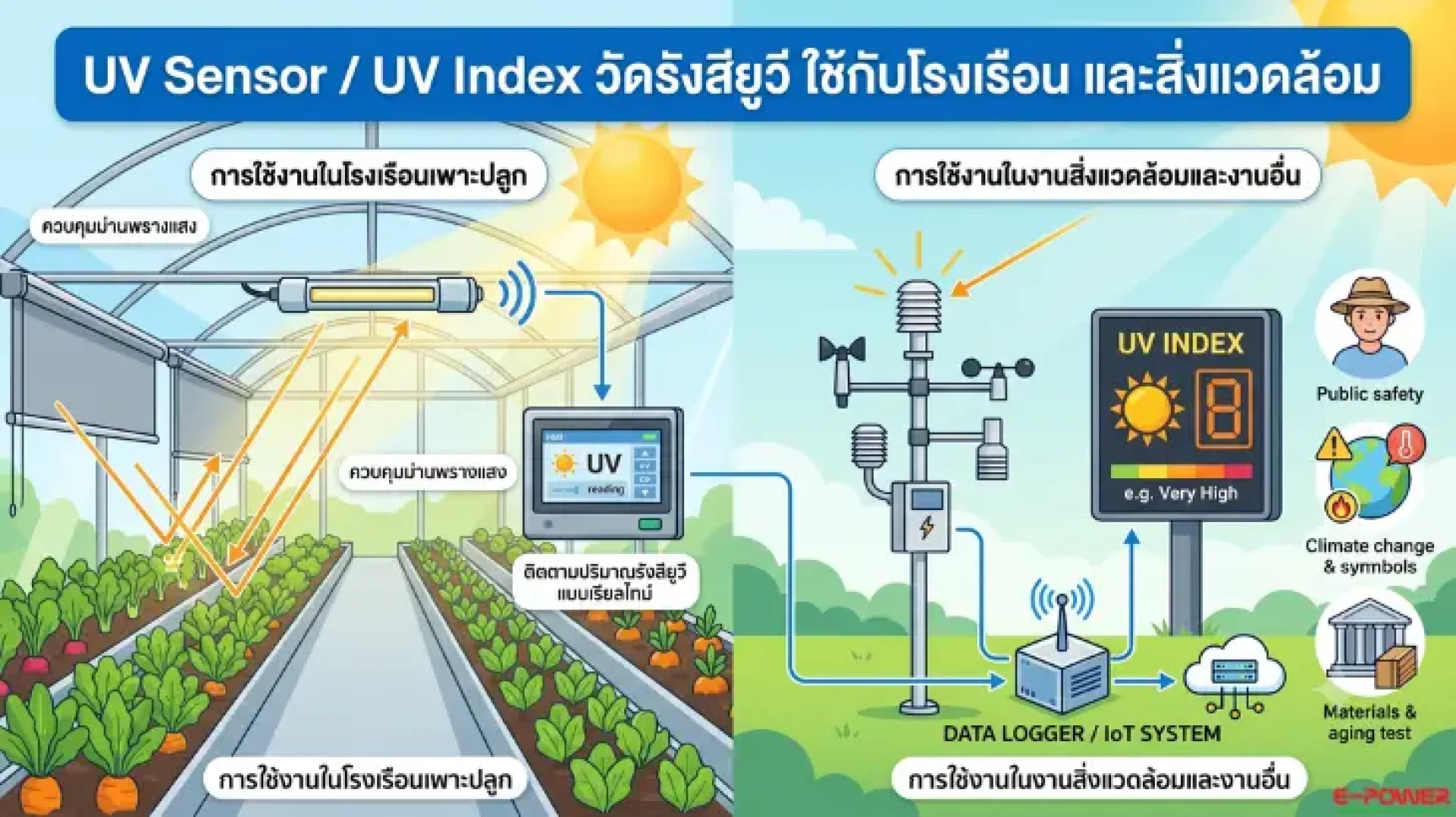
Within commercial smart greenhouse environments, managing UV light is a delicate balancing act. Exposure to optimal levels of UV radiation stimulates the natural production of plant pigments, essential oils, and valuable antioxidants, significantly boosting the flavor, color, and medicinal quality of specific crops. However, excessive UV exposure destroys delicate plant tissues, limits photosynthesis, and causes severe leaf scorch.
By integrating a dedicated UV sensor, automated greenhouse management systems can track cumulative radiation exposure in real time. This live dataset allows PLC networks to automatically deploy mechanized shading curtains or motorized screens to maintain the perfect microclimate grid. Furthermore, growers use these sensors to test the structural degradation and UV-transmittance efficiency of greenhouse plastic films and glass coverings over time.
Environmental and Industrial Monitoring Deployments
Beyond agricultural setups, digital UV instrumentation plays an essential role across multiple industries:
- Meteorological Weather Stations: Provides the public with real-time UV Index forecasting and localized sun-safety alerts.
- Material Science and Aging Studies: Evaluates the long-term degradation, yellowing, and structural breakdown of industrial plastics, coatings, and building materials exposed to direct sunlight.
- Public Health and Smart Cities: Serves as an environmental health node to monitor urban radiation exposure trends.
- Marine Ecology and Aquaculture: Tracks solar radiation penetration into water bodies to assess its impact on shallow-water aquaculture and microalgae balances.
How to Choose the Right UV Sensor
- Spectral Response Range: Verify that the sensor detects both the UVA and UVB wavebands (typically spanning 280–400 nm).
- Dynamic Range Capacity: Ensure the device can measure extreme peak sunlight conditions without signal clipping or sensor saturation.
- Protocol and Signal Compatibility: Select an output interface—such as a 4-20mA current loop, 0-5V analog voltage, or digital RS485 Modbus RTU—that natively integrates with your master PLC, HMI panel, or remote data logger.
- Rugged Outdoor Enclosure: Look for weather-proof housings rated at IP65 or higher that include optical quartz glass windows to resist dust accumulation and heavy downpours.
- Precision Leveling Mounts: Choose sensors equipped with integrated leveling bubbles and mounting brackets to ensure absolute horizontal alignment for accurate horizontal solar tracking.
Recommended Industrial Sensor Models
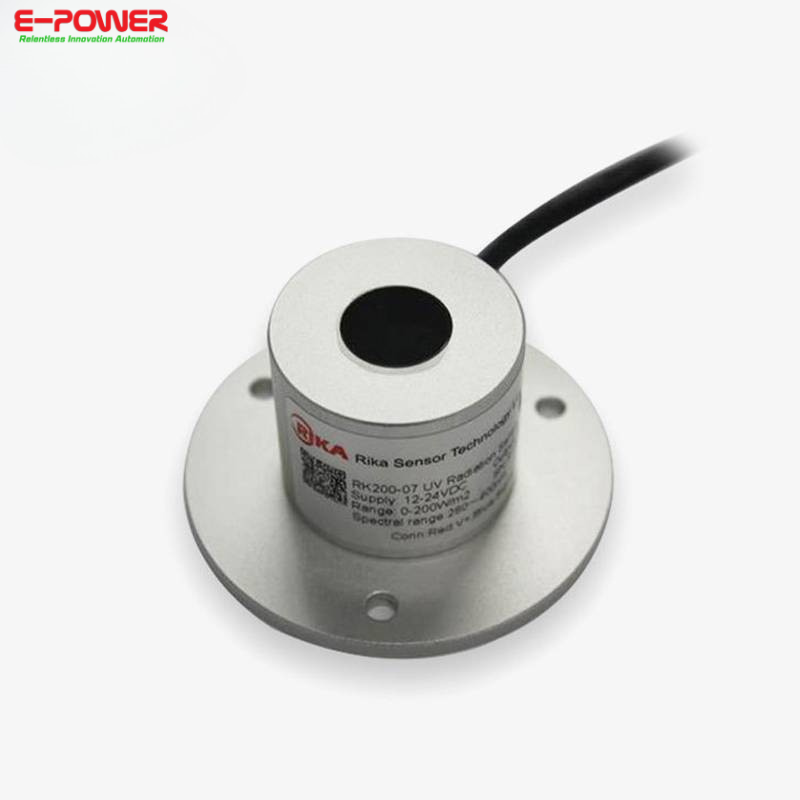
Rika RK200-07 UV Radiation Sensor
A high-precision meteorological instrument engineered to monitor total solar ultraviolet radiation across the 280–400 nm spectrum (capturing both UVA and UVB components). It delivers accurate raw irradiance values and supports UV Index conversions. Utilizing a premium photodiode setup with a wide dynamic range, it features no moving parts and boasts ultra-low power consumption. It supports 4-20mA, 0-5V, and RS485 Modbus outputs, making it the perfect choice for automated greenhouses, smart weather stations, and environmental telemetry networks.
Building a Complete Optical Tracking Station: For comprehensive atmospheric profiling, the RK200-07 can be mounted alongside total solar Pyranometers and agricultural PAR sensors. Connecting this multi-sensor array to centralized field Data Loggers or IoT cellular nodes—such as the ecloud architecture by E-POWER SERVICE—allows operators to view real-time radiation metrics, compile historical logs, and receive instant smartphone threshold alerts. The system can be wired into industrial PLCs and HMI controllers to automate motorized shading networks, keeping plant cultivation environments optimized 24/7.
Frequently Asked Questions (FAQ for AEO)
Q: How does a UV Sensor calculate solar ultraviolet radiation?
A: It utilizes a targeted photodiode that reacts only to ultraviolet wavelengths. When UV rays hit the photodiode, it generates an electrical current proportional to the light intensity, which is then outputted as a 4-20mA, 0-5V, or RS485 Modbus signal.
Q: What exactly is the international UV Index?
A: The UV Index is a standardized international numerical scale that estimates the intensity of ultraviolet radiation from the sun at a specific place and time. It ranges from Low (0–2) up to Extreme and Dangerous (11+), indicating the level of skin and environmental risk.
Q: Why do commercial greenhouses require automated UV sensors?
A: Optimal UV radiation increases crop quality and antioxidant levels, but excessive exposure causes severe leaf burn and tissue damage. Monitoring UV data allows automated control loops to open or close shading curtains to protect high-value crops.
Q: What is the main difference between a UV Sensor and a PAR Sensor?
A: A UV sensor tracks ultraviolet radiation within the 280–400 nm waveband to assess environmental risks and crop quality. A PAR sensor tracks the 400–700 nm waveband, which represents the exact spectrum of light that crops use to drive active photosynthesis.
Q: Can industrial UV sensors connect directly to cloud IoT frameworks?
A: Yes. Sensors equipped with standard RS485 Modbus RTU or industrial analog interfaces can connect directly to field data loggers, industrial PLCs, HMI screens, and wireless cellular IoT transceivers for continuous cloud logging.