What is ORP? How to Control Water Disinfection at the Right Level
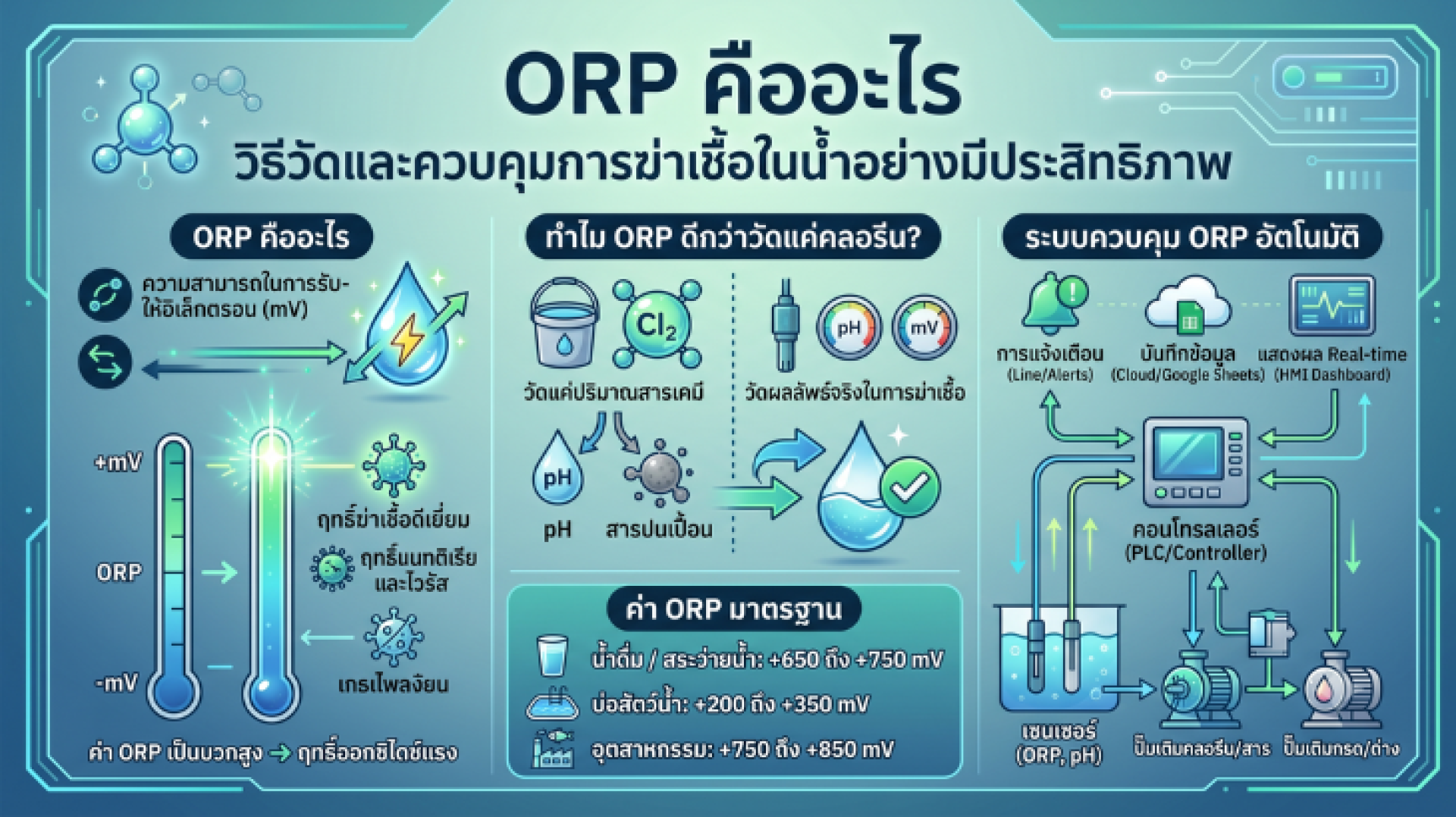
ORP (Oxidation-Reduction Potential) is a measurement of water's ability to gain or release electrons, expressed in millivolts (mV). A high positive ORP value means the water has strong oxidizing power — capable of destroying pathogens, bacteria, and viruses effectively.
Why is ORP More Reliable Than Measuring Chlorine Alone?
Many facilities rely solely on measuring free chlorine (Cl₂) levels — but the same amount of chlorine can produce very different disinfection results depending on the water's pH, temperature, and existing contaminants.
ORP solves this problem. Rather than measuring what was added, ORP measures the actual disinfection capacity of the water at that moment.
| Parameter | Measures | Limitation |
| Free Chlorine (Cl₂) | Chemical quantity | Doesn't reflect true effectiveness at high pH |
| pH | Acidity / Alkalinity | Describes water condition, not kill power |
| ORP | Actual oxidizing power | Best indicator of real disinfection performance |
ORP Target Values by Application
The correct ORP setpoint depends on how the water will be used. The table below summarizes industry-standard reference values:
| Application | Target ORP (mV) | Notes |
| Drinking Water / Municipal | +650 to +750 | WHO and EPA recommend minimum +650 mV |
| Swimming Pools | +700 to +750 | Used together with pH 7.2–7.6 |
| Wastewater Treatment | +400 to +600 | Depends on discharge standards |
| Aquaculture (Shrimp / Fish) | +200 to +350 | Values too high are harmful to aquatic life |
| Food & Beverage Industry | +750 to +850 | For process sanitation |
| Ozone Water Systems | +800 to +1000 | Very strong — requires special monitoring |
ORP and pH — Always Control Together
ORP and pH are directly related, especially when chlorine is the primary disinfectant:
- When pH rises (more alkaline) → chlorine converts to Hypochlorite (OCl⁻) → disinfection power drops → ORP decreases
- When pH drops (more acidic) → chlorine becomes Hypochlorous Acid (HOCl) → disinfection power increases → ORP rises
The correct control formula:
ORP Control + pH Control = Complete, Reliable Disinfection
Modern automated systems use both ORP Sensors and pH Sensors simultaneously to precisely control chemical dosing.
How ORP Sensors Work
ORP Sensors (also called Redox Electrodes) use a platinum or gold electrode immersed in water, measuring the electrical potential difference against a reference electrode (e.g., Ag/AgCl). The result is converted to an mV value displayed on a controller or transmitted as a 4–20 mA signal to a PLC or SCADA system.
Common Sensor Types
1. Inline Sensors (Pipe-mounted)
- Continuous 24/7 measurement without stopping the process
- Outputs: 4–20 mA / RS-485 Modbus
2. Submersible Sensors (Pond / Tank)
- For open water: wastewater ponds, aquaculture, storage tanks
- Weatherproof: IP68 rated
3. Portable ORP Meters
- For field spot-checks and sensor calibration verification
How Automated ORP Control Systems Work
Industrial ORP control systems typically consist of three layers:
1. Sensing Layer
ORP Sensor + pH Sensor installed at key monitoring points
Real-time data transmission via 4–20 mA or Modbus RTU/TCP
2. Control Layer
PLC (e.g., LicOS EC201S from E-Power) receives sensor data
Compares measured values against setpoints
Automatically controls Dosing Pumps to add chlorine or ozone as needed
3. HMI / SCADA Layer
Displays ORP, pH, and temperature in real time on HMI screens or web dashboards
Sends alerts via Line / Telegram when values go out of range
Logs historical data to Google Sheets or cloud servers
Real-World Applications of ORP Control
Aquaculture (Shrimp & Fish Farms)
ORP is a critical indicator of water ecosystem health in aquaculture ponds. An ORP below +100 mV signals low dissolved oxygen and possible accumulation of hydrogen sulfide (H₂S) — a serious threat to aquatic life. E-Power's IoT system can alert farmers instantly via mobile phone.
Swimming Pools
Automated ORP controllers maintain the target range of +700 to +750 mV, reducing chlorine consumption by 30–40% compared to manual dosing — and eliminating the eye irritation and skin reactions caused by excess chlorine.
Food & Beverage Manufacturing
ORP monitoring is used to verify Critical Control Points (CCPs) under HACCP standards, confirming that process water has sufficient disinfection capacity. Data is logged automatically for traceability and audit purposes.
Wastewater Treatment Plants
ORP guides the Nitrification/Denitrification process. Different ORP levels indicate specific stages of biological reaction, enabling precise process control without waiting for laboratory analysis.