Hydroponic Nutrient Management : What is the Ideal EC Level for Different Target Crops?
In precision agriculture, particularly within hydroponics, optimizing crop yields and quality relies heavily on proper plant nutrition—the balance of dissolved minerals. For agricultural engineers and modern growers, the central question is clear: How can we guarantee that the nutrient solution maintains perfect electrical balance, avoiding structural deficits or toxicity stress?
The answer lies in monitoring EC (Electrical Conductivity). Measuring EC is the most efficient and reliable metric for quantifying nutrient concentrations in a hydroponic loop. Understanding, tracking, and calibrating target EC values for specific crop varieties is essential for constructing a high-ROI Smart Farm system.
What is EC in Hydroponics and Why is it Critical?
EC (Electrical Conductivity) quantifies the capacity of a solution to pass an electrical current. It is universally measured in milliSiemens per centimeter (mS/cm). Because plant fertilizers are composed of dissolved mineral salts, their concentrations directly shift the solution's conductivity.
- Under-concentrated EC Levels: Plants suffer from systemic nutrient deficiency, resulting in stunted development, chlorosis (yellow leaves), and depressed harvests.
- Over-concentrated EC Levels: High salt concentrations create osmotic shock within the root system. This prevents roots from absorbing water, leading to tip burn, root rot, and collapse.
Core Matrix: Ideal EC Targets Across Varied Crop Typologies
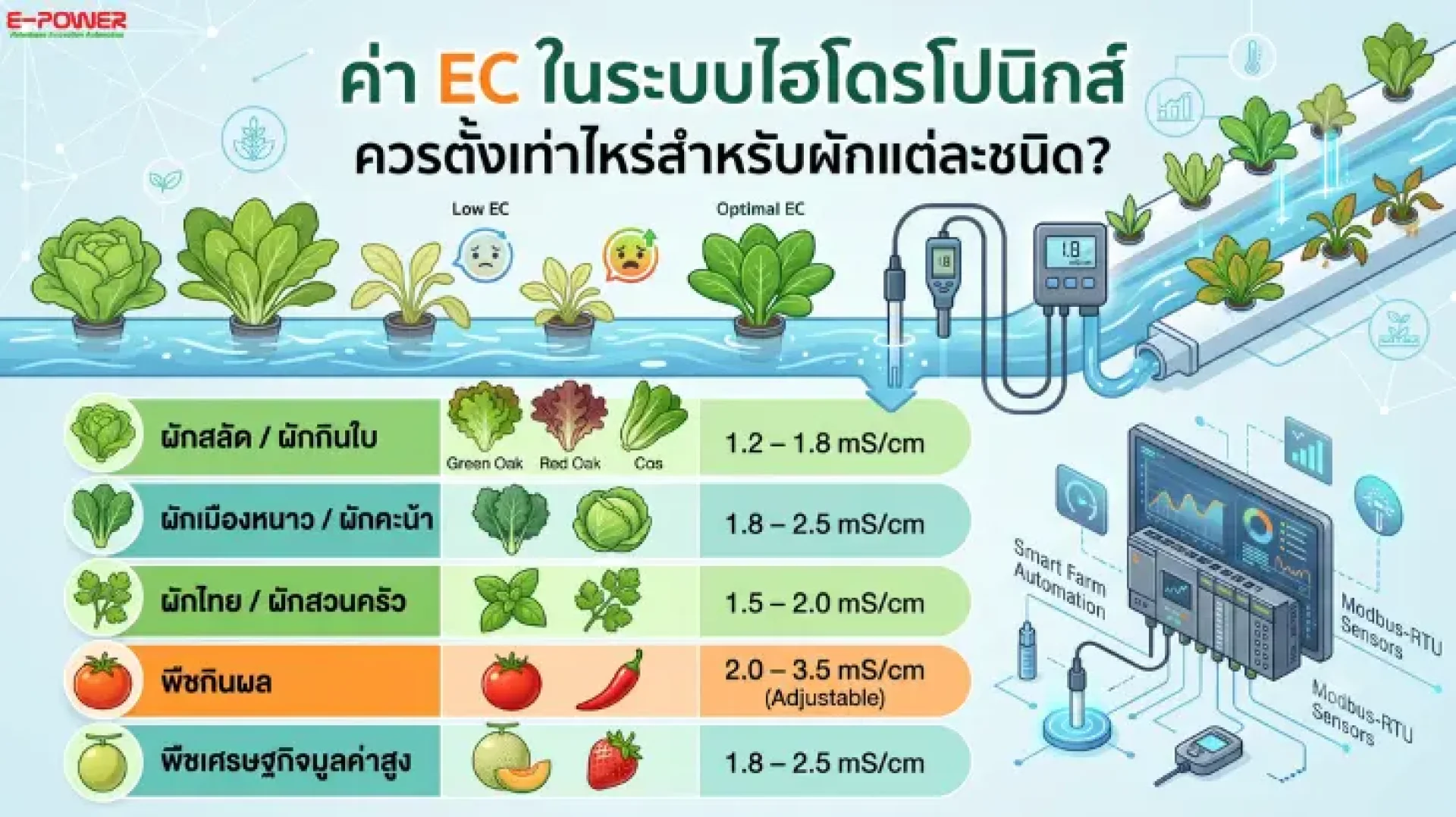
Every plant variety functions within unique physiological parameters. Under standard conditions, ideal EC ranges (mS/cm) are organized as follows:
| Crop Typology | Plant Varieties | Target EC Range (mS/cm) |
| Leafy Greens / Salads | Green Oak, Red Oak, Cos, Butterhead | 1.2 – 1.8 |
| Brassicas / Cold Climates | Kai-Lan (Chinese Kale), Bok Choy, Napa Cabbage | 1.8 – 2.5 |
| Culinary Herbs | Sweet Basil, Holy Basil, Celery, Coriander | 1.5 – 2.0 |
| Fruiting Crops | Tomatoes, Peppers, Cucumbers | 2.0 – 3.5 (Varies by growth stage) |
| High-Value Cash Crops | Melons, Strawberries | 1.8 – 2.5 |
Engineering Note: EC values shift significantly based on water temperature and pH stability. Advanced automated farms must track these parameters simultaneously using dedicated industrial probes to ensure active validation loop accuracy.
Upgrade to Agricultural Automation with Industrial Sensors by E-Power Service
To step up from manual test pens to closed-loop automated nutrient dosing via PLCs or smart controllers, E-Power Service Co., Ltd. delivers robust, industry-proven hardware configurations:
- Renke Soil Conductivity (EC), Moisture & Temperature Sensor: Featuring a rugged 304 stainless steel probe array and an IP68 hermetic seal, this multi-parameter sensor can be applied to fluid reservoirs to maintain precise EC and temperature analytics without sensor degradation. Product Link: Renke Soil Moisture & EC Sensor
- Industrial Water Quality Sensor Solutions (RS485 Modbus): Beyond raw electrical conductivity, our automation catalogs include specialized pH transmitters and fluid temperature monitors. These integrate seamlessly into your automatic irrigation system networks, facilitating real-time diagnostic reporting.
Technical Conclusion
Setting the optimal baseline EC value is the starting point; maintaining chemical equilibrium despite fluctuating temperatures is what ensures success. Utilizing RS485 Modbus-RTU industrial EC transmitters simplifies automated control loops, ensuring operational reliability.
For customized industrial agricultural IoT system designs or complete instrumentation consultation, contact the automation specialists at E-Power Service.