LoRaWAN vs NB-IoT vs 4G: Which Network Drives Remote Soil Sensors Best Without WiFi?
LoRaWAN, NB-IoT, and 4G represent the core long-range wireless networks deployed within modern smart agriculture and isolated rural farming environments. In target precision agricultural zones, pulling live telemetry from soil sensors, weather parameters, or automated water solenoids frequently hits a hard bottleneck: vast geographic fields where standard local WiFi is non-existent.
The critical engineering design challenge is: "When implementing an IoT ecosystem across a farm with zero WiFi access, which wireless communication architecture delivers the highest stability and ROI?" Today, E-Power Service (epower.co.th) breaks down the technical matrix to guide your hardware allocation.
Decoding the Top 3 Non-WiFi Wireless Technologies
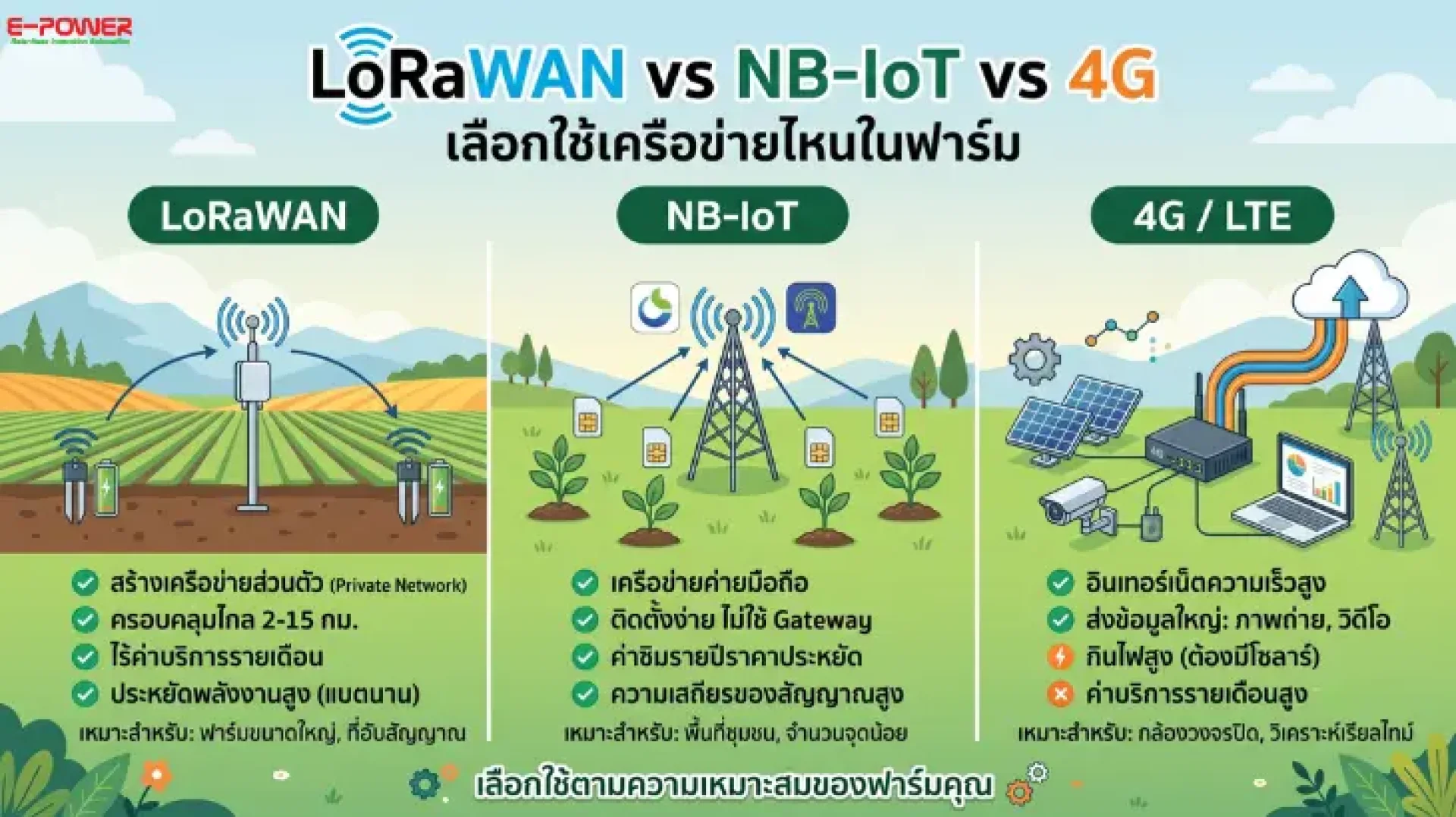
LoRaWAN (Long Range Wide Area Network)
A low-power wide-area network (LPWAN) protocol that empowers agro-industrial businesses to operate their own autonomous private network without dependence on mobile service providers.
- How it Works: A central Gateway is deployed locally on-site, serving as an access point capable of polling wireless nodes from 2 to 15 kilometers away.
- Pros: Zero recurring cellular subscription fees. It offers exceptional power efficiency (sensor batteries can last up to 5 years) and provides full communication immunity in deep valleys or absolute cellular dead zones.
- Cons: Requires upfront investment for the local gateway hardware, and is engineered strictly for low-bandwidth payloads (no image/video streaming).
NB-IoT (Narrowband Internet of Things)
A specialized cellular-based LPWAN technology run by telecom carriers optimized for smart internet-of-things utility tracking.
- How it Works: Every field sensor node is outfitted with a specialized telemetry IoT SIM card, piping data packets directly to nearby public cell towers.
- Pros: Eliminates the need to maintain or install local gateway equipment. It provides reliable signal penetration and operates at similar low-power brackets to LoRa.
- Cons: Incurs annual recurring data plan fees per SIM slot and demands continuous placement within active commercial cellular coverage map footprints.
4G / LTE
High-bandwidth, high-speed mobile network standard identical to standard consumer smartphone setups.
- How it Works: An industrial 4G/LTE cellular router is positioned on-site, broadcasting high-speed data downlinks to linked nodes or processors.
- Pros: Incredible bandwidth payload capacity. It handles continuous real-time processes seamlessly, such as live security CCTV feeds, thermal drone imagery uploads, or machine-learning plant pathogen photography.
- Cons: Severe current draw penalties (demands robust hardwired or solar energy banks) and carries much higher monthly subscription fees.
Technical Matrix: LoRaWAN vs NB-IoT vs 4G for Smart Farming
| Parameter | LoRaWAN | NB-IoT | 4G / LTE |
| Subscription Cost | None (Caps at initial hardware) | Low annual subscription fee | Higher monthly service plan |
| Cellular Dependence | Independent (Private Subnet) | Dependent on carrier signal | Dependent on carrier signal |
| Maximum Free Range | 2 - 15 km from local Gateway | Dependent on cellular tower limits | Dependent on cellular tower limits |
| Payload Capacity | Low (Numeric logs) | Low (Numeric logs) | High (Data logs, photos, video) |
| Power Efficiency | Extremely High (3-5 Year Battery) | High (2-3 Year Battery) | Low (Demands constant supply) |
The Verdict: Selecting Your Agricultural Bus
- Deploy LoRaWAN if: Your cultivation grid spans massive acres in isolated typography (mountains, remote valleys) lacking reliable carrier towers. When operating dozens of field points, private LoRa infrastructure secures the best long-term cost margin.
- Deploy NB-IoT if: The property sits comfortably inside public carrier coverage, and you favor a plug-and-play installation without the responsibility of troubleshooting local gateway components.
- Deploy 4G if: The agricultural application requires heavy telemetry arrays, real-time edge processing data, PLC cloud integration, or live surveillance feeds demanding immediate high-bandwidth pipes.
Ready to launch or optimize your automated precision agriculture platform? E-Power Service (epower.co.th) provides premium industrial environmental sensors, PLC hardware configurations, and edge telemetry consulting. Contact our application engineering specialists today to customize your wireless control layout.