What are the Differences Between Mechanical and Ultrasonic Wind Sensors?
Did you know that Ultrasonic Wind Sensors can detect wind gusts as short as 1 second in duration? The world is rapidly shifting toward modern ultrasonic sensing technology, rendering traditional mechanical wind sensors increasingly obsolete. Ultrasonic wind sensors offer high accuracy, exceptional repeatability, and virtually zero maintenance—even under extreme weather conditions.
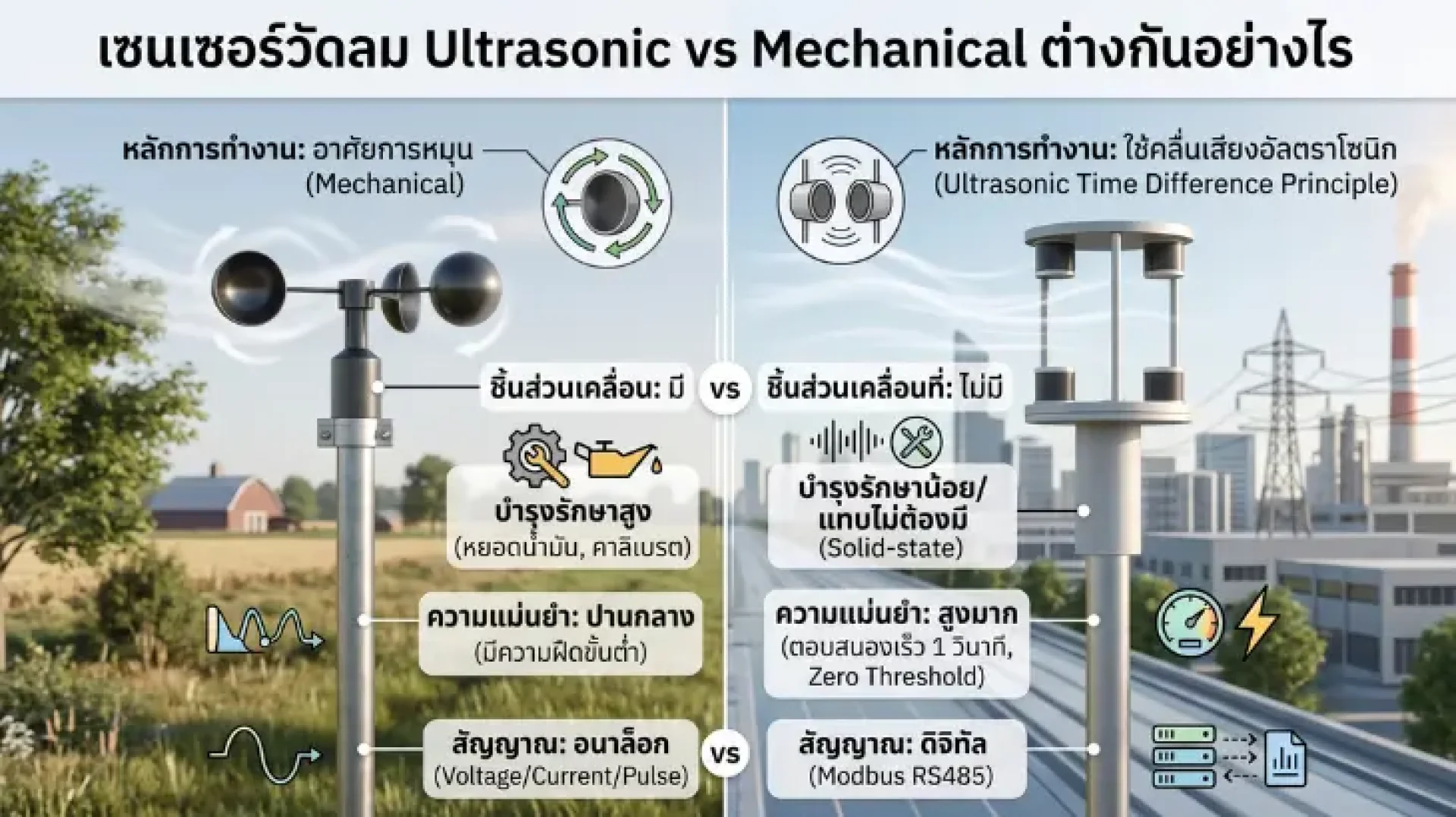
The key advantage lies in their "solid-state" design with no moving parts. Utilizing semiconductor electronics and ultrasonic transducers, these sensors send sound pulses through the air to measure wind speed and direction based on transit time differences. Moreover, they can measure ultra-low wind speeds without a minimum startup threshold ($0 text{ m/s}$).
If you are evaluating wind detection solutions for industrial plants or environmental monitoring systems, let’s explore how mechanical and ultrasonic wind sensors compare to help you make the right investment.
Technical Comparison at a Glance
| Feature | Mechanical Wind Sensor | Ultrasonic Wind Sensor |
| Operating Principle | Mechanical rotation/deflection caused by airflow | Measurement of ultrasonic wave transit time |
| Moving Parts | Yes (susceptible to mechanical wear and friction) | None (Solid-state, high durability) |
| Maintenance | High (requires frequent lubrication and recalibration) | Maintenance-free |
| Accuracy & Speed | Moderate (requires initial wind threshold to rotate) | High accuracy, fast response, measures zero-speed wind |
| Data Output | Analog (Voltage/Current) or Pulse signals | Digital Modbus RS485, Serial Data |
| Primary Applications | General non-critical uses (e.g., basic agriculture) | Industrial plants, meteorology, Smart Cities, HVAC |
Understanding Mechanical Wind Sensors
Mechanical wind sensors rely on rotating components (such as cups or propellers) to convert wind kinetic energy into electrical signals (voltage or current) for speed measurement, alongside a mechanical vane for direction.
Common Types of Mechanical Sensors
- Cup Anemometers: Features 3 or 4 rotating cups paired with a tail vane.
- Propeller / Vane Anemometers: Utilizes a small turbine/propeller that aligns with the wind direction to measure speed and angle simultaneously.
- Hot-Wire Anemometers: Measures the rate of heat dissipation from an electrically heated wire exposed to airflow.
- Pressure Plate Anemometers: Converts physical deflection from wind pressure into wind speed values.
Understanding Ultrasonic Wind Sensors
Ultrasonic wind sensors contain no moving mechanical parts, eliminating physical wear and tear. They operate on the Ultrasonic Transit Time Difference Principle: when wind blows in the same direction as the sound wave, transit time decreases; when blowing against it, transit time increases.
Key Types of Ultrasonic Sensors
- 2D Ultrasonic Wind Sensors: Measures wind speed and direction in a single horizontal plane—ideal for general weather stations.
- 3D Ultrasonic Wind Sensors: Measures wind vector components across three dimensions to analyze vertical turbulence and complex airflow.
- Compact & Solar-Powered Units: Low-power designs suitable for off-grid remote telemetry stations.
Heated Ultrasonic Sensors: Equipped with internal heating elements to prevent ice and snow buildup in freezing climates.
5 Reasons Why Ultrasonic Sensors Outperform Mechanical Types
- High Accuracy & Sensitivity: Delivers precise readings up to $pm 0.1text{ to }pm 0.5text{ m/s}$ for speed and $pm 1^circtext{ to }pm 2^circ$ for direction, with instantaneous response times.
- Long-term Durability: Eliminates bearing failure, corrosion, and physical breakage. Constructed with UV-resistant and anti-corrosive housing rated at IP65/IP67.
- Lower Total Cost of Ownership (TCO): Although the initial purchase cost is higher, it significantly reduces system downtime and eliminates recurring maintenance costs.
- Superior Data Quality: Built-in Digital Signal Processing (DSP) filters out environmental noise and signal interference.
- Seamless Automation Integration: Supports digital communication protocols like Modbus RS485 to interface directly with PLCs, SCADA systems, and IoT gateways.
Industrial Applications
- Industrial Stacks & Chimneys: Monitors wind velocity and direction for real-time pollutant dispersion modeling.
- Renewable Energy: Optimizes wind turbine blade pitch and yaw alignment in wind farms.
- Smart Agriculture & Weather Stations: Integrates with environmental monitoring instruments like the Rika RK100-02 Wind Speed Sensor.
- Transportation & Infrastructure: Installed on bridges, marine ports, and railways to ensure operational safety during high-wind events.
Industrial Sensor Solutions by E-Power Service
If you need high-precision environmental sensors built for industrial reliability, E-Power Service provides comprehensive hardware and system integration expertise:
- Weather & Environmental Sensors: Including the Rika RK100-02 Wind Speed Sensor and Rika RK520-01 Soil Sensor for Smart Farming and industrial monitoring stations.
- Liquid & Water Quality Sensors: Solutions such as the Supmea SUP-TDS210-C Conductivity Meter and OPTOD Optical Dissolved Oxygen Sensor, offering seamless Modbus RS485 connectivity to PLC Control Systems.
The engineering team at E-Power Service is ready to assist you in selecting, configuring, and integrating the optimal sensor architecture for your facility.