Water Quality Sensor EC & Salinity: Is There a Difference Between Water Salinity and Conductivity?
Water quality sensors are the heart of efficient water management, whether in aquaculture farms, smart agriculture, or industrial wastewater treatment systems. However, a common question among engineers and fishery operators is: "What is the difference between EC (Electrical Conductivity) and Salinity?" and "Why do these values significantly impact the survival of aquatic life, including freshwater fish, saltwater species, and shrimp?"
Today, E-Power Service will walk you through the key differences, operating principles of these sensors, and practical guidelines for selecting the right solution for your system.
What is a Water Quality Sensor for EC (Electrical Conductivity)?
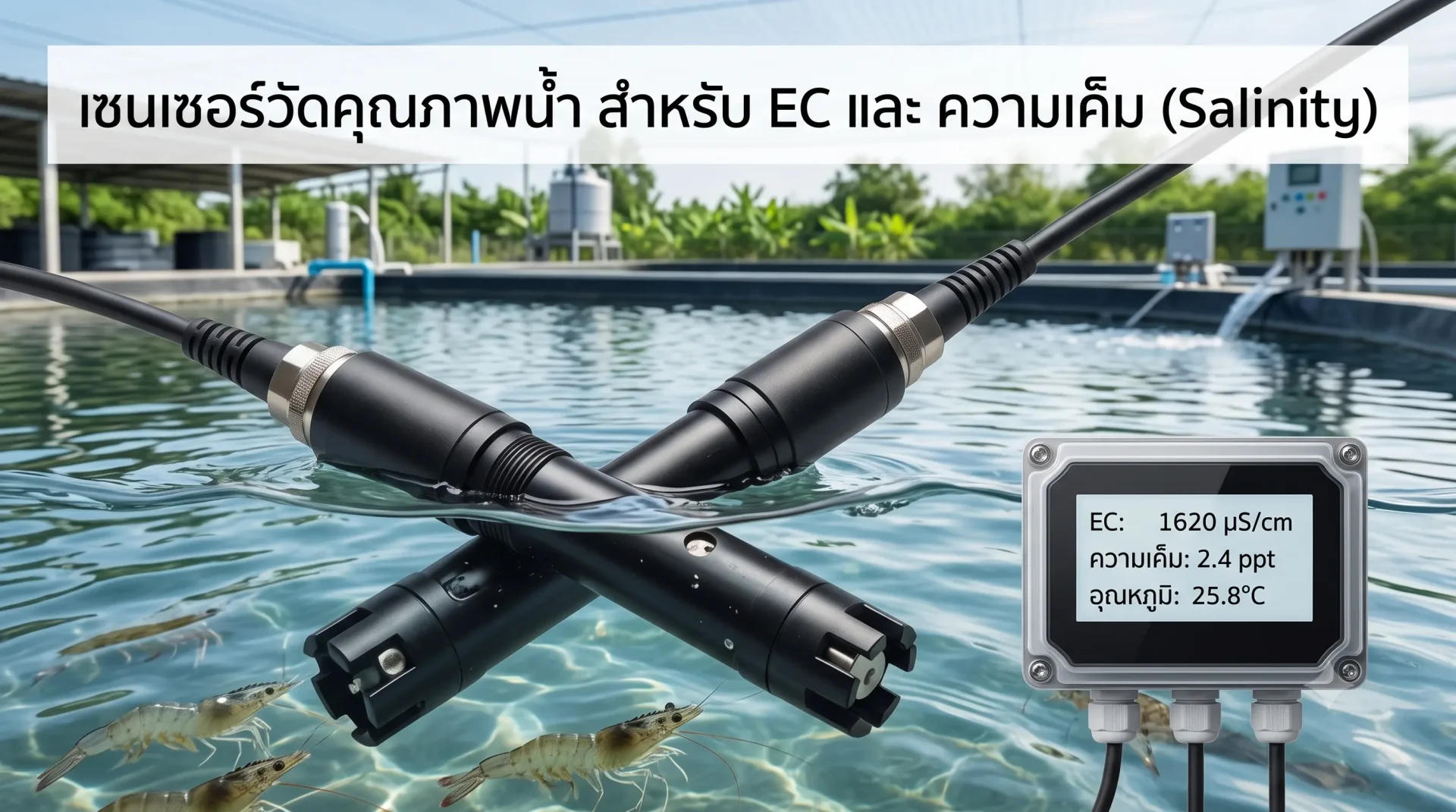
A water quality sensor for EC (Electrical Conductivity) is a device used to measure water's ability to conduct an electric current. Electricity flows through water more effectively when dissolved minerals and salts are present.
- EC Units: Commonly measured in microSiemens per centimeter (µS/cm) or milliSiemens per centimeter (mS/cm).
- Influencing Factors: The higher the concentration of dissolved minerals—such as sodium, calcium, magnesium, or nitrates—the better the electrical current flows, resulting in a higher EC reading.
- Key Characteristic: An EC reading does not identify specific minerals; rather, it measures the total concentration of all dissolved ions in the water.
What is a Water Quality Sensor for Salinity?
A water quality sensor for salinity (Salinity Sensor) is designed to measure the total concentration of dissolved salts in water, focusing primarily on sodium chloride (NaCl).
Salinity Units: Measured in Parts Per Thousand (ppt), Grams per Liter (g/L), or Practical Salinity Units (PSU).
Natural Salinity Levels:
- Pure / Freshwater: Salinity levels close to 0 – 0.5 ppt
- Brackish Water: Salinity ranges between 0.5 – 30 ppt
- Seawater: Average salinity around 35 ppt
Water Quality Sensor Comparison: EC vs. Salinity
To put it simply: "EC measures the electrical conductivity of water," while "Salinity directly calculates the concentration of salt."
| Comparison Topic | EC (Electrical Conductivity) | Salinity |
| Parameter Measured | Total dissolved mineral ions | Dissolved salt concentration (NaCl) |
| Primary Units | µS/cm or mS/cm | ppt (parts per thousand) or PSU |
| Applications | Hydroponic crops, RO/DI water systems, boiler feed water | Aquaculture farms, mangrove environments, seawater applications |
| Operating Principle | Applies an electric current to directly measure conductivity | Measures EC combined with temperature, then calculates ppt |
Most modern salinity sensors combine an EC electrode with an integrated temperature sensor, using mathematical formulas to convert real-time readings into accurate salinity values (ppt).
Why EC and Salinity Are Critical for Aquaculture and Industry
Critical for Aquaculture
All aquatic organisms rely on internal mechanisms to maintain water and mineral balance (Osmoregulation).
- Impact of Sudden Water Changes: Heavy rainfall can cause salinity levels to drop suddenly, while water evaporation can cause levels to spike. These rapid fluctuations lead to severe stress, reduced feeding, weakened immunity, or lethal shock in aquatic animals.
- Real-time Monitoring: Installing a real-time water quality sensor allows farm operators to detect changes instantly and adjust water or salinity levels before losses occur.
Critical for Industrial Systems & Smart Farming
- Industrial Operations: Controlling EC levels in cooling towers and boilers prevents scale build-up and pipe corrosion.
- Smart Farming: Regulates nutrient solution delivery in automated irrigation systems, ensuring crops receive precise fertilization without root burn or nutrient deficiency.
Recommended Water Quality Sensors from E-Power Service
For precise readings, long-term durability, and seamless integration with automated control systems, E-Power Service recommends our industrial-grade sensor solutions:
- Industrial EC / Conductivity Sensor (Modbus RS485): Features chemical and corrosion-resistant electrode materials, Automatic Temperature Compensation (ATC), and Modbus RS485 protocol for reliable long-distance communication.
- Salinity Sensor for Aquaculture: Submersible-type salinity sensor specifically designed for shrimp ponds, sea bass farming, and general fisheries. Delivers stable readings with minimal maintenance required.
- Multi-Parameter Water Quality Sensor Solution: Integrated multi-parameter system (pH, EC, Salinity, DO, Temperature) designed for direct connectivity with PLCs (CODESYS / Siemens / Mitsubishi), HMI screens, or SCADA & IoT systems for remote smartphone monitoring.
Interested in installing or need expert advice regarding water quality sensors?
The engineering team at E-Power Service is ready to assist you with equipment selection, technical specifications, and custom automation system design tailored to your operational needs.
For inquiries or further details, contact us on LINE Official Account: @epower