Edge AI
Last updated: 23 Sept 2026
7 Views
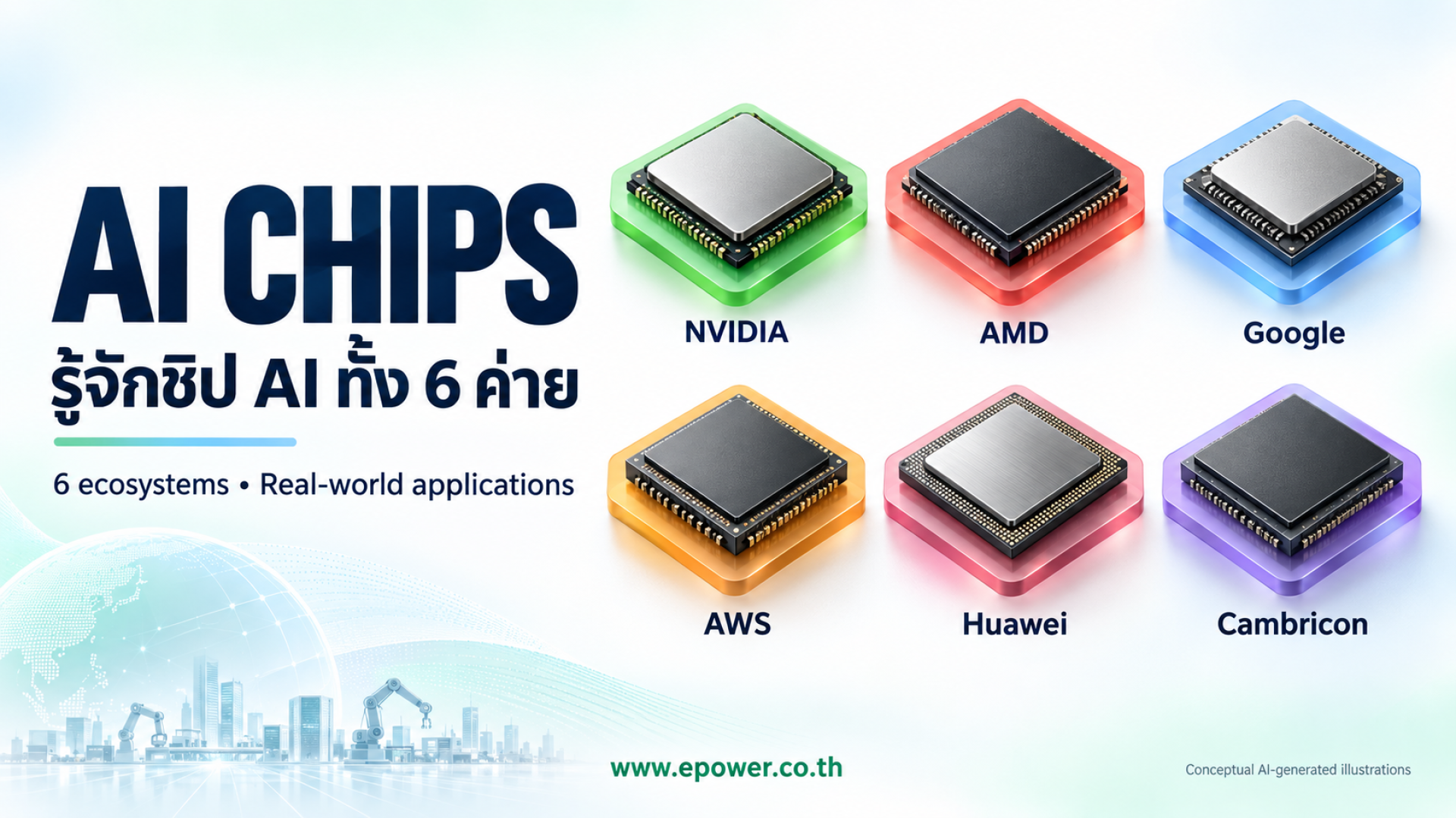
AI chips provide the computing power behind applications such as chatbots, image analysis, recommendation systems, and generative AI. Their capabilities depend on more than processing speed: memory, connectivity, software support, and system configuration all influence real-world results.
This overview introduces six AI computing ecosystems and examples of the workloads they support. It covers four specific accelerators alongside the broader Huawei Ascend and Cambricon product ecosystems.
NVIDIA B200: Large Language Models and Enterprise AI
The NVIDIA B200 uses the Blackwell architecture and supports model training, fine-tuning, and inference—the process of running a trained model to generate results.
Example applications include conversational AI, recommendation systems, and large language models. NVLink connectivity and NVIDIA’s AI software help multiple GPUs work together within larger systems.
NVIDIA specifies 1,440 GB of total GPU memory across eight GPUs in DGX B200, equivalent to 180 GB per GPU in that configuration.
AMD Instinct MI355X: AI and High-Performance Computing
The AMD Instinct MI355X is built on the CDNA 4 architecture. It provides 288 GB of HBM3E memory and up to 8 TB/s of memory bandwidth.
Its large memory capacity makes it relevant to demanding AI workloads, while its computing capabilities also support scientific and high-performance computing applications. Deployment should account for compatibility with AMD’s ROCm software ecosystem and the frameworks used by the project.
Google TPU7x Ironwood: Large-Scale AI on Google Cloud
Google TPU7x, also known as Ironwood, is a purpose-built AI accelerator available through Google Cloud infrastructure. It supports large-scale training and inference, including dense models and Mixture of Experts (MoE) models.
Google’s specification table lists 192 GiB of high-bandwidth memory per chip and up to 9,216 chips per pod. These capabilities support projects that need substantial computing resources and communication between accelerators.
AWS Trainium3: Generative AI on AWS
AWS Trainium3 is designed for AI training and inference within the AWS ecosystem. Each chip provides 144 GB of HBM3e memory and 4.9 TB/s of memory bandwidth.
It works with the AWS Neuron software stack and is relevant to organizations developing or deploying large generative AI models on AWS. Software compatibility, deployment architecture, and actual workload performance remain important considerations.
Huawei Ascend: An Integrated Enterprise AI Ecosystem
Huawei Ascend combines Atlas hardware with the CANN software platform and related development tools.
The ecosystem supports model training and inference for enterprise AI applications. Capabilities vary across the hardware portfolio, so a deployment should be evaluated using the specifications of the selected product and its supported software.
This entry describes an ecosystem rather than a single chip model.
Cambricon MLU: Cloud and Edge AI Products
Cambricon offers MLU accelerators and the NeuWare software platform. Its portfolio includes cloud AI accelerators and separate products intended for edge computing.
Applications can include cloud-based model training and inference, as well as AI processing closer to cameras, sensors, or other data sources using suitable edge products.
Cloud and edge capabilities should not be assumed to exist in every model. Product selection depends on the application and the required software support.
How to Compare AI Chips
A useful comparison starts with the workload:
• Training: How large is the model, and how much memory does training require?
• Inference: What response time and throughput does the application need?
• Software: Are the framework, libraries, and model operations supported?
• Connectivity: Does the workload need multiple accelerators working together?
• Deployment: Will the system run in the cloud, in a data center, or at the edge?
• Cost: What are the hardware, energy, cooling, software, and operating costs?
Peak performance figures alone do not establish which accelerator will work best. Numerical precision, sparsity, and test conditions can differ between specifications.
What This Means for Industrial Automation and IoT
Training a large model and deploying AI on a production line are different tasks.
A project may use cloud or data-center infrastructure to train a model, then deploy it on an edge device for visual inspection, equipment monitoring, or sensor-data analysis. The edge device should be selected according to response-time requirements, power consumption, industrial interfaces, and environmental conditions.
Understanding the complete workflow helps connect AI computing capabilities with practical industrial needs.
Explore more insights into Automation, IoT, and AI at www.epower.co.th.
Official Sources
• NVIDIA DGX B200
• AMD Instinct MI355X
• Google Cloud TPU7x
• AWS Trainium
• Huawei Ascend
• Cambricon
Editorial note: This article is an independent educational overview, not a performance ranking. The accompanying chip illustrations are AI-generated conceptual images, not product photographs. Brand and product names identify the technologies discussed and do not imply manufacturer endorsement or a partnership with EPOWER. Specifications and suitability depend on the selected product and system configuration. GB and GiB are different units.
Information reviewed: September 2026.
This overview introduces six AI computing ecosystems and examples of the workloads they support. It covers four specific accelerators alongside the broader Huawei Ascend and Cambricon product ecosystems.
NVIDIA B200: Large Language Models and Enterprise AI
The NVIDIA B200 uses the Blackwell architecture and supports model training, fine-tuning, and inference—the process of running a trained model to generate results.
Example applications include conversational AI, recommendation systems, and large language models. NVLink connectivity and NVIDIA’s AI software help multiple GPUs work together within larger systems.
NVIDIA specifies 1,440 GB of total GPU memory across eight GPUs in DGX B200, equivalent to 180 GB per GPU in that configuration.
AMD Instinct MI355X: AI and High-Performance Computing
The AMD Instinct MI355X is built on the CDNA 4 architecture. It provides 288 GB of HBM3E memory and up to 8 TB/s of memory bandwidth.
Its large memory capacity makes it relevant to demanding AI workloads, while its computing capabilities also support scientific and high-performance computing applications. Deployment should account for compatibility with AMD’s ROCm software ecosystem and the frameworks used by the project.
Google TPU7x Ironwood: Large-Scale AI on Google Cloud
Google TPU7x, also known as Ironwood, is a purpose-built AI accelerator available through Google Cloud infrastructure. It supports large-scale training and inference, including dense models and Mixture of Experts (MoE) models.
Google’s specification table lists 192 GiB of high-bandwidth memory per chip and up to 9,216 chips per pod. These capabilities support projects that need substantial computing resources and communication between accelerators.
AWS Trainium3: Generative AI on AWS
AWS Trainium3 is designed for AI training and inference within the AWS ecosystem. Each chip provides 144 GB of HBM3e memory and 4.9 TB/s of memory bandwidth.
It works with the AWS Neuron software stack and is relevant to organizations developing or deploying large generative AI models on AWS. Software compatibility, deployment architecture, and actual workload performance remain important considerations.
Huawei Ascend: An Integrated Enterprise AI Ecosystem
Huawei Ascend combines Atlas hardware with the CANN software platform and related development tools.
The ecosystem supports model training and inference for enterprise AI applications. Capabilities vary across the hardware portfolio, so a deployment should be evaluated using the specifications of the selected product and its supported software.
This entry describes an ecosystem rather than a single chip model.
Cambricon MLU: Cloud and Edge AI Products
Cambricon offers MLU accelerators and the NeuWare software platform. Its portfolio includes cloud AI accelerators and separate products intended for edge computing.
Applications can include cloud-based model training and inference, as well as AI processing closer to cameras, sensors, or other data sources using suitable edge products.
Cloud and edge capabilities should not be assumed to exist in every model. Product selection depends on the application and the required software support.
How to Compare AI Chips
A useful comparison starts with the workload:
• Training: How large is the model, and how much memory does training require?
• Inference: What response time and throughput does the application need?
• Software: Are the framework, libraries, and model operations supported?
• Connectivity: Does the workload need multiple accelerators working together?
• Deployment: Will the system run in the cloud, in a data center, or at the edge?
• Cost: What are the hardware, energy, cooling, software, and operating costs?
Peak performance figures alone do not establish which accelerator will work best. Numerical precision, sparsity, and test conditions can differ between specifications.
What This Means for Industrial Automation and IoT
Training a large model and deploying AI on a production line are different tasks.
A project may use cloud or data-center infrastructure to train a model, then deploy it on an edge device for visual inspection, equipment monitoring, or sensor-data analysis. The edge device should be selected according to response-time requirements, power consumption, industrial interfaces, and environmental conditions.
Understanding the complete workflow helps connect AI computing capabilities with practical industrial needs.
Explore more insights into Automation, IoT, and AI at www.epower.co.th.
Official Sources
• NVIDIA DGX B200
• AMD Instinct MI355X
• Google Cloud TPU7x
• AWS Trainium
• Huawei Ascend
• Cambricon
Editorial note: This article is an independent educational overview, not a performance ranking. The accompanying chip illustrations are AI-generated conceptual images, not product photographs. Brand and product names identify the technologies discussed and do not imply manufacturer endorsement or a partnership with EPOWER. Specifications and suitability depend on the selected product and system configuration. GB and GiB are different units.
Information reviewed: September 2026.

Related Content