Smart Poultry Farm : Automatic Temperature Control for EVAP Broiler Houses
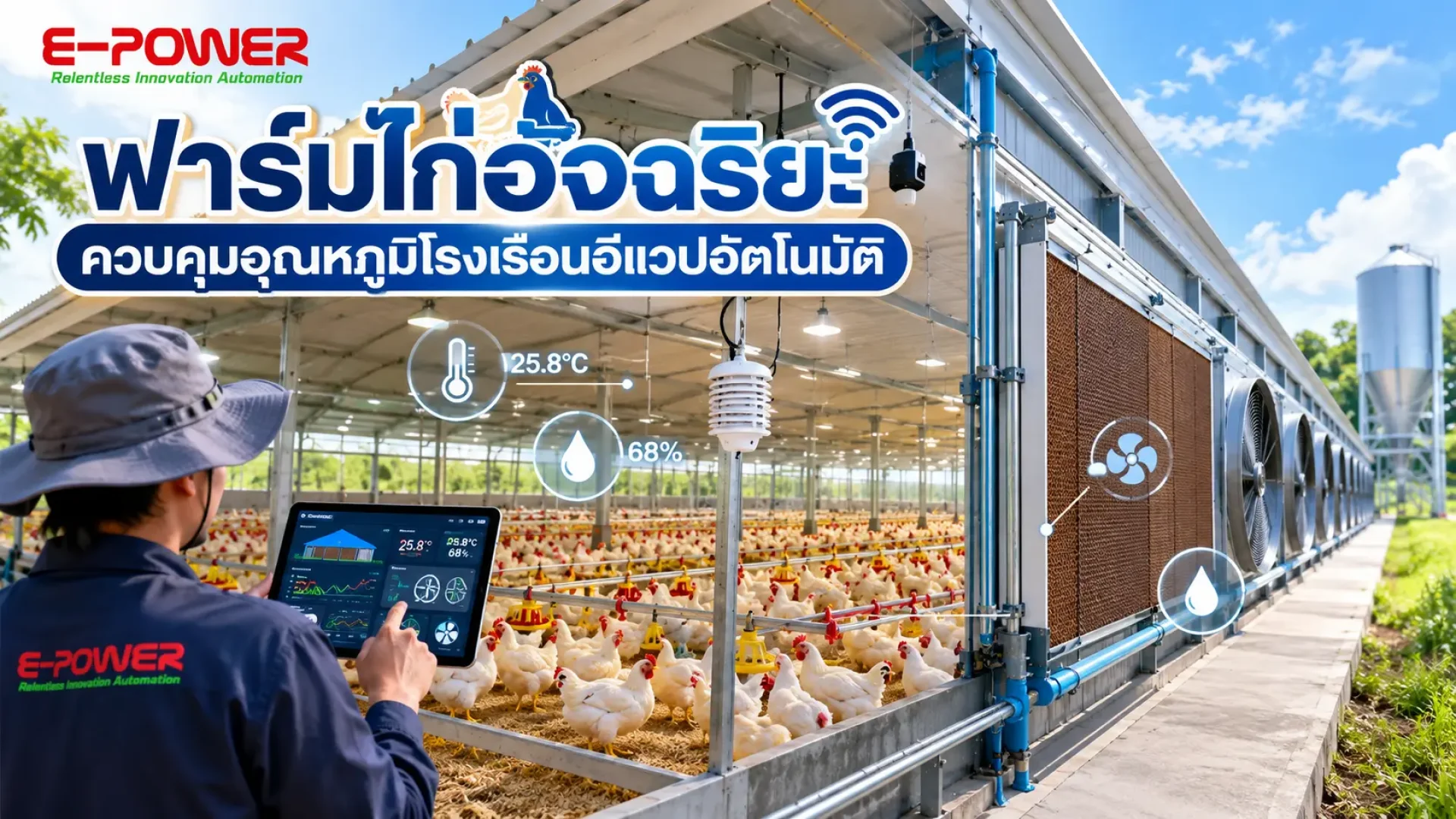
SMART POULTRY FARM
Smart Poultry Farm: Automatic Temperature Control for EVAP Broiler Houses
The right temperature for broilers at every age, how closed evaporative-cooled houses work, and how sensors and automation cut mortality, improve feed conversion, and save energy.
Quick answer: what temperature should a broiler house be?
It depends on bird age. Day-old chicks need about 3233°C, then the target drops by 23°C per week until birds aged 5 weeks and older sit at about 2224°C, with relative humidity around 6070%. In evaporative-cooled (EVAP) houses, air speed also matters, because moving air makes birds feel cooler than the actual temperature. A smart poultry farm uses multiple sensors with an automatic controller to adjust fans, cooling pads, and brooding to match bird age around the clock.
01
Recommended broiler house temperature by age
| Bird age | Target temperature | Notes |
| Days 03 | 3233°C | Chicks can't yet regulate body temperature and need brooding heat |
| Days 47 | 3032°C | Avoid direct drafts on chicks |
| Week 2 | 2830°C | Reduce brooding and increase minimum ventilation |
| Week 3 | 2628°C | Birds generate more of their own heat |
| Week 4 | 2426°C | Full tunnel ventilation and cooling pads on hot days |
| Week 5 onwards | 2224°C | Large birds overheat most easily and face the highest heat-stress risk |
These are general guidelines. Use them together with your breed's management guide and watch actual bird behavior: chicks huddling means they are cold, while panting and spread wings mean they are hot.
What birds feel is not what the thermometer reads
In tunnel-ventilated EVAP houses, air moving over the birds can make them feel several degrees cooler than the actual temperature. Mature birds benefit from strong airflow, but chicks get chilled and sick if exposed to too much. High humidity also makes it harder for birds to shed heat by panting. A good automatic system therefore doesn't look at temperature alone; it considers bird age, humidity, and ventilation level together.
02
How does an EVAP house work?
An evaporative cooling (EVAP) house is a closed poultry house with large exhaust fans at one end that pull outside air through wet cooling pads at the other. Evaporating water draws heat out of the air, so the air entering the house is cooler.
Airflow in an EVAP house
Over a flock cycle, the house runs in three main modes:
| Mode | Operation |
| Minimum ventilation | During brooding or cool nights, a few fans run on a timer to remove ammonia and moisture without overcooling the house |
| Transitional | As temperature rises, fans are added in stages to remove excess heat without using the cooling pads yet |
| Tunnel with cooling pads | On hot days or with large birds, all fans run and the pad pump turns on, combining airflow and evaporation to remove heat |
A caution about cooling pads
Cooling pads work best in dry air. If humidity in the house is already high, running the pad pump adds more moisture, making it harder for birds to cool themselves and wetting the litter so ammonia rises. Automatic control should therefore use humidity as a condition for running the pad pump.
03
Sensors every smart poultry farm needs
| Sensor | Purpose |
| Temperature-humidity (multiple points) | Mounted at the front, middle, and rear at bird height, since the fan end is usually warmer than the pad end; the average drives control |
| Ammonia (NH) | Increases ventilation when ammonia rises, especially during brooding and at night |
| CO | Shows whether minimum ventilation is sufficient while the house is closed for brooding |
| Static pressure | Measures negative pressure inside the house to adjust air inlets for even distribution and detect open doors or leaks |
| Water meter | An unusual drop in drinking water is one of the first signs that birds are getting sick or the water system has a problem |
| Power failure detection and energy meter | Alerts instantly on outages or brownouts and tracks the energy use of fans and pumps |
The most serious risk: a power failure in a closed house
When fans stop in a densely stocked closed house, temperature climbs rapidly and large birds can die in great numbers within a short time. A smart poultry farm needs a battery-backed power failure alarm, automatic generator start, and ideally an emergency curtain release to let air in.
04
What can automation do?
| Function | Benefit |
| Age-based temperature curve | The setpoint drops automatically each day following the growing curve, with no manual changes |
| Staged fan control | Adds or removes fans with heat load, with hysteresis to prevent rapid cycling |
| Inverter fan speed control | Slows fans when full airflow isn't needed, saving more energy than on/off control alone |
| Humidity-aware pad pump control | Runs pads only when it's hot and humidity isn't already too high, reducing damp air and wet litter |
| Mobile alerts | Abnormal temperature, high ammonia, falling water intake, or power failure trigger instant LINE or Telegram alerts |
| Flock-by-flock records | Compare climate data with body weight, feed conversion, and mortality to improve the next flock |
05
E-POWER smart poultry farm system
- RS485 Modbus-RTU sensors for temperature, humidity, ammonia, CO, and static pressure at multiple points, plus water and energy meters
- FlowPLC / IoT Edge Gateway runs control logic in Node-RED to drive fans, inverters, pad pumps, and brooders, and keeps working even if the internet drops
- HMI screen at the house entrance so farm staff can view readings and adjust the age-based temperature curve easily
- Dashboard and alerts: monitor every house on mobile and receive LINE or Telegram alerts 24 hours a day
- Retrofit-ready: add to existing EVAP houses without rebuilding
Frequently asked questions
What temperature should a broiler house be?
About 3233°C for day-old chicks, dropping 23°C per week until birds aged 5 weeks and older are at about 2224°C, with humidity around 6070%.
What is a smart poultry farm?
A farm that uses sensors and automatic control to manage the house environment, such as temperature, humidity, and ammonia, with data logging and mobile alerts.
What is an EVAP house?
A closed house that uses exhaust fans to pull air through wet cooling pads, where evaporating water lowers air temperature before it enters the house.
Why install temperature sensors at several points?
Cool air from the pads warms as it travels to the fan end, so the rear of the house is usually hotter. A single sensor doesn't represent the whole house.
Can automation be added to an existing house?
Yes. Sensors and controllers can be added to existing fans, pad pumps, and brooders without building a new house.
Ready to turn your poultry house into a smart farm?
E-POWER engineers can survey your houses, design sensor and automatic control systems, and install alerts for your farm.
Talk to us on LINE @epower info@epower.co.thTel. +66 81-559-5145 · YouTube: Epower Service · TikTok: epowerservice_
Related articles: Ammonia in poultry and swine houses · 10 smart farm sensors every modern farm needs · Smart farming vs conventional farming · Surge protection for RS485 · What is a CT and why use it with a power meter