What Is a Pressure Transmitter? How to Choose the Range and Thread Type
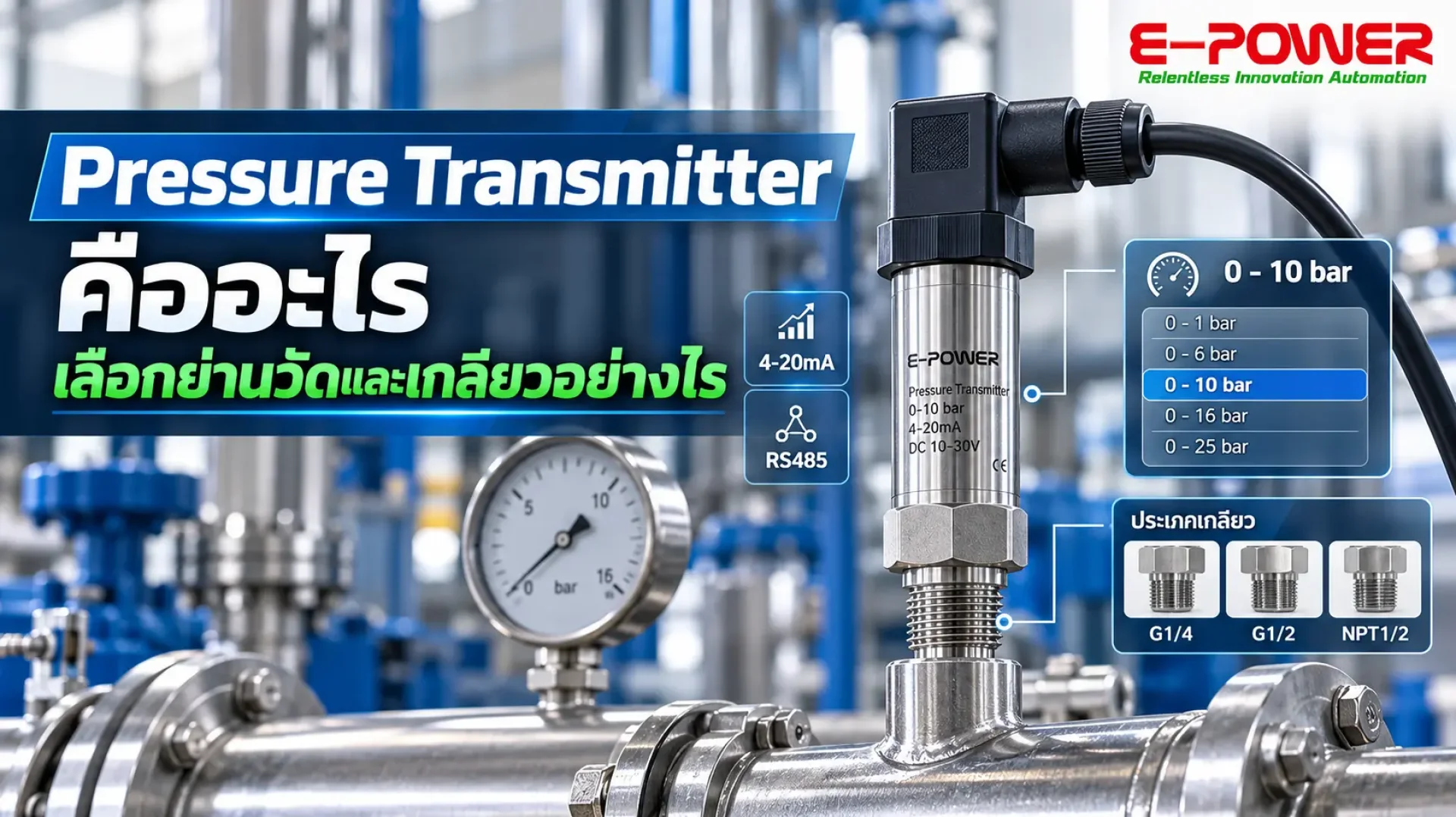
PRESSURE MEASUREMENT GUIDE
What Is a Pressure Transmitter? How to Choose the Range and Thread Type
A practical guide to choosing the right pressure sensor: pressure types, selecting an accurate range, common thread standards, and on-site installation.
Quick answer
A pressure transmitter is a device that measures the pressure of a liquid or gas and converts it into a standard signal, such as 420mA or RS485 Modbus-RTU, for a PLC or monitoring system to use for control and display.
To choose an accurate range, keep normal operating pressure at about 5075% of full scale. The range must exceed the highest pressure the system can reach, but shouldn't be wider than necessary, since error is a percentage of full scale. The thread must match the existing mounting point, such as G1/4, G1/2, NPT1/2, or M20×1.5.
01
How does a pressure transmitter work?
Inside a pressure transmitter is a thin diaphragm that flexes under pressure. A sensing element, such as a piezoresistive silicon sensor or a capacitive ceramic cell, measures that deflection, and electronics convert it into a standard electrical signal. Unlike a dial pressure gauge that can only be read by eye, a pressure transmitter feeds automation systems, so it can control pumps, trigger alarms, and log data.
Common pressure units
| Unit | Compared with 1 bar |
| kPa | 1 bar = 100 kPa |
| MPa | 1 MPa = 10 bar |
| psi | 1 bar 14.5 psi |
| kgf/cm² | 1 bar 1.02 kgf/cm² (roughly interchangeable in general work) |
02
Pressure types to know before you choose
| Type | Measured relative to | Typical use |
| Gauge pressure | Atmospheric pressure (reads 0 when open to air) | Water lines, pumps, compressed air, hydraulics; the most common |
| Absolute pressure | Perfect vacuum | Vacuum systems and work that must not vary with weather |
| Differential pressure | The difference between two points | Filter clogging, flow measurement, closed-tank level |
| Compound / vacuum | Both negative and positive pressure | Pump suction lines and systems with both suction and discharge |
03
How to choose a pressure range for accurate measurement
Range is the specification most often chosen wrong. Many people oversize it "to be safe", which makes readings coarser. Follow four principles:
- Keep normal pressure at about 5075% of full scale. For a system running at 46 bar, choose 010 bar
- The range must exceed the highest pressure that can actually occur, including pump start-up and fast valve closure
- Check the overpressure rating, typically 1.52 times full scale; systems with water hammer need a high overpressure rating
- Don't oversize the range, because error is a percentage of full scale
Example: why an oversized range loses accuracy
| Range | ±0.5% FS accuracy | Possible error |
| 010 bar | 0.5% × 10 bar | ±0.05 bar |
| 0100 bar | 0.5% × 100 bar | ±0.5 bar |
At a 5 bar operating point, a 0100 bar sensor could be off by 10% of the reading, far too much for pump control.
04
Common thread types and how to avoid leaks
Threads fall into two main groups: parallel threads, sealed with a washer, and tapered threads, sealed by wedging the threads together with tape or sealant. Never mix the two groups, or the joint won't tighten properly and will leak.
| Thread | Type | Sealing and notes |
| G1/4, G1/2 | Parallel (BSPP) | Sealed with a face washer; common on European and Asian instruments |
| NPT1/4, NPT1/2 | Tapered (US) | Sealed by thread interference with tape; found on US machinery and petrochemical plants |
| PT / R (BSPT) | Tapered (British/Japanese) | Common in plumbing and Japanese machinery; similar size to NPT but a different thread angle, so not interchangeable |
| M20×1.5 | Metric | Found on some pressure gauges and hydraulic systems; sealed with a washer |
| Tri-Clamp | Clamp fitting | Food, beverage, and pharma; easy to remove for hygienic cleaning |
Field tip
Before ordering, remove the existing gauge or sensor and check its thread, or look it up in the machine maker's specifications. If unsure, use a purpose-made thread adapter.
05
Other factors to check before buying
| Factor | Recommendation |
| Process medium | Water, oil, and air work with a 316L stainless diaphragm. Corrosive liquids need special materials or ceramic; viscous or dirty media need a flush diaphragm |
| Medium temperature | Steam or hot liquids need a cooling siphon or a high-temperature model |
| Accuracy | ±0.5% FS is enough for general work; choose ±0.25% FS or better for fine control |
| Output signal | 2-wire 420mA resists noise and runs long distances; RS485 Modbus-RTU puts many sensors on one cable; 010V suits short runs |
| Electrical connection | Fixed cable, DIN (Hirschmann) connector, or M12, chosen by the IP rating the site requires |
06
Installing a pressure transmitter for stable readings
- Fit an isolation valve before the sensor so it can be replaced without shutting down the system
- On liquid lines, tap the side of the pipe, not the top where air collects or the bottom where sediment settles. On gas lines, tap the top to avoid condensate
- Use a snubber on pulsating systems such as piston pumps to protect the diaphragm and steady the reading
- Keep away from turbulent flow, such as immediately after elbows or valves, to measure true line pressure
- Use shielded cable and proper grounding, especially near inverters or outdoors
07
Pressure transmitter applications
Constant-pressure pump systems
Feeds pressure to an inverter that adjusts pump speed, holding pressure steady and saving energy
Compressed air and hydraulics
Detects abnormally low or high pressure to prevent machine faults
Farm irrigation and fertigation
Keeps line pressure steady so drip emitters deliver evenly across every plot
Liquid level measurement
Uses hydrostatic pressure to measure water level in tanks and boreholes
RECOMMENDED PRODUCTS
Related sensors from E-POWER
Supmea SUP-P260 Submersible Level Transmitter
Submersible pressure sensor for water level in tanks and ponds, with SS316L diaphragm, ±0.5% FS accuracy, IP68 protection, and RS485 or 420mA output options
View product detailsSupmea Electromagnetic Flowmeter LDG-A100
Electromagnetic flowmeter with ±0.5% accuracy, used alongside a pressure transmitter in pump systems to track both pressure and actual water use
View product detailsE-POWER
Build automatic pressure control
E-POWER's FlowPLC and IoT Edge Gateway read pressure transmitters over both 420mA and RS485 Modbus-RTU, drive inverters with PID to hold constant pressure, cut pumps on abnormal high or low pressure, log historical trends, and send LINE or Telegram alerts. Ideal for water pump systems, compressed air, and farm irrigation.
Frequently asked questions
What is a pressure transmitter?
A device that measures liquid or gas pressure and converts it to a standard signal such as 420mA or RS485 for a PLC or monitoring system.
How do I choose a pressure range for accuracy?
Keep normal pressure at about 5075% of full scale, make sure the range exceeds the highest possible pressure, and avoid oversizing, since error is based on full scale.
What is the difference between a pressure transmitter and a pressure gauge?
A gauge shows pressure on a dial for people to read, while a transmitter sends an electrical signal to automation systems for control, alarms, and data logging.
Can G1/4 and NPT1/4 threads be swapped?
No. G1/4 is a parallel thread sealed with a washer, while NPT1/4 is tapered and sealed by thread interference. Use a thread adapter if needed.
Can a pressure transmitter measure water level?
Yes, using hydrostatic pressure: mount it at the tank bottom or use a submersible type. About 9.81 kPa equals 1 metre of water depth.
Not sure which range or thread to choose?
Send us your operating pressure, process medium, and existing thread type. E-POWER engineers will recommend a suitable model and design automatic pressure control for you.
Talk to us on LINE @epower info@epower.co.thTel. +66 81-559-5145 · YouTube: Epower Service · TikTok: epowerservice_