Hospital Wastewater Treatment Monitoring: pH, DO, TDS, NTU
Hospital Wastewater Treatment: What to Monitor in Real Time, 24 Hours a Day
Hospital wastewater carries chemicals, pharmaceuticals, disinfectants and pathogens, so a monthly water test is not enough. This article explains which parameters to measure, how to measure them online, and a real system already in operation.
Quick answer: what must hospital wastewater be tested for before discharge?
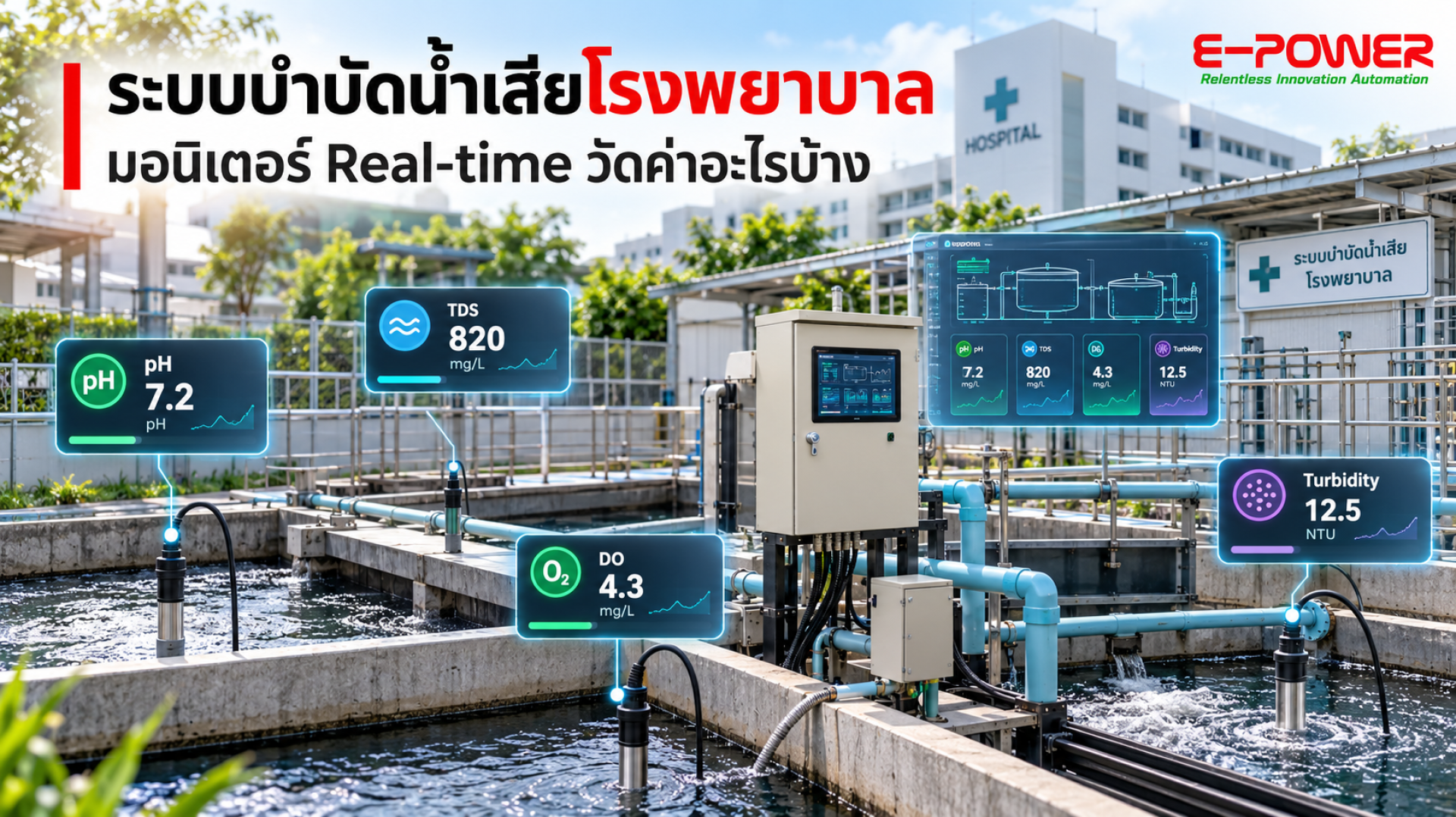
A hospital wastewater treatment system should continuously measure four key parameters: pH (acidity/alkalinity), TDS (total dissolved solids), DO (dissolved oxygen) and turbidity, plus chlorine or ORP at the disinfection tank. BOD, COD and coliform bacteria still require samples sent to a laboratory at the intervals required by law.
Why hospital wastewater needs 24-hour monitoring
Hospital wastewater comes from many sources at once: wards, operating rooms, laboratories, laundry and kitchens, so its quality changes throughout the day. If a large amount of chemicals or disinfectant is poured down the drain, the microorganisms in the treatment tank can die and the system can stop working within hours.
Occasional sampling finds problems too late. A real-time water quality monitoring system tells staff the moment a value starts to drift, so they can act before non-compliant water is discharged. Hospitals in Thailand must also record the operation of their treatment systems under Pollution Control Department requirements, and automatic data logging greatly reduces that paperwork.
4 key parameters for hospital wastewater treatment
All four can be measured with permanently installed water quality sensors that send data over RS485 Modbus or 4-20 mA directly to a PLC and IoT system.
| Parameter | What it tells you | Where to install |
|---|---|---|
| pH | Acidity or alkalinity; must stay in the range where microbes work and within effluent limits | Equalization tank and final holding tank |
| TDS | Total dissolved substances; flags chemical and mineral contamination | Equalization tank and final holding tank |
| DO | Dissolved oxygen; shows whether microbes have enough oxygen to break down organic matter | Aeration tank |
| Turbidity | Cloudiness of the water; shows settling performance and clarity before discharge | Clarifier and final holding tank |
pH: acidity and alkalinity
pH is the first value to measure, because microbes in biological treatment work best near neutral. If the water turns strongly acidic or alkaline from cleaning agents or laboratory chemicals, treatment efficiency drops immediately. Under Thailand's building effluent standard, discharged water must have a pH between 5 and 9.
TDS: total dissolved solids
TDS measures everything dissolved in the water, including minerals, chemicals and some organic compounds. A sudden spike in TDS signals that chemicals have entered the drain, helping staff trace the source quickly.
DO: dissolved oxygen
In the aeration tank, microbes need oxygen to digest waste. If DO is too low, treatment is incomplete and odors develop. If it is too high, the aerators are running more than needed and wasting electricity. Activated sludge systems typically hold DO around 2 mg/L, so continuous DO measurement improves both water quality and energy efficiency.
Turbidity
Turbidity, measured in NTU, reflects suspended particles in the water. If water leaving the clarifier is still cloudy, sludge is escaping with it, which usually pushes the effluent's suspended solids (SS) and BOD over the limit as well.
Other parameters worth adding
Beyond the four key parameters, hospitals should consider measuring ORP or residual chlorine at the disinfection tank to confirm the water is adequately disinfected before discharge. Water temperature and flow rate help analyze system load more accurately. BOD, COD, SS and coliform bacteria still need laboratory samples on the required schedule, and online data gives early warning of whether the next test is likely to pass.
How an IoT water quality monitoring system works
A real-time wastewater monitoring system has four parts working in sequence.
Installed in tanks or pipelines, continuously measuring pH, TDS, DO and turbidity and sending data over RS485 Modbus RTU.
Collects values from every sensor, displays them at the panel and controls equipment such as aerators or chemical dosing pumps.
Sends data to the cloud so operators can view it on a computer or phone from anywhere, with data logging for reports.
When any value leaves its set range, the system alerts immediately, with a warning light at the panel and a message to the person in charge.
Case study: wastewater monitoring at Bamrasnaradura Infectious Diseases Institute
E-Power Service Co., Ltd. installed a wastewater water quality monitoring system at Bamrasnaradura Infectious Diseases Institute, measuring in real time 24 hours a day and connected through the Haiwell IoT platform. The delivered system includes:
- pH, TDS, DO and turbidity sensors installed in the treatment tanks
- An IoT control panel with an HMI display at the tank
- An online dashboard to check values anytime, anywhere
- Historical data logging for analysis and reporting
- Automatic alerts when values fall outside standard limits
Benefits of real-time hospital wastewater monitoring
Lower risk of non-compliant discharge, because problems are visible the moment values change, without waiting for lab results. Less work for staff, who no longer walk to the tanks to record readings every day. Historical data ready to use for regulatory reports and hospital accreditation. Lower electricity costs when DO readings control the aerators so they run only as needed.
How to choose water quality sensors for treatment tanks
Wastewater contains sludge, grease and biofilm, so sensors should be designed specifically for wastewater. Choose sensors with a digital RS485 Modbus output for easy connection to a PLC and IoT system, an IP68 rating for submerged installation, and simple maintenance. For DO, choose an optical (fluorescence) sensor that needs no electrolyte or membrane replacement, ideal for continuous use in aeration tanks.
Recommended sensors for wastewater treatment
Dissolved Oxygen (DO) Sensor
Continuously measures DO in aeration tanks. RS485 Modbus RTU output connects directly to a PLC or IoT system, ideal for energy-saving aerator control.
View product detailsTurbidity Sensor
Measures turbidity in NTU at the clarifier and final holding tank. RS485 Modbus RTU output warns of sludge carryover before effluent exceeds limits.
View product detailsFrequently asked questions (FAQ)
What must hospital wastewater be tested for before discharge?
Continuously measure pH, TDS, DO and turbidity, plus chlorine or ORP at the disinfection tank. BOD, COD, SS and coliform bacteria must be sampled and sent to a laboratory on the required schedule.
What pH must effluent have?
Under Thailand's building effluent standard, pH must be between 5 and 9. Always check the latest regulation that applies to your building type and size.
Can BOD and COD be measured online?
Online sensors can estimate COD, but results for legal reporting must still come from a laboratory. Online systems are mainly for surveillance and early warning.
Can I check water quality remotely on my phone?
Yes. The control panel sends data to an IoT platform, where operators can see live values, historical charts and alerts on their phone 24 hours a day.
Can it be added to an existing treatment system?
Yes. Sensors can be submerged in tanks or mounted on pipelines, and the panel can be installed alongside the existing motor control panel without a long shutdown.
Need wastewater monitoring for your hospital or plant?
E-Power handles everything from selecting water quality sensors and designing PLC/HMI control panels to on-site installation, dashboards and alerts.
Talk to our engineers on LINE