Radar Water Velocity Sensors: Calculating Flow in Rivers and Canals
HYDROLOGY MONITORING
Radar Water Velocity Sensors: Calculating Flow in Rivers and Canals
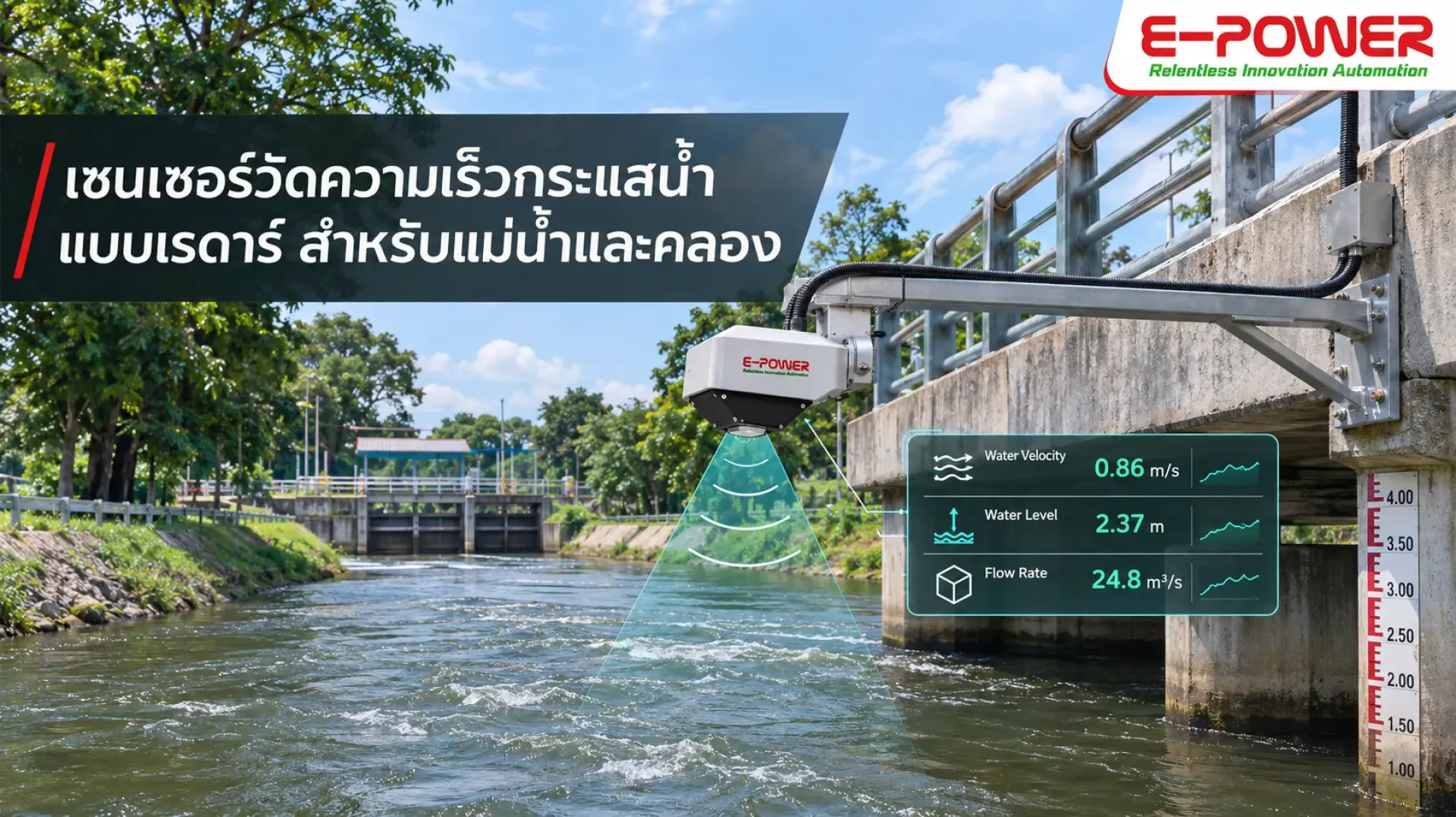
Measure from a bridge or riverbank pole without entering the water. With nothing submerged for debris or sediment to damage, the system keeps working even during floods.
The radar water velocity sensor is increasingly popular in irrigation, water allocation, and flood warning because it solves the problem of traditional methods that require lowering instruments into the water, which is dangerous and impossible during strong flows. This article explains how it works, how to calculate discharge, and how to install a water velocity sensor for reliable data.
Quick answer: can canal flow be measured without entering the water?
Yes. A radar water velocity sensor mounted on a bridge or overhanging arm beams microwaves at the water surface and measures speed from the frequency shift of the reflected signal (Doppler). Combined with a radar level sensor and the channel cross-section, it calculates discharge (Q) = mean velocity x cross-sectional area in real time, 24 hours a day, with nothing touching the water.
01
How does a radar water velocity sensor work?
The sensor is mounted at the tilt angle specified by the manufacturer and sends microwaves onto the small ripples moving with the current. The reflected waves return with a frequency shift proportional to surface speed, following the Doppler principle, so the sensor calculates surface velocity instantly.
Non-contact
No propellers or submerged probes to be damaged by debris, water hyacinth, or sediment
Safe
Staff don't need boats or wading gauges during strong flows
Continuous
Logs data every minute, capturing flood changes as they happen
Low maintenance
No moving parts and no probes to clean of sediment
02
How is discharge calculated from water velocity?
Q = k x Vsurface x A
Q = discharge (m³/s) · k = velocity coefficient · V = surface velocity (m/s) · A = wetted cross-sectional area (m²)
| Value needed | Source |
| Surface velocity | Radar water velocity sensor |
| Coefficient k | Surface water moves faster than water near the bed, so it must be converted to mean velocity. Typical values are around 0.8-0.9 depending on channel shape, and should be calibrated by field surveys |
| Water level | Radar level sensor installed at the same point |
| Cross-sectional area | Calculated from water level and a surveyed channel cross-section |
Worked example
A rectangular canal 6 m wide with 1.5 m water depth has a 9 m² cross-section. The sensor measures 0.8 m/s surface velocity. With k = 0.85, Q = 0.85 x 0.8 x 9 = 6.12 m³/s, or roughly 22,000 m³ per hour.
03
Comparing water velocity measurement methods
| Method | Advantages | Limitations |
| Radar surface velocity | Non-contact, easy to install, continuous, flood-proof | Measures surface only, needs a k factor and surface ripples |
| Propeller current meter | Low cost, measures at multiple depths | Needs an operator, not continuous, dangerous in strong flow |
| Submerged ultrasonic Doppler | Measures within the water column, better for slow flow | Submerged probe at risk of sediment burial and debris, frequent maintenance |
| ADCP | High accuracy, full cross-section velocity profile | Expensive; usually used for surveys or calibration |
A common approach is to install a radar water velocity sensor for continuous monitoring and use an ADCP or current meter survey occasionally to calibrate k for that channel.
04
Installing a water velocity sensor for accurate results
- Choose a straight, uniform reach away from bends, gates, weirs, or bridge piers that cause turbulence
- Mount over mid-channel, where flow is fastest, or use several sensors on very wide rivers
- Set the angle and direction as specified: align the sensor with the flow direction and match the tilt angle to the configured value
- Keep the beam clear of railings, branches, or cables
- Install a level sensor at the same point and resurvey the cross-section periodically, as sedimentation changes the area
Limitations to know
Radar relies on surface ripples. On very calm, mirror-smooth water, readings may become unstable. Strong wind blowing with or against the current can also bias surface velocity. For tidal channels where flow reverses, choose a model that detects flow direction.
05
Applications for water velocity sensors
| Application | Benefit |
| Irrigation canals | Know how much water each area receives for fair allocation |
| Flood warning | Track upstream flood flows and warn downstream areas early |
| Urban drainage | Assess drainage canal capacity and control pumping stations |
| Reservoirs and dams | Measure inflow to plan releases |
| Industrial effluent channels | Measure discharge in open channels without touching wastewater |
RECOMMENDED PRODUCT
Companion sensor from E-POWER
PRODUCT_NAME
PRODUCT_DESC
06
Real-time flow monitoring stations from E-POWER
- Radar water velocity and level sensors on a bridge or bank pole, connected over RS485 Modbus-RTU
- FlowPLC / IoT Edge Gateway calculates cross-sectional area, discharge, and daily totalized volume on site
- Solar power and 4G or LoRaWAN for remote locations
- Dashboards and LINE or Telegram alerts when discharge or water level exceeds warning thresholds
Frequently asked questions about water velocity sensors
Can canal flow be measured without entering the water?
Yes. Use a radar water velocity sensor with a water level sensor mounted above the surface, then calculate discharge from velocity and cross-sectional area.
How does a radar water velocity sensor work?
It sends microwaves to the water surface and measures the frequency shift of the reflection using the Doppler principle to calculate surface velocity.
Why multiply by a coefficient k?
Surface water flows faster than the cross-section average. The k factor converts surface velocity to mean velocity and should be calibrated by field survey.
Does radar velocity measurement work during floods?
Very well, since nothing is submerged for debris or logs to damage, and flood flows have clear surface ripples.
Can it be installed where there is no grid power?
Yes, using solar panels and batteries with an IoT gateway that transmits over 4G or LoRaWAN.
Need non-contact flow measurement for a river or canal?
E-POWER engineers can design flow monitoring stations, from sensor selection and siting to solar power, dashboards, and mobile alerts.
Talk to us on LINE @epower info@epower.co.thTel. +66 81-559-5145 · YouTube: Epower Service · TikTok: epowerservice_