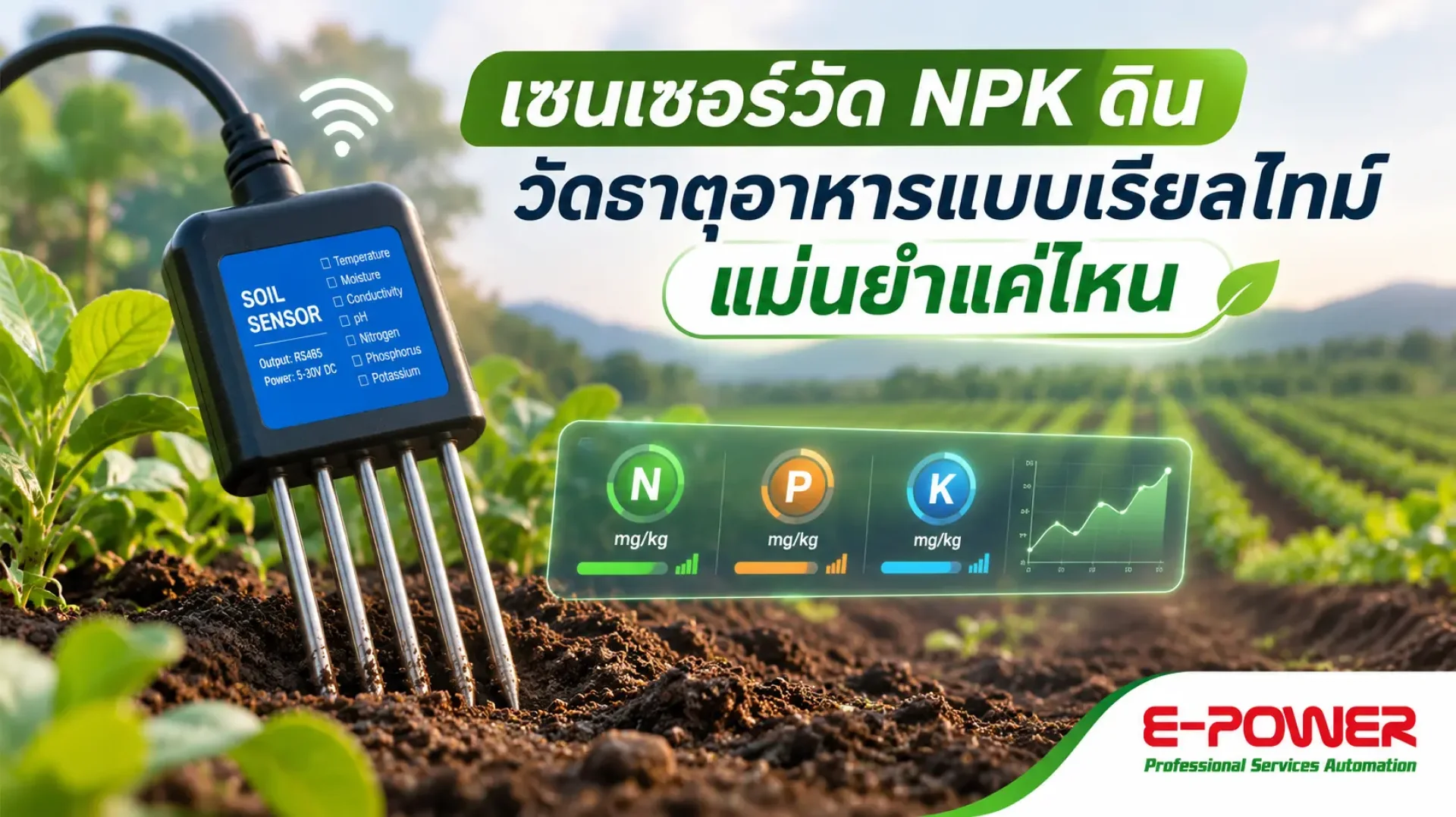
Soil NPK Sensors: How Accurate Is Real-Time Nutrient Measurement?
SMART FARM SOIL GUIDE
Soil NPK Sensors: How Accurate Is Real-Time Nutrient Measurement?
Knowing nitrogen, phosphorus, and potassium levels in your soil around the clock sounds appealing, but how reliable are the readings, and how should you use them? This article gives a straight answer.
The soil NPK sensor has drawn strong interest from growers and smart farms because it promises instant nutrient readings without waiting weeks for lab results. Before investing, it is worth understanding how these sensors work and where their limits lie, so you can use the data correctly and avoid poor fertilizer decisions.
Quick answer: can an NPK sensor replace a soil lab test?
Not entirely. Most soil NPK sensors on the market measure soil electrical conductivity and estimate N, P, and K with a formula. They are well suited to tracking trends, such as nutrients rising after fertilizing or dropping after heavy rain, but are not accurate enough to replace laboratory soil analysis. The most effective approach is to lab-test the soil as a baseline and calibrate the sensor, then use the sensor to watch changes between tests.
01
How does a soil NPK sensor work?
The most common soil NPK sensor has three metal probes inserted into the root zone and outputs data over RS485 Modbus-RTU. Many models combine several readings in one unit, such as soil moisture, temperature, EC, and pH.
| Principle | Characteristics |
| EC-based estimation | The most common type. Measures conductivity, which relates to dissolved salts and nutrients in soil water, then converts it to N, P, and K with the maker's formula. Affordable and easy to install |
| Ion-selective electrodes (ISE) | Measures specific ions such as nitrate or potassium. More accurate, but costly, needs frequent calibration, and electrodes have a limited life |
| Spectroscopy | Analyzes soil samples with light, usually as a handheld or lab instrument, and requires calibration against local soils |
Know this before buying
An accuracy figure such as ±2% FS in a datasheet usually describes the measuring circuit against the maker's own formula. It does not mean the N, P, and K readings match lab results to that level, because readings also depend on soil type, moisture, and the fertilizers in the field.
02
How accurate are soil NPK sensors, and what skews the readings?
Soil moisture
Dry soil conducts less, so NPK reads lower; wet soil reads higher, even with the same nutrients
Salts and salinity
Saline soil or high-salt irrigation water makes readings read high
Soil type
Clay, loam, and sandy soils conduct differently, so one formula can't fit every soil
Soil contact
Air gaps or gravel around the probes make readings unstable
For these reasons, soil NPK sensor readings are best used to see changes at the same spot over time, rather than comparing absolute numbers directly against fertilizer recommendation tables.
03
Can an NPK sensor replace a soil lab test?
| Topic | Soil NPK sensor | Laboratory soil test |
| Speed | Real time, every minute | Days to weeks |
| Accuracy | Estimated; good for trends | Standard methods; accurate and citable |
| Data provided | Estimated N, P, K plus moisture, temperature, EC, and pH depending on model | Available N, P, K, organic matter, pH, secondary and micronutrients |
| Frequency | Continuous all season | Usually 1-2 times a year |
| Best for | Tracking fertilizer response and leaching | Planning fertilizer programs and soil improvement |
In short, the two methods complement each other rather than replace one another. The lab tells you how much nutrient the soil really holds, while a soil NPK sensor shows how nutrients change between lab tests. In Thailand, soil samples can be tested by Land Development Department offices or private laboratories.
04
Getting the most from a soil NPK sensor
- Lab-test the soil as a baseline, sampling at the same spot as the sensor to know the field's true values
- Calibrate against lab results: compare sensor and lab values several times and derive a field-specific correction factor; accuracy improves greatly
- Read at similar moisture levels, using the same sensor's moisture value to choose reading times, or compare only post-irrigation readings
- Install at root depth and firm the soil around the probes with no air gaps
- Use several points across soil zones; soil within one field can vary widely, so one point can't represent it all
- Watch trends, not single numbers, using historical charts to see changes after fertilizing, rain, or irrigation
Real farm use cases
- Fertigation: check whether soil nutrients rise as applied and avoid double-dosing
- After heavy rain: detect nutrient leaching and plan top-ups in time
- Orchards such as durian: compare soil conditions between strong and weak tree zones
- Trial plots and research: record soil changes throughout the crop cycle
05
Real-time soil monitoring from E-POWER
- RS485 Modbus-RTU soil sensors measuring moisture, temperature, EC, pH, and NPK at multiple points
- FlowPLC / IoT Edge Gateway logs data locally, applies lab-based correction factors, and transmits over 4G or LoRaWAN
- Integration with automatic irrigation and fertigation, using moisture and nutrient trends to guide watering and feeding
- Dashboards and LINE or Telegram alerts: view history for every point and get notified of abnormal changes
Frequently asked questions about soil NPK sensors
Can an NPK sensor replace a soil lab test?
Not entirely. Sensors suit real-time trend tracking, while fertilizer planning and soil improvement should still rely on laboratory analysis.
How accurate are soil NPK sensors?
EC-based models give estimates whose accuracy depends on soil type, moisture, and salinity. Calibrating against lab results for the field improves accuracy significantly.
Why do NPK readings change with soil moisture?
Most sensors rely on electrical conductivity, which rises when soil is wetter, so compare readings taken at similar moisture levels.
How deep should a soil NPK sensor be installed?
At the main root depth of the crop, which varies by species, with soil firmly packed around the probes.
How often should soil be lab-tested when using sensors?
At least once or twice a year, or before each crop cycle, to provide a reference and recalibrate the sensors.
Want to track soil nutrients in real time?
E-POWER engineers can help you choose soil sensors, plan installation points, calibrate against lab results, and connect automatic irrigation and fertigation.
Talk to us on LINE @epower info@epower.co.thTel. +66 81-559-5145 · YouTube: Epower Service · TikTok: epowerservice_
Related articles: 10 smart farm sensors every modern farm needs · Soil water potential vs soil moisture · Automatic fertigation system · EC and salinity water quality sensors · Smart farm data logging