


EPS-TBQ-2C Pyranometer Solar Radiation Sensor
คำอธิบายสินค้าแบบย่อ
The EPS-TBQ-2C pyranometer solar radiation sensor is an integrated Class 1 radiometer designed to measure total solar radiation in the 0.3–3.2 μm wavelength band. It employs a fast-response wire-wound thermopile as its core sensing element, with the sensing surface coated in 3M matte black paint. This configuration precisely converts the thermoelectric potential generated by solar radiation into electrical signals. Its dual-layer quartz glass dome structure effectively suppresses air convection interference. The inner and outer dome design minimizes self-radiation effects, ensuring stable and high-precision radiation measurements. This solar radiation is highly suitable for applications including meteorological monitoring, environmental observation, and photovoltaic assessment.
Introduction
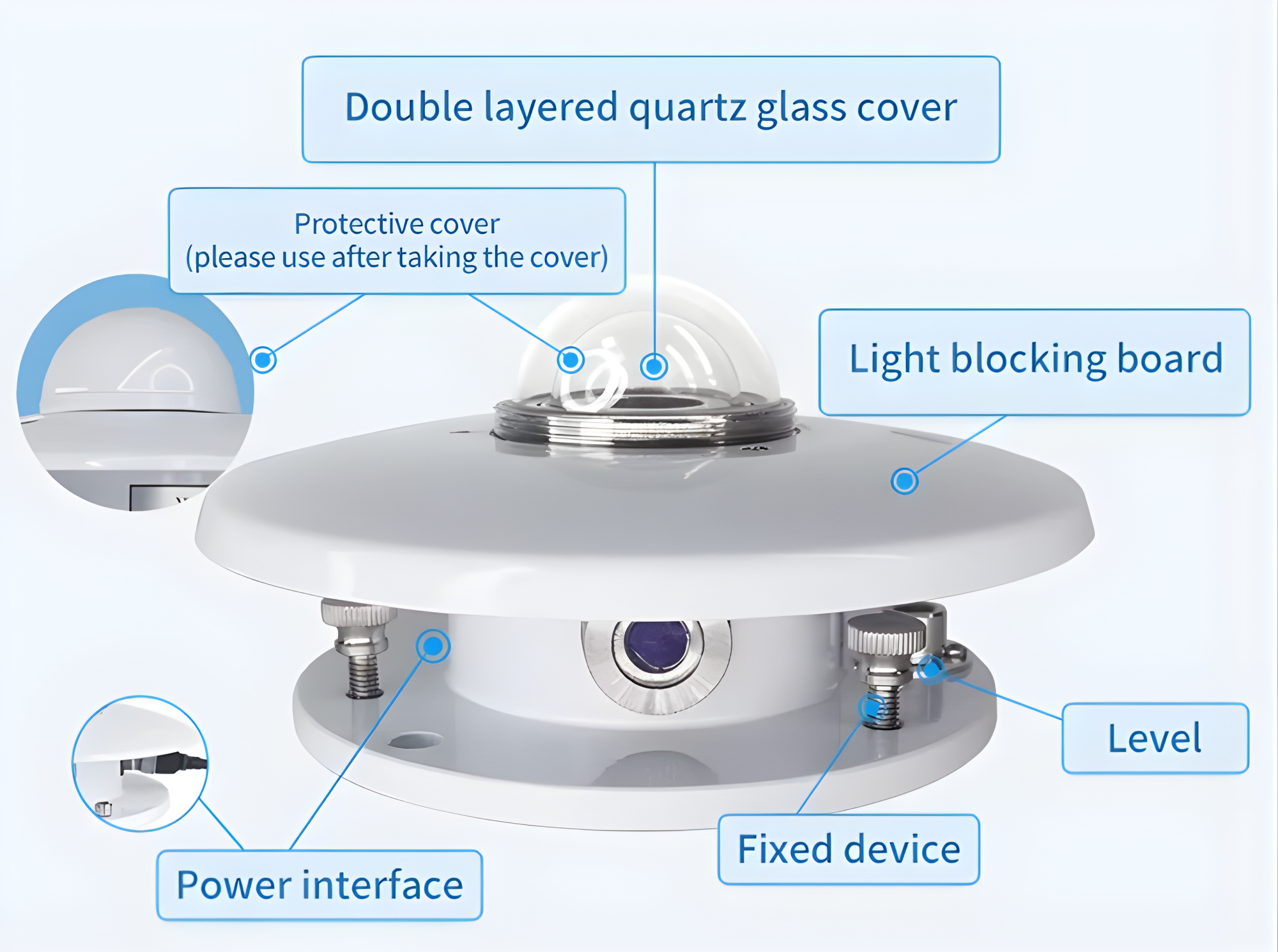
The EPS-TBQ-2C Total Radiation Pyranometer is primarily used as a Class 1 instrument for measuring total solar radiation within the wavelength range of 0.3–3.2 micrometers. This pyranometer consists of a double-layer quartz glass cover, sensing elements, a sunshield, and a desiccant chamber within the housing. The following sections will illustrate its key structural components, providing a clearer understanding of the product’s internal construction and fundamental performance characteristics.
Product Parameters
| Parameter | Specification |
|---|---|
| Sensitivity | 7-14mv/kw*-2 |
| Response time | <35s(99% response) |
| Annual stability | +2% |
| Cosine response | +7%(solar elevation10") |
| Position | +5%(solar elevation10°) |
Structure of pyranometer solar radiation sensor
- Double-layer quartz glass cover: The outer cover minimizes temperature fluctuations caused by air convection, while the inner cover blocks infrared radiation emitted by the outer cover itself.
- Sensing Element: Utilizes a wire-wound, electroplated, fast-response thermopile. The sensing surface is coated with 3M matte black paint. When exposed to sunlight, the temperature rises, creating a thermoelectric potential difference with the cold junction on the opposite side. This potential difference is directly proportional to the intensity of solar radiation.
- Light shield: Used for periodic calibration and zero-point testing, it blocks incident radiation to ensure measurement accuracy.
- Desiccant in the housing: Maintains a dry internal environment, prevents fogging on the inner surface of the glass cover, and enhances long-term optical transmittance.


 MakeWebEasy