How Many Types of Dissolved Oxygen (DO) Sensors Are There?
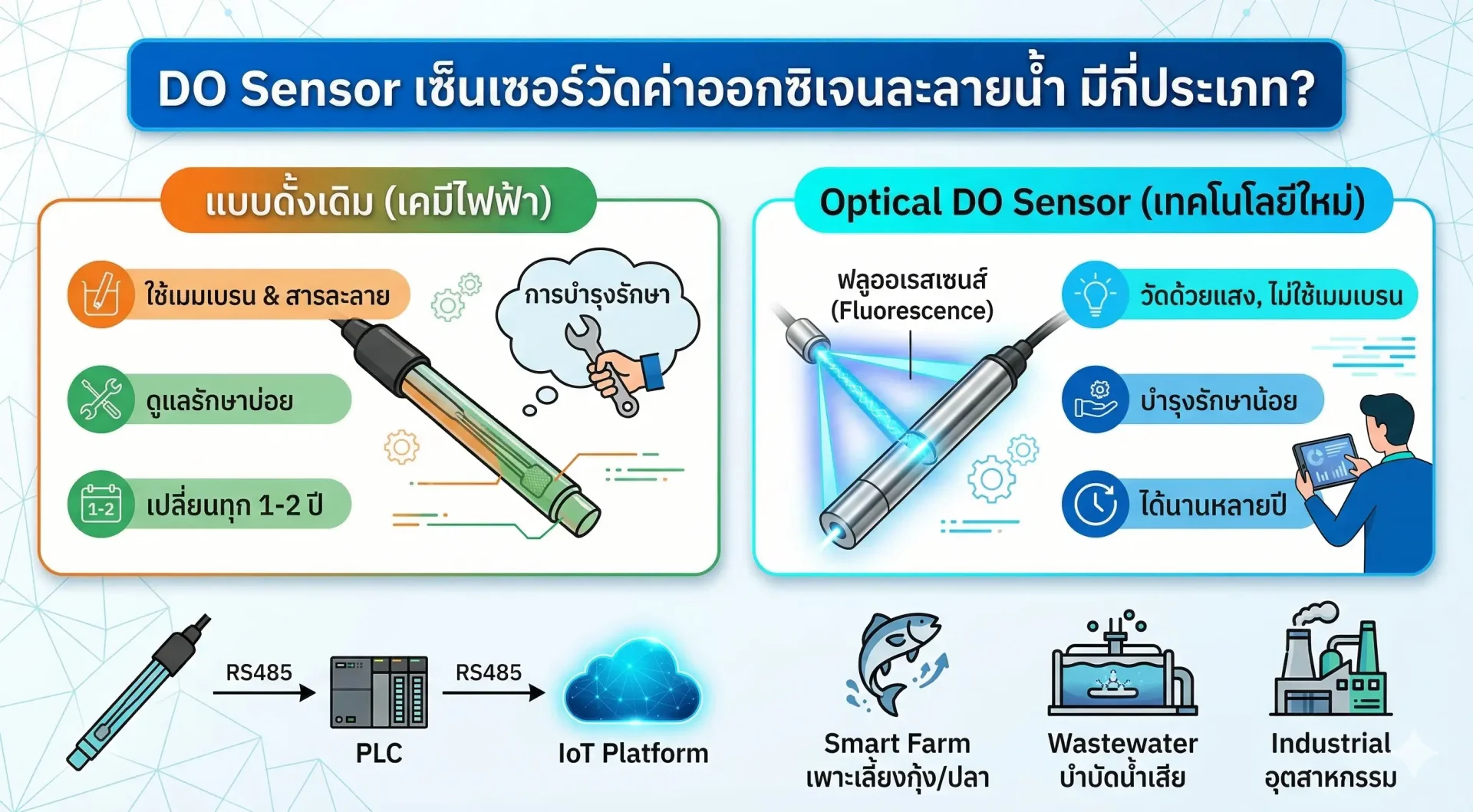
Did you know that traditional dissolved oxygen sensors (electrochemical) have a limited lifespan of only 1-2 years and require frequent maintenance, whereas modern Optical DO Sensors can operate for years with virtually zero maintenance?
When building a Smart Farm (aquaculture) or an Automation system for a wastewater treatment plant, selecting an accurate and durable Water Quality Sensor is the core to efficiently processing data on an IoT Platform or controlling equipment via a PLC. This article delves into the different types of DO sensors and how to choose the right one for your automated systems.
Why Measure Dissolved Oxygen (DO)?
Dissolved Oxygen is the amount of oxygen gas dissolved in water, typically measured in mg/L or ppm. Maintaining DO levels within standard ranges (usually 5-6 mg/L or higher for aquatic life) is critically important:
- In Smart Aquaculture (Shrimp/Fish Farms): If DO levels drop too low, aquatic life will die or experience stunted growth. Having a real-time sensor allows the system to automatically toggle aerator machines on and off instantly.
- In Wastewater Treatment: The bacteria used to break down waste require oxygen. Precisely controlling DO levels helps save massive amounts of energy consumed by aeration motors.
- In Industrial Piping (Cooling / Boilers): Excessively high DO levels can accelerate corrosion in metal pipes.
What Are the Types of DO Sensors?
To seamlessly connect data to a SCADA or HMI control system, we must understand the pros and cons of the two main types of sensors: Electrochemical and Optical.
Why Are Optical DO Sensors the Best Fit for Industrial IoT?
For System Integrators or engineers developing automation systems, the Optical DO Sensor is the ultimate choice. It operates on the "Fluorescence" principle, emitting blue light onto a luminescent dye to measure oxygen levels. This provides several key advantages:
- Low Hidden Costs (Low Maintenance): There is no need to frequently replace membranes or refill electrolyte solutions, making it ideal for remote installations (Remote Monitoring).
- Industrial-Grade Accuracy: It is highly resistant to hydrogen sulfide (H₂S) and fouling, and its readings are not disrupted by chemical reactions.
- Easy Integration: Modern optical sensors often come with standard industrial outputs like RS485 (Modbus RTU). This allows engineers to easily pull data into HMI (HTML5) screens, Data Loggers, or write control programs using CODESYS.
How to Choose the Right DO Sensor for Your Project
- Need a low-maintenance, long-term system? Choose an Optical DO Sensor made from 316L stainless steel or titanium for high corrosion resistance.
- Want to connect to the Cloud? Select a sensor with an RS485 output to easily link with an IoT Gateway.
- Dealing with frequent temperature fluctuations? Make sure to choose a model equipped with Automatic Temperature Compensation to prevent reading inaccuracies.
Highly Recommended Quality Instrument Sensor
If you are looking for a world-class water quality sensor, the RK500-04 (Optical DO Sensor) is a highly attractive option. With a high resolution of 0.01 mg/L, an IP68 waterproof rating, and RS485 support, it is fully equipped for immediate integration into your automation systems.
E-Power Service is Ready to Consult on Water Quality Sensor Systems
Having a high-quality sensor is just the beginning; maximizing the value of the data is what truly matters. At E-Power Service, we don't just supply industrial-grade Water Quality Sensors—we are expert System Integrators. We design automated aerator control systems, Smart Farms, and the E-power IoT Platform to fully elevate your business into the digital era.