What is the Difference Between Analog and Digital Sensors?
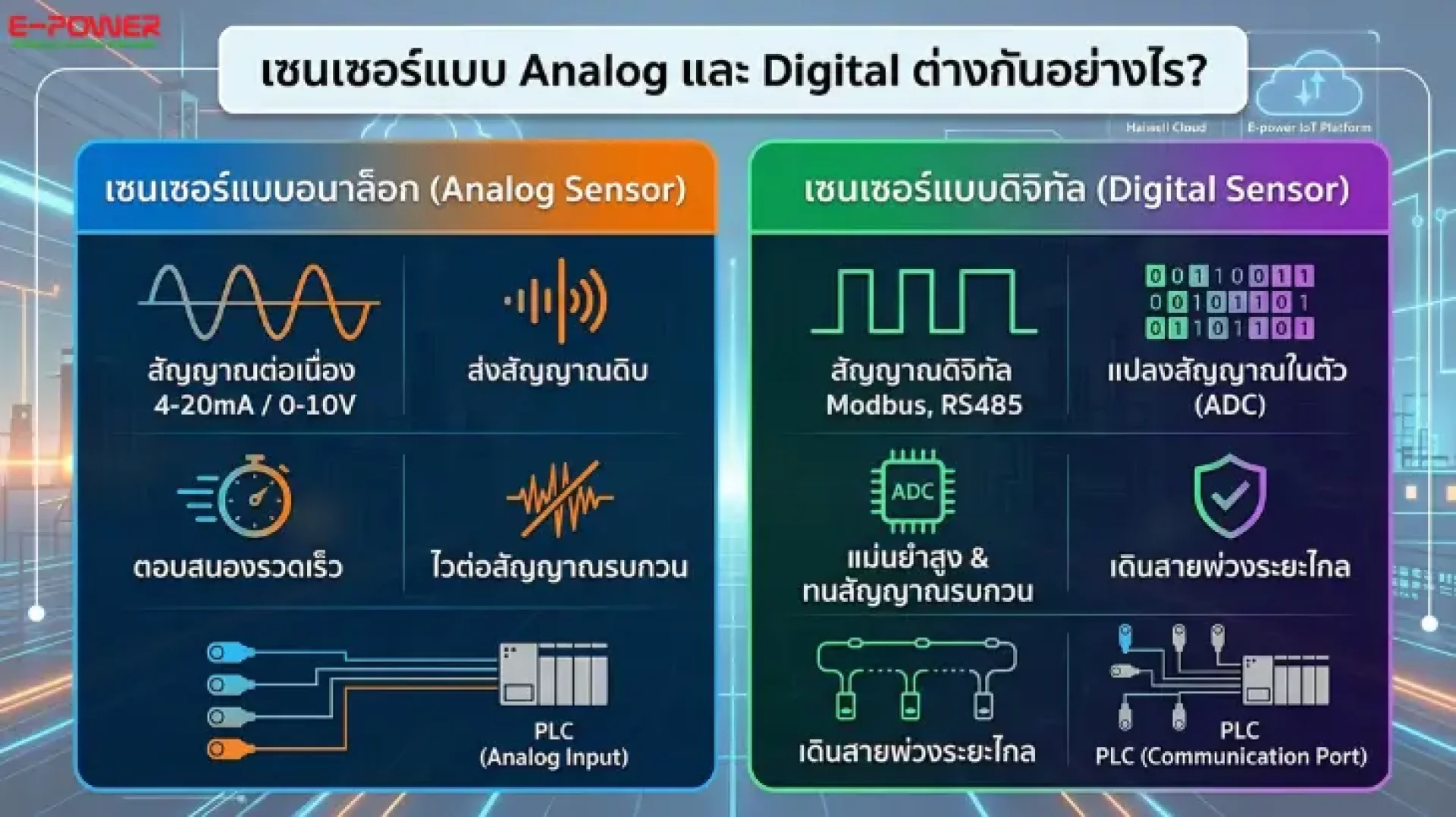
Analog sensors and digital sensors are instrument sensors that enable industrial machinery to intelligently perceive and interpret physical changes in their environment. In automation systems, analog sensors continuously feed electrical signals into the PLC to create high-speed control loops. Digital sensors, on the other hand, focus on transmitting noise-resistant data, making them ideal for logic programming with CODESYS standards to pull data for monitoring on Haiwell Cloud SCADA. For example, extracting parameters from Water Quality Sensors in wastewater treatment plants or managing sensor networks in Smart Farms to transmit data to the E-power IoT Platform. Choosing the right application for both sensor systems is a crucial factor in ensuring production process safety and maximum stability.
Signal Differences: Analog vs. Digital Signals
The fundamental basis for selecting a sensor is understanding the type of signal:
- Analog Signals: These signals feature a continuous flow of changing electrical current or voltage. The standard signals widely used in factories are 4-20mA or 0-10V. The advantage is real-time response, but caution is required regarding electrical noise when wiring over long distances.
- Digital Signals: These are non-continuous signals where data is converted into binary codes (0 and 1) or data packets. They commonly communicate via industrial protocols such as RS485 (Modbus RTU). The advantages are high accuracy, noise immunity, and the ability to transmit data over long distances for stable connection to the E-power IoT Platform.
In-Depth Comparison: Analog vs. Digital Sensors
1. Analog Sensors
These are devices that measure physical attributes and output a continuous electrical signal. These sensors typically lack complex internal processing circuits. Their function is to send raw signals to the PLC or controller for conversion.
- Ideal for: Applications requiring high-speed control or systems where the control panel already supports Analog Input (AI) modules.
- Industrial Examples: Pressure Transmitters in air pipes, Ultrasonic Level Sensors transmitting 4-20mA signals.
2. Digital Sensors
Digital sensors have a microcontroller or an ADC (Analog-to-Digital Converter) circuit embedded within the probe. They completely convert physical values into digital data before transmitting it to the control system.
- Ideal for: Systems with numerous measurement points, as they allow for daisy-chain wiring, saving cables and PLC ports.
- Industrial Examples: RS485 Water Quality Sensors (e.g., pH, DO, EC sensors) popular in wastewater treatment systems, or soil temperature and humidity sensors for Smart Farm systems.
How to Determine if a Sensor is Analog or Digital?
Engineers can verify the sensor type through 3 main checkpoints:
- Output Signal: If the brand specification states a 4-20mA or 0-10V output, it is analog. If it specifies RS485, RS232, I2C, or SDI-12, it is digital.
- PLC Connection: Analog sensors must connect to AI (Analog Input) ports, whereas digital sensors usually connect to Communication ports (e.g., RS485 or Ethernet ports).
- Datasheet: This is the most reliable method to confirm specifications before purchasing equipment.
Applications in Automation and IoT Systems
Selecting the appropriate sensor for the site will help you control the budget and increase machine efficiency (OEE).
Analog Sensor Applications:
- Controlling the speed of inverters (VFD) and motors in production lines.
- Measuring oil or chemical levels in storage tanks (Tank Level Monitoring).
- Systems using legacy PLCs or systems that do not require cloud data transmission.
Digital Sensor Applications:
Smart Farms and Precision Agriculture: Extracting data from weather and soil sensors directly to the E-power IoT Platform for automated irrigation control.
Smart Wastewater Treatment Systems: Using multiple digital Water Quality Sensors in a daisy-chain to transmit data for real-time display on Haiwell Cloud SCADA dashboards.
Advanced Automation: Integrating sensor networks with controllers programmed via CODESYS to create complex operational logic.
Conclusion
Both analog and digital sensors are fundamental foundations of automation systems. The key difference is that analog sensors respond rapidly and are suited for basic control, while digital sensors offer precise data transmission, easy wiring, and serve as the perfect starting point for Industrial IoT implementation.
If your factory is looking for solutions to upgrade production lines or transform existing machinery into a Smart Factory, the engineering team at E-Power Service is ready to consult. We specialize in Automation system design, PLC programming using CODESYS standards, sourcing all types of Instrument Sensors, and providing comprehensive turnkey installation of display systems via Haiwell Cloud SCADA.