Wind Sensor : Working Principles and Professional Troubleshooting Guide
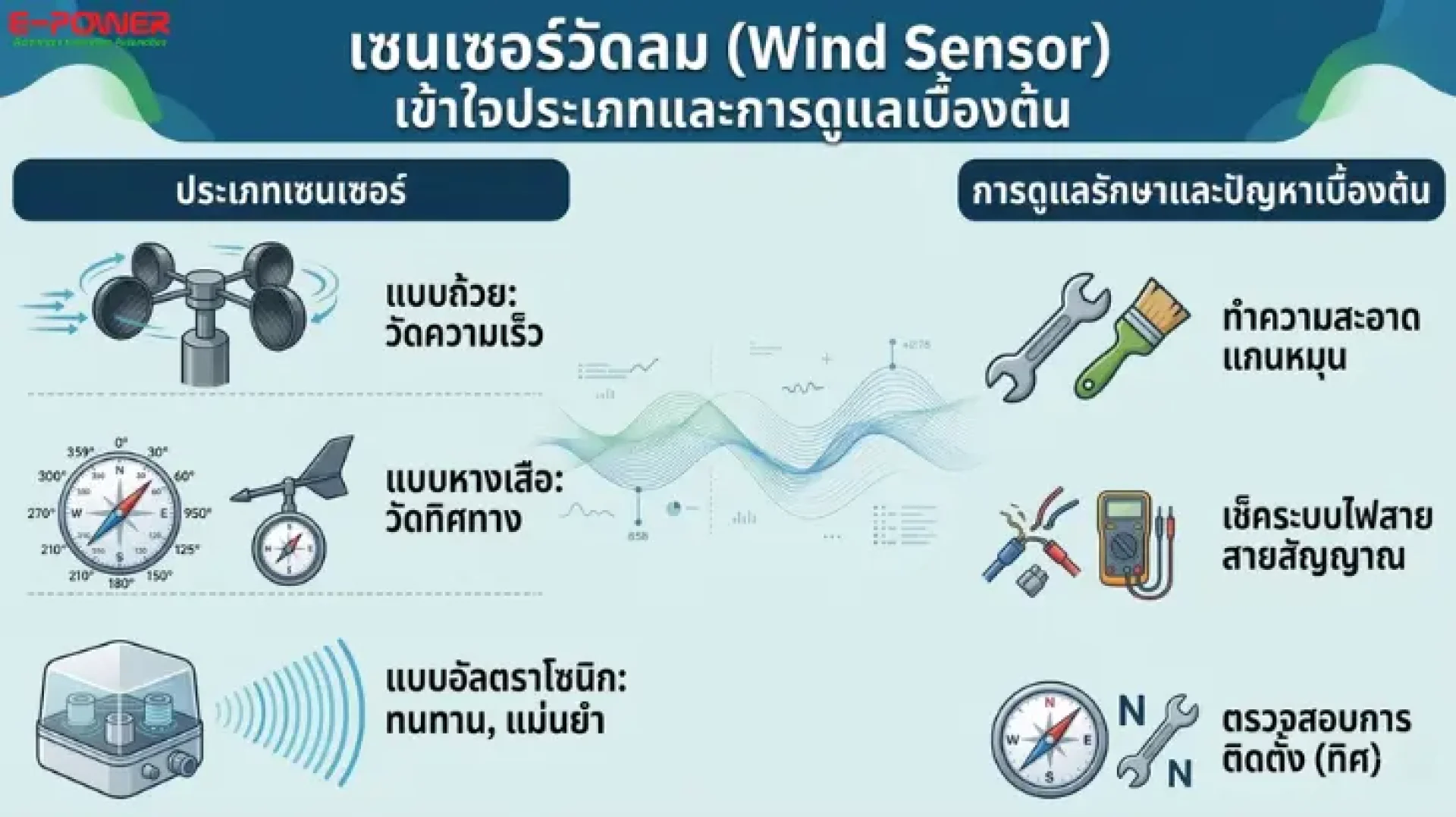
Wind Sensor (Wind Sensor) is a critical tool for determining the safety and efficiency of automation systems and smart farms. From measuring wind speed to checking wind direction, accurate data is what modern engineers and farmers demand. This article will help you understand the mechanisms of each sensor type, while revealing basic troubleshooting methods and professional maintenance guidelines from the E-Power Service team.
1. How Do Wind Sensors Work? A Deep Dive into 3 Technologies
In smart agriculture or weather station installations, we typically encounter three main types of wind sensors:
Cup Anemometer (Wind Speed Sensor)
This is the most popular industrial standard. It operates using three hemispherical cups that catch the wind and rotate around a vertical axis. The rotation speed is transmitted to internal sensing elements to generate output signals, such as 4-20mA or RS485, allowing the Automatic Control System (PLC) to calculate precise wind speed values.
Wind Direction Sensor (Wind Vane)
This device uses a "tail wing" or wind vane to align itself with the wind direction. The rotating shaft is connected to an Encoder or a Potentiometer to identify the angular position (0-359°) and transmit data as electrical signals back to the control cabinet.
Ultrasonic Wind Sensor
A modern innovation with No Moving Parts. It uses high-frequency sound waves to measure the Travel Time of sound between transmitters and receivers. It calculates both wind speed and direction simultaneously. This type is highly durable and requires minimal maintenance, making it ideal for areas with extreme weather conditions.
2. Essential Industrial-Grade Components
Choosing equipment from experts like E-Power Service ensures you get industrial-grade components:
- Sensing Part: Such as carbon fiber wind cups that are lightweight yet durable and UV-resistant.
- Transducer: High-quality circuitry that supports IoT connectivity and industrial standard signals, enabling rapid system integration.
3. Troubleshooting Guide
If the sensors on your farm or factory start malfunctioning, follow these inspection steps:
Issue: Sensor is not rotating smoothly or is stuck
- Check for foreign objects: Dust, sand, animal fur, or leaves stuck in the rotating shaft are common causes of inaccurate readings.
- Wear and Tear: After long-term use, internal bearings may degrade. Regularly clean and lubricate them, or opt for sensors with high-level seals like IP65/IP67.
Issue: Zero Reading (Wind speed shows 0)
- Electrical System: Check the power supply voltage and signal cables for any internal breaks or loose connections.
- Connection Points: Inspect the internal Reed Switch or signal converter. If the shaft rotates normally but no data appears on the controller, it may be time to replace the sensor.
Issue: Inaccurate Direction
- Critical Installation Point: The "N" (North) symbol on the sensor must always point toward True North. If installed at the wrong angle, all wind direction data in your Smart Farm system will be incorrect.
Conclusion: Invest Once for Long-Term Stability
Selecting industrial-grade wind speed and direction sensors along with regular maintenance is the key to success for modern agriculture and industrial safety systems. Whether you need a traditional Wind Cup or advanced Ultrasonic technology, visit our Smart Farm IoT solutions at www.epower.co.th. Our engineers at E-Power Service are ready to provide expert advice and support at every step.