How Do Wind Speed and Direction Sensors Work?
Wind speed and direction sensors have long been essential tools for atmospheric assessment. Today, these devices have become the heart of various modern industries, driving everything from Smart Agriculture and construction to renewable energy and comprehensive automation systems.
For those seeking high-quality equipment, RIKA Sensor is a globally trusted leading brand in environmental monitoring. E-Power Service has carefully selected and distributed these products to meet the demands of the Thai industrial sector. Today, we will take you on a deep dive into how these wind sensors work and provide professional techniques for selecting the most cost-effective solution for your system.
Wind Sensor Applications
Wind speed and direction sensors are applied across a vast scope of fields. For example:
- Weather Stations: To collect accurate meteorological data.
- Smart Farm: Assessing wind direction and speed to plan pesticide spraying or greenhouse management.
- Wind Turbines: Evaluating wind resources to control the rotation of power-generating turbines.
- Safety Operations: Used in high-rise construction, seaports, and airports to provide severe weather alerts.
How Do Wind Speed and Direction Sensors Work?
Typically, a wind sensor system consists of two primary components working in tandem:
1. Anemometer
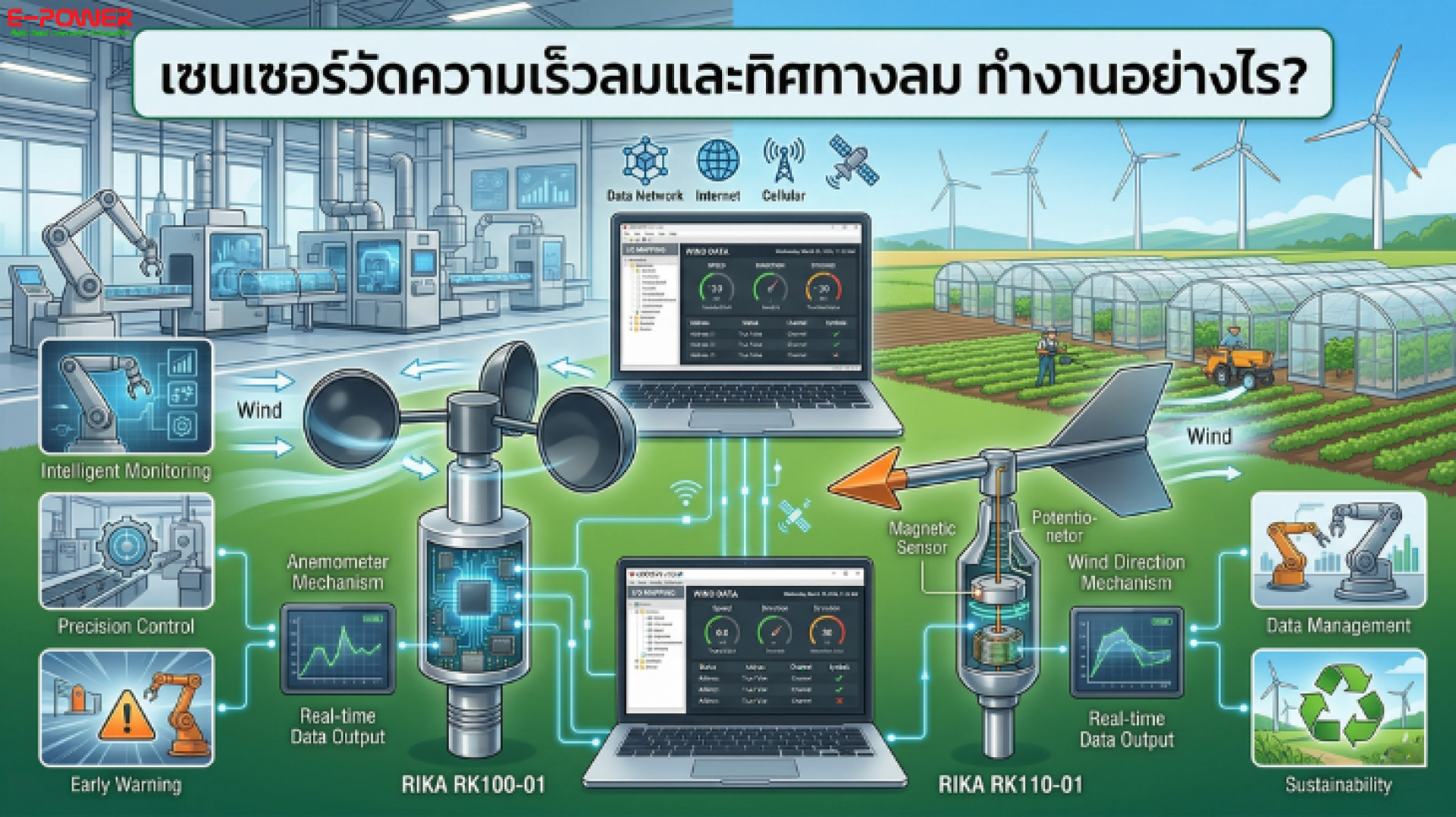
This device measures wind speed. The most popular design is the "Cup Anemometer," featuring three cups mounted on a rotating shaft. As the wind blows, it causes the cups to rotate at a rate directly proportional to the wind speed. The system calculates the rotations and converts them into an accurate speed value.
(Additionally, there are Sonic Anemometers that use the travel time of sound waves between transmitters and receivers to calculate wind speed without moving parts).
- Recommended RIKA Model: RIKA RK100-01 (Wind Speed Sensor) features a highly durable 3-cup design made of carbon fiber or polycarbonate, offering excellent response and precision.
2. Wind Vane
The Wind Vane is used to identify the direction from which the wind is blowing. It often features a flat plate or arrow that rotates freely around a vertical axis. The arrow always points toward the source of the wind. Inside the shaft, a magnetic sensor or potentiometer converts the rotation angle into an electrical signal (such as Analog or RS485) to be sent to the control system.
- Recommended RIKA Model: RIKA RK110-01 (Wind Direction Sensor) is an arrow-shaped sensor designed to withstand extreme weather while providing high accuracy across a full 360 degrees.
Professional Tips for Choosing a Cost-Effective Wind Sensor
Selecting a wind sensor that matches your specific application is crucial. Here are five key factors to consider:
- Accuracy: Choose sensors with low error margins (e.g., ±1% for wind speed and ±2 degrees for direction).
- Durability: Since they are installed outdoors, opt for materials resistant to UV radiation, corrosion, and a wide temperature range.
- Output Interface: Ensure the output signal is compatible with your Data Logger or PLC, such as 4-20mA, 0-5V, or RS485 Modbus RTU for IoT applications.
- Response Time: Select sensors with low latency so the system can promptly record sudden changes like wind gusts.
- Value for Money: Invest in equipment that balances "industrial-grade performance" with a "reasonable price".
Why Choose RIKA Sensor?
RIKASENSOR manufactures sensors with integrated high-performance digital circuits. They are specifically designed to resist electromagnetic interference (EMC) and offer excellent surge protection. Every product meets international CE standards, making them ideal for everything from Smart Farms to heavy machinery and port operations. With world-class manufacturing experience, you can be confident in long-lasting quality.
Conclusion
Wind speed and direction sensors are vital instruments that help us understand and respond to the weather accurately. Choosing standardized equipment like RIKA Sensor will significantly enhance safety and efficiency for your business.
If you are looking for wind sensors, weather station equipment, or wish to integrate systems into Smart Farm IoT and Automation, contact E-Power Service immediately. Our expert engineering team is ready to consult, recommend solutions, and provide the equipment that best fits your real-world needs.
- Website: www.epower.co.th
- LINE Official: @epower