Soil Moisture Sensors : IoT Technology for Automatic Irrigation Systems
Agricultural irrigation is the heartbeat of cultivation. Generally, it can be categorized into three main types: traditional surface irrigation (furrow or flood irrigation), ordinary sprinkler systems, and micro-irrigation.
Traditional methods often result in massive water waste and low efficiency. While sprinklers are popular, they still lose significant water to the environment. Today, modern micro-irrigation technologies—such as micro-sprinklers, Drip Irrigation, and sub-surface irrigation—have taken a leading role.
Soil Moisture Sensors have emerged as the ultimate solution to perfect these technologies. They provide precise water conservation control and significantly higher water utilization rates compared to traditional methods. Implementing a scientific Automatic Irrigation System not only saves water but also skyrockets agricultural yields. The core of this system is the Soil Moisture Sensor, acting as the primary controller to minimize water loss. This article explores sensor technology and efficient automatic irrigation planning.
Current Soil Moisture Measurement Technologies
There are various methods available in the market, with the primary ones being:
1. Neutron Soil Moisture Tester
Uses neutron attenuation to measure water content. High-speed neutrons lose energy when interacting with hydrogen atoms in water.
- Pros: High accuracy.
- Cons: Risk of radiation leakage if not properly shielded. It is difficult to measure shallow soil moisture, which is vital for crop growth. Consequently, this technology is restricted or banned in many regions.
2. Dielectric Soil Moisture Sensor
Relies on the soil's dielectric properties. For capacitive sensors, capacitance is proportional to the dielectric constant. Since water has a much higher dielectric constant than soil solids, capacitance increases as moisture rises.
- Highlights: High accuracy, wide range, fast response, and ideal for Online Monitoring within a Smart Farm ecosystem.
3. Tensiometer Type Sensor
Uses a porous ceramic cup buried in the soil connected to a vacuum gauge to measure the "suction" or tension of the soil water.
- Pros: Simple structure and indicates water flow direction.
- Cons: Limited by soil type (e.g., clay), complex conversion to water content, and prone to hysteresis, making it less ideal for rapid electronic control systems.
Automatic Irrigation via Soil Moisture Sensors
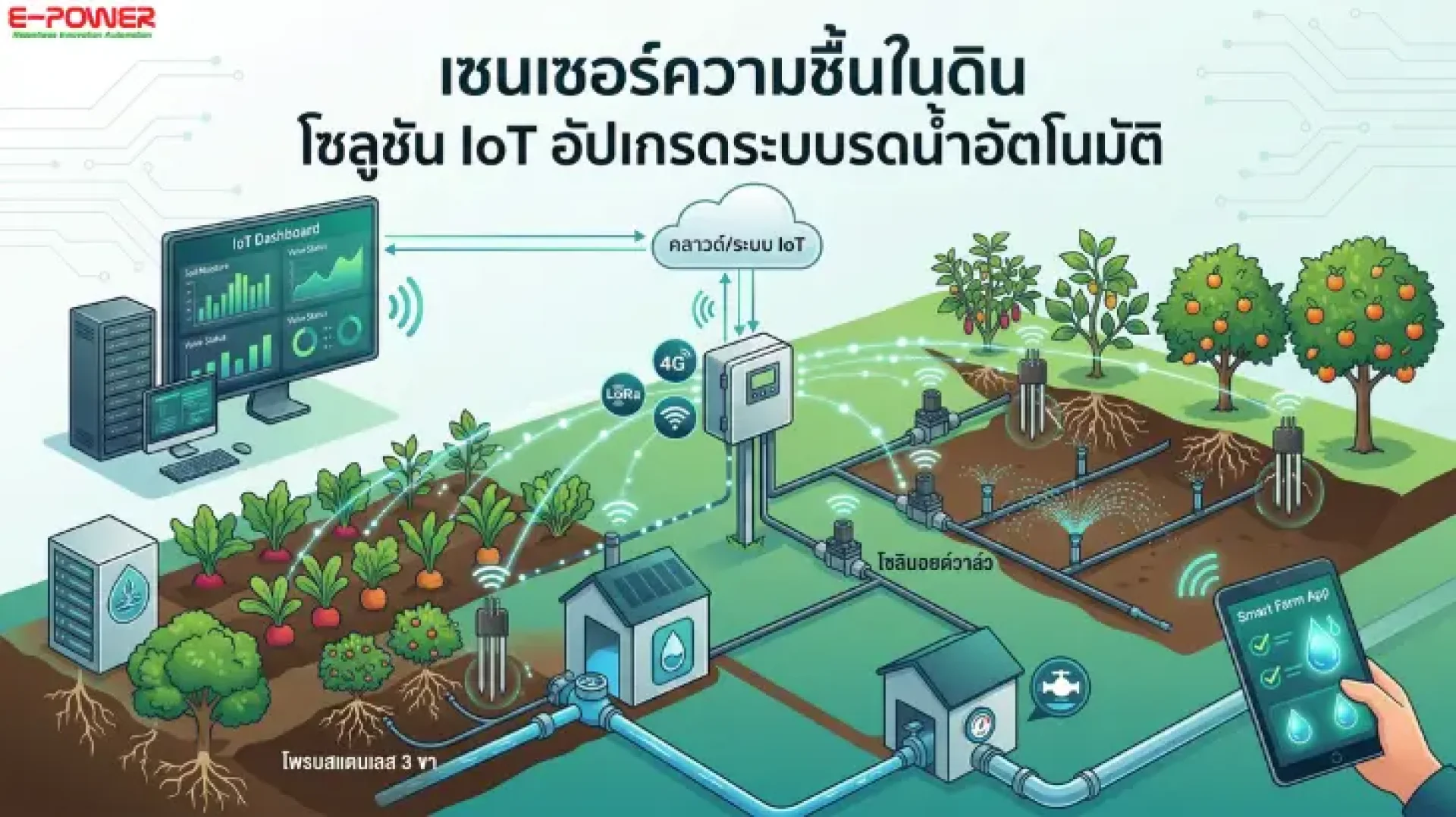
A Soil Moisture Sensor (typically a 3-pin stainless steel probe) is buried at the root zone for real-time monitoring. It converts capacitance into voltage or current signals sent to the main controller.
- Low Moisture: The system triggers a relay to open the Solenoid Valve.
- Optimal Moisture: The system automatically closes the valve to prevent waste. Data can be transmitted via RS485 to a computer or the E-power IoT Platform for real-time status tracking and historical analysis.
Key Components of an Automated Irrigation System
- Monitoring Center: Includes servers, software platforms (like the water-saving irrigation platform), and databases.
- Communication Network: Supports GPRS, 4G, and LoRa signals.
- Valve Control System: Wireless roaming networks (LoRa) eliminate the need for field wiring. Solenoid valves open or close based on pre-set moisture thresholds.
- Soil Moisture Monitoring System: Sensors connect via RS485 to a valve controller, which communicates with a field controller via LoRa, eventually uploading data to the center via 4G.
- Water Pump Control System: Integrates PLC and flow meters to monitor power consumption, pump status, and pipeline flow.
Advantages of Upgrading to Automatic Irrigation
- Intelligent Irrigation: 100% automated; shuts off during rain and activates during dry spells.
- Precise Irrigation: Zoning allows for different watering schedules for shrubs, lawns, or crops.
- Labor Saving: Eliminates manual watering, allowing farmers to focus on management.
- Improved Quality: Consistent water and fertilizer application leads to optimal growth and a cleaner plant environment.
Conclusion
Implementing agricultural automatic irrigation removes human error and guesswork. It is the only path toward high-efficiency and precision agriculture. Systems driven by IoT and Soil Moisture Sensors alleviate water scarcity while reducing long-term costs.
For high-quality sensors or expert Smart Farm and Automation design, E-Power Service Co., Ltd. (ePower) is ready to provide tailored solutions. Learn more at www.epower.co.th or LINE ID: @epower