What are Industrial Sensors and Actuators?
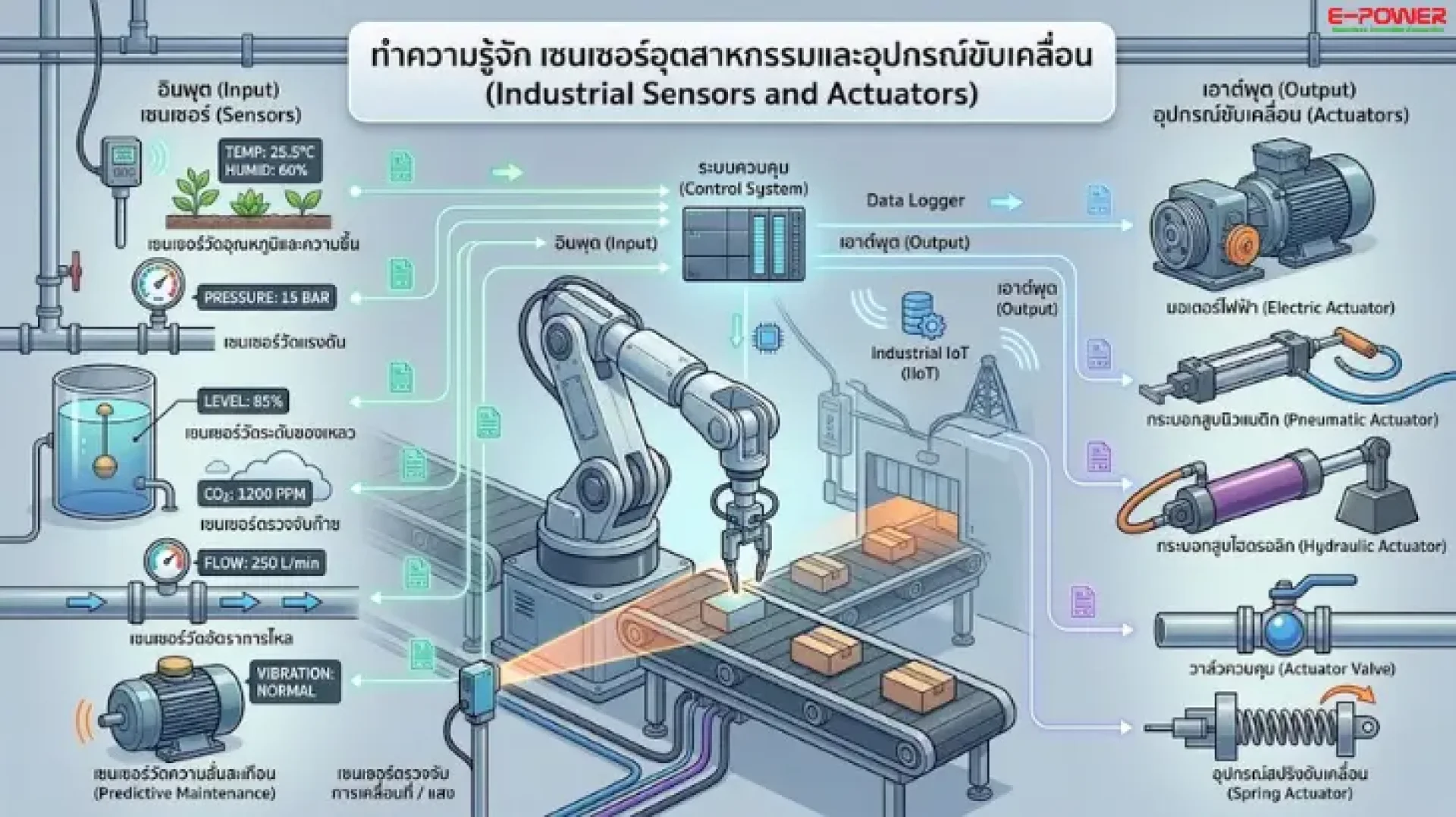
In Automated Control Systems, Industrial Sensors and Industrial Actuators function as the "senses" and "muscles" of a machine. These two components work in tandem to detect environmental conditions and execute commands with precision. This article provides an in-depth look at their working principles, various types, and key differences to help you effectively implement them within your Industrial IoT systems.
What are Industrial Sensors and Actuators?
- Industrial Sensors: Devices that convert physical or chemical properties in the environment (such as temperature, pressure, humidity, or light intensity) into electrical signals. This data is then sent to a central control unit, such as a [PLC (Programmable Logic Controller) system].
- Industrial Actuators: Devices that receive command signals from a controller and convert them into physical action—such as mechanical displacement, speed, force, or torque. These drive machine parts to move, rotate, or grip. Common forms include motors, cylinders, and valves.
In summary, within a control system, sensors function as the "Input signals," while actuators function as the "Output signals."
Working Principles
- Industrial Sensors: These typically utilize physical or chemical reactions to convert measured values into electrical or communication signals (such as Modbus RTU). Common principles include resistance effects, thermoelectric effects, Piezoelectric properties, photoelectric effects, and chemical sensitivity.
- Industrial Actuators: These control the direction and speed of mechanical movement by adjusting electrical current or air pressure. For example, an electric motor may use a Hall Sensor or Encoder to measure rotation speed and direction, allowing the controller to manage the motor’s operation with high precision.
Types of Industrial Sensors
Selecting an accurate Instrument Sensor is the foundation of a reliable system. Here are the most common types used in industry today:
1. Temperature & Humidity Sensor
Measures heat and moisture in the air and converts them into electrical signals. High accuracy and fast response times make these essential in manufacturing, HVAC systems, and Smart Farms. Specifically, the Renke Temp & Humid Transmitter is widely used for efficient climate control in greenhouses.
2. Pressure Sensor
Measures the pressure of liquids or gases. These devices feature excellent interference resistance and are commonly used in industrial automation and weather forecasting.
3. Motion Sensor
Measures position changes or displacement relative to a reference point. These play a critical role in mechanical engineering and the automotive industry.
4. Liquid Level Sensor
Converts liquid height into electrical signals. Available in float, ultrasonic, and radar types, these are vital for wastewater treatment, petrochemical industries, and monitoring water levels in factory storage tanks using the Renke Submersible Water Level Sensor.
5. Flow Sensor
Measures the flow volume of liquids or gases using magnetic, turbine, or radar technologies. They are widely used in piping systems, chemical processing, and food and beverage industries.
6. Vibration Sensor:
Converts vibration states into electrical signals to facilitate Predictive Maintenance. These are typically installed on motors, fans, and air compressors to detect impending equipment failure.
7. Gas Sensor
Monitors concentrations of various gases, such as flammable or toxic gases. They are used in mining, chemicals, and agriculture, including the Renke CO2 Sensor for monitoring indoor air quality.
8. Optical Sensor
Uses light principles to measure intensity, color, or position. Known for rapid response times, they are used in Robot Vision systems and automatic lighting.
Types of Actuators
- Manual Actuators: Controlled by human force via gears or levers. Simple and cost-effective, but limited in automated applications.
- Pneumatic Actuators: Uses air pressure to drive valves or pistons. Popular in general factory environments.
- Hydraulic Actuators: Uses fluid pressure instead of air. Ideal for applications requiring high force and heavy-duty power.
- Electric Actuators: Powered by electric motors. These offer quiet operation, high efficiency, and superior precision.
- Spring Actuators: Operates using spring tension released at a specific threshold. Often used in emergency applications for one-time operation.
Contact ePower for Industrial Sensor and Automation Solutions
If you are looking for high-quality sensors from Renke or need experts to design Automation systems, Smart Farms, or CODESYS programming, the engineering team at E-Power Service is ready to provide comprehensive consultation and service.
- Website: www.epower.co.th
- Line Official: @epower
- Hotline: 081-559-5145