Temperature and Humidity Sensor : Digital vs. Analog Comparison – Which is the Most Cost-Effective?
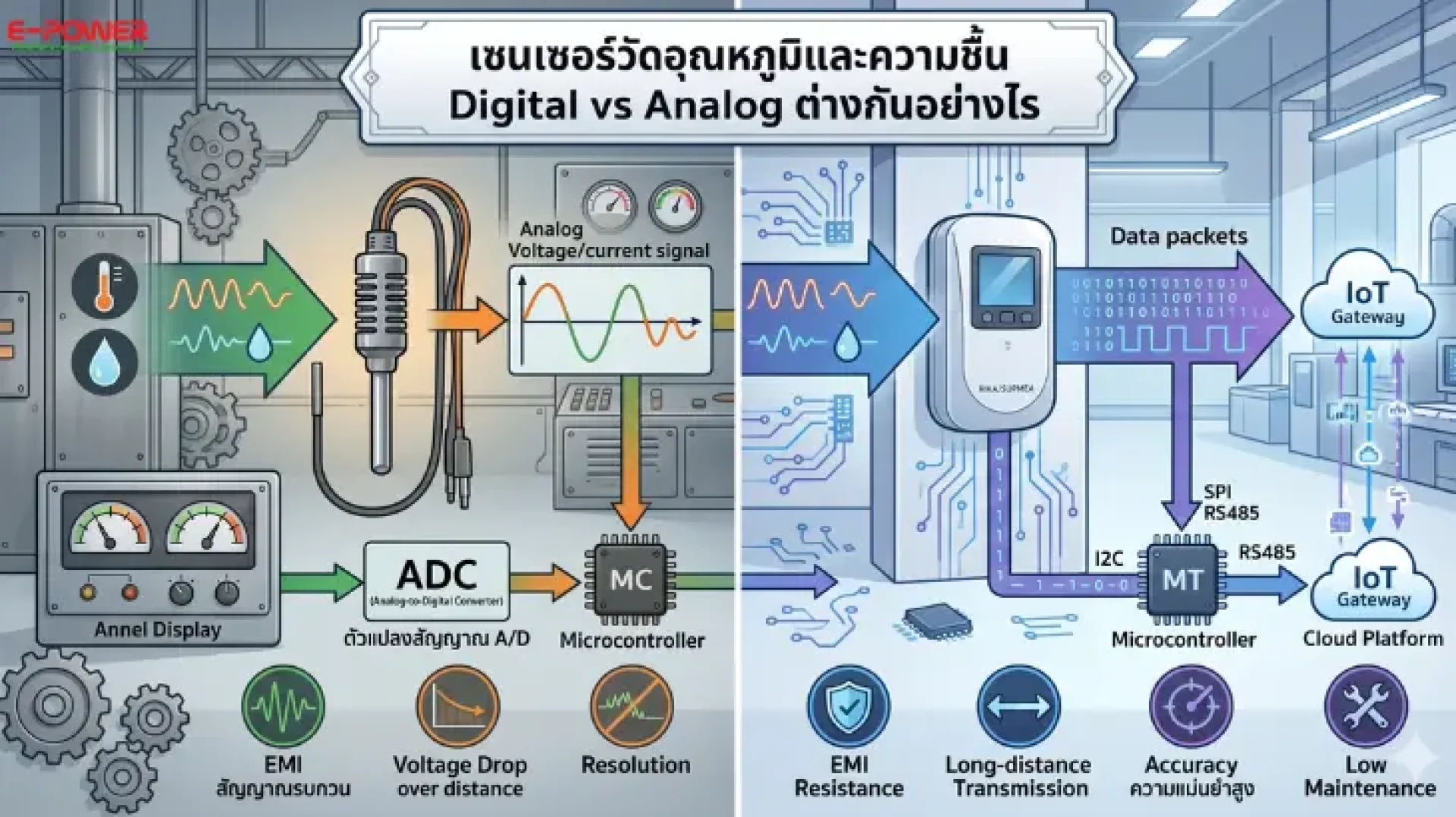
Temperature and Humidity Sensor solutions are critical components in modern technology, ranging from commercial building climate control to complex industrial automation. Traditionally, we relied on analog sensors such as RTDs or Thermocouples. However, with the rapid rise of IoT and Robotics, the digital temperature and humidity sensor has become increasingly vital. This article analyzes the pros, cons, and ideal applications of both types to help you choose the best solution for your project.
What is an Analog Temperature and Humidity Sensor?
An analog Temperature and Humidity Sensor detects physical changes and converts them into continuous electrical signals, such as Voltage, Current, or Resistance. The output is a "raw signal" that directly represents the temperature or humidity magnitude at that specific moment.
What is a Digital Temperature and Humidity Sensor?
A digital Temperature and Humidity Sensor is an Integrated Device that combines the sensing element, an Analog-to-Digital Converter (ADC), and a communication interface into a single chip. It outputs digital signals (binary 0s and 1s), ensuring high stability and allowing for immediate connection to modern microcontrollers.
Key Comparisons
1. Working Principle and Processing
- Analog: Outputs continuous electrical values. Connecting to a PLC or digital controller requires an external ADC circuit for conversion.
- Digital: Processes data internally and transmits via standard protocols like I2C, SPI, or RS485, reducing external circuit complexity. Popular examples include the SHT series or wall-mounted devices with built-in LCDs.
2. EMI Sensitivity (Electromagnetic Interference)
In factory environments with large motors or machinery, EMI is a major challenge for any Temperature and Humidity Sensor.
- Analog: Susceptible to noise, especially over long cable runs. However, the 4-20mA signal is an industrial standard that offers excellent noise immunity.
- Digital: Higher resistance to EMI because data is transmitted as digital logic. It often includes error-checking mechanisms like Checksums, ensuring higher data accuracy.
3. Signal Transmission Distance
- Analog: Often suffers from Voltage Drop over long distances, causing readings to become inaccurate.
- Digital: As long as the voltage remains within the defined thresholds, digital data remains accurate throughout the wire, making it ideal for medium to long-range transmission.
4. Power Consumption and Maintenance
- Analog: Simple circuitry, lower power consumption, and lower initial maintenance costs.
- Digital: Slightly higher power usage due to internal processing, but modern versions feature Sleep Mode and remote self-diagnostics. This leads to a lower Total Cost of Ownership (TCO) in the long run by reducing the need for manual on-site calibration.
Top Recommended Temperature & Humidity Sensors from E-Power
If you are looking for high precision and durability, here are our top picks available at www.epower.co.th:
1. For Smart Agriculture and Smart Farms (Digital)
Recommended: RIKA SENSOR RK210-01 – A digital Temperature and Humidity Sensor integrating soil measurement. Highly accurate, corrosion-resistant, and easily connected via RS485 Modbus.
2. For Industrial and Meteorological Stations (High-Precision Digital)
Recommended: RIKA SENSOR RK330-01 – Designed specifically for weather sensing. It features a Radiation Shield to ensure precise readings even under direct sunlight.
3. For Factory Control and HVAC Systems (Analog 4-20mA)
Recommended: SUPMEA SUP-WS – A popular analog Temperature and Humidity Sensor for buildings and control rooms. Offers standard 4-20mA or 0-10V output with a sleek design.
Conclusion
When selecting a Temperature and Humidity Sensor, the right choice depends on your environment. For traditional heavy-duty factories, the 4-20mA analog signal remains a reliable standard. However, for Industry 4.0 or Smart Farms, digital sensors provide the most efficient data management. Looking for precise and durable sensor solutions? E-Power is ready to consult and provide the perfect equipment for your needs.