Water Tank Level Sensor : Types and How to Choose the Right One?
A Water Tank Level Sensor is a critical innovation and a "Game Changer" for modern industrial plants and residential areas. Today, over 4 billion people—roughly two-thirds of the world's population—face severe water shortages for at least one month each year.
Statistics show that the agricultural sector accounts for 70% of global water use, followed by industry at 20% and households at 12%. These figures clearly reflect that water is the primary driver of the global economy. Efficient water management is the only sustainable solution to mitigate water scarcity.
Utilizing a Water Tank Level Sensor allows you to manage water resources cost-effectively by providing early warnings before a tank runs dry and preventing overflow waste. This article explores every aspect, from sensor types and essential features to future trends, helping you select the most effective solution for your application.
Applications Requiring Water Level Measurement
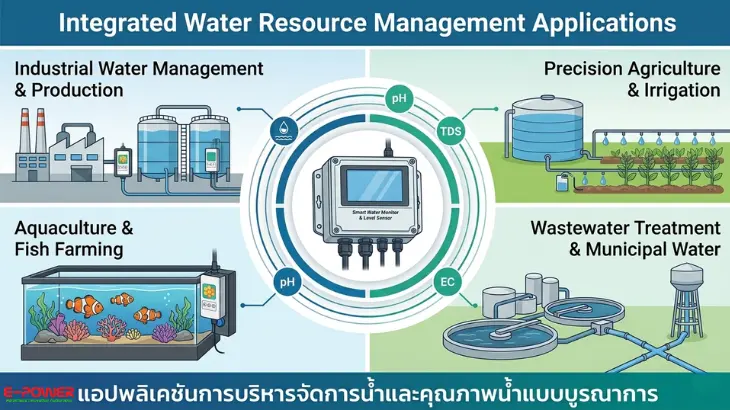
- Industrial Water Management: Energy, textile, and automotive industries require a continuous water supply. Sensors provide accurate data for refill planning and overflow prevention.
- Smart Agriculture: Helps farmers schedule irrigation precisely through storage tanks, reducing water waste and protecting crop yields.
- Municipal & Wastewater Treatment: Controls water flow, detects leaks, and monitors usage to ensure compliance with standards.
- Environmental Monitoring: Measures levels in dams, rivers, or lakes to predict and alert for disasters like floods or droughts.
- Residential Systems: Informs homeowners of remaining water levels and automates pump control to prevent dry-running or overflowing.
Essential Features of a Water Level Sensor
- Accuracy & Precision: Should have an error margin within $pm 1%$ FS for reliable results.
- Durability: An IP68 rating is recommended for complete dust and waterproof protection, withstanding temperatures from -20°C to +60°C.
- Ease of Installation: Saves time and long-term costs, especially models with external recalibration.
- Signal Output: Must support industry standards like 4-20mA, 0-5V, or RS485 (Modbus-RTU) for PLC and IoT integration.
Comparative Analysis of Sensor Types
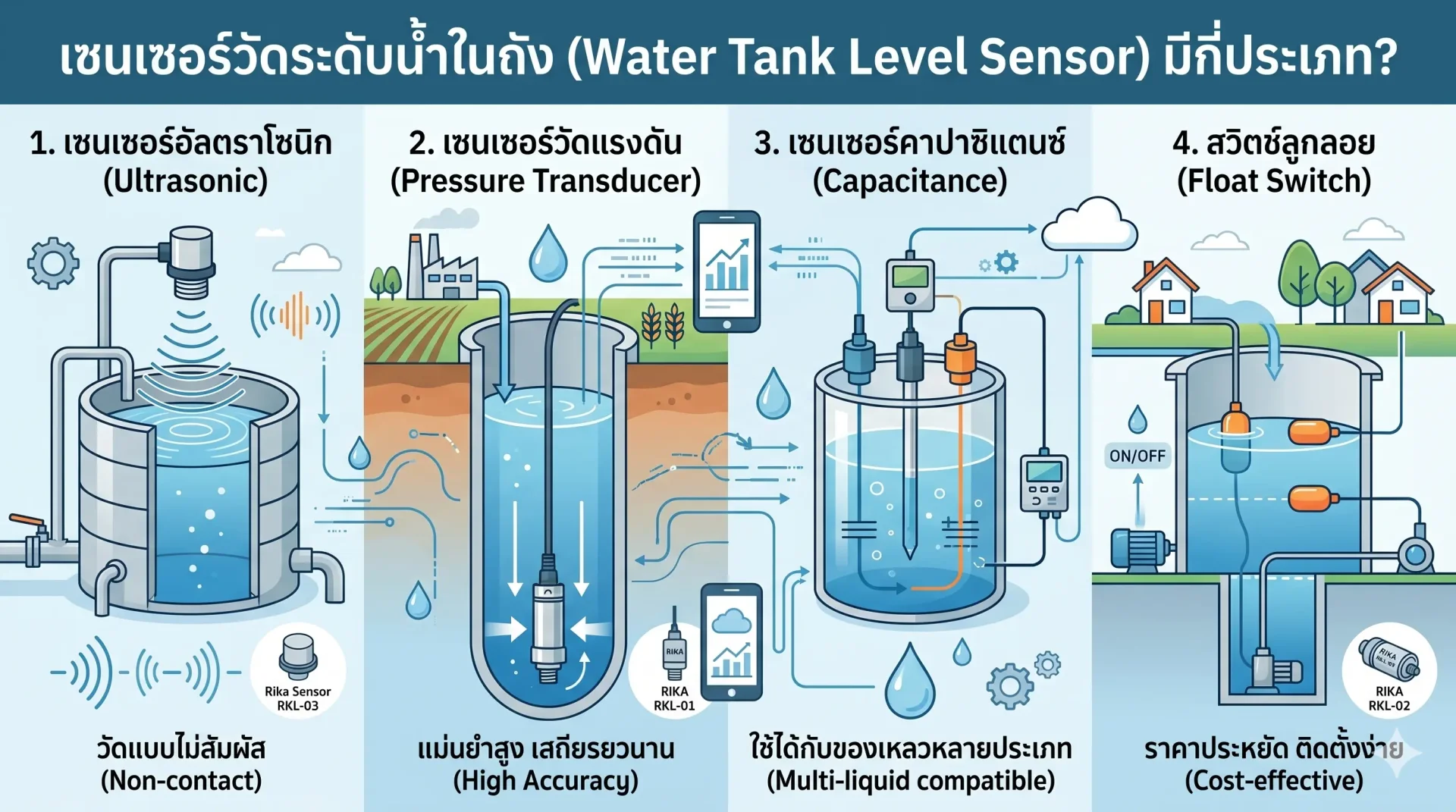
1.Ultrasonic Level SensorsUses high-frequency sound waves reflected off the water surface.
- Pros: Non-contact measurement; unaffected by liquid color or transparency; resistant to dust and moisture.
- Cons: Cannot operate in a vacuum; not suitable for submersion.
Recommended: RIKA RKL-03 – Measures up to 30 meters with high precision.
2. Pressure Transducer Level Sensors
Uses hydrostatic pressure principles by installing at the bottom of the tank.
- Pros: Extremely accurate with excellent long-term stability.
- Suitability: Ideal for clean water and wastewater; sensitive to changes in liquid density.
3. Capacitance Level Sensors
Measures changes in electrical capacitance as the liquid level fluctuates.
- Application: Suitable for various liquids, including water, oil, and chemicals.
- Tip: Should be installed in the center of the tank to reduce interference from tank walls.
4. Float Switch Level Sensors
A simple mechanical float that moves with the water to open/close a circuit.
- Pros: Most cost-effective and easiest to install.
- Application: Best for basic ON/OFF pump control in households or sumps.
Featured Water Tank Level Sensors from E-Power
1. Non-contact: RIKA RK500-06 Ultrasonic Level TransmitterA premium solution for those requiring high precision without submerged parts.
- Why use it: Eliminates scaling or chemical corrosion issues. Perfect for wastewater sumps or industrial chemical tanks.
- Specs: Supports various ranges (up to 30m); RS485 (Modbus-RTU) or 4-20mA output for instant IoT/PLC connection.
2. Submersible: RIKA RKL-01 Liquid Level Transmitter
The go-to choice for deep tanks or open wells.
- Why use it: Easy installation—simply drop it to the bottom. High resistance to water pressure.
- Specs: Stainless Steel 316L body; IP68 rated; supports RS485 / 4-20mA / 0-5V.
3. Basic Control: RIKA RKL-02 Float Level Controller
For basic, cost-effective, and durable level control.
- Why use it: Ideal for simple residential pump automation or basic wastewater systems.
Enhance Efficiency with E-Power IIoT Solutions
- To monitor your Water Tank Level Sensor data from anywhere, we recommend:
- IoT Cloud Box (C-BOX): Uploads sensor data to the epowercloud IIoT system for real-time mobile monitoring.
- Haiwell PLC / HMI: For advanced automated pump control and local graphical displays.
Summary: Smart Purchasing Guide
- Industrial / Chemical: Choose Ultrasonic to reduce maintenance.
- Deep Wells / Reservoirs: Choose Pressure Transducer for long-term stability.
- Agriculture / Budget-friendly: Choose RS485 Output to connect multiple units to a Smart Farm system.
For consultation on measurement ranges or technical data, visit us at www.epower.co.th or contact us via LINE ID: @epower.