Automatic Weather Station (AWS) : What Parameters Can It Measure?
The Automatic Weather Station (AWS) is a critical tool prioritized by the World Meteorological Organization (WMO), with over 10,000 stations deployed globally to collect in-depth atmospheric data. Data retrieved from an Automatic Weather Station is essential for accurate weather forecasting, directly impacting disaster management, precision agriculture (Smart Farming), industrial operations, construction, and maritime safety. Ultimately, this data plays a vital role in enhancing safety and the quality of life for everyone.
Today, an Automatic Weather Station (AWS) is available in various types, sizes, and configurations, depending on the budget and specific data requirements—ranging from basic monitoring kits to sensors utilizing the most advanced technology. This article dives deep into the parameters an AWS system can measure, including accuracy standards and data logging frequency.
Atmospheric Data Collection via Automatic Weather Station
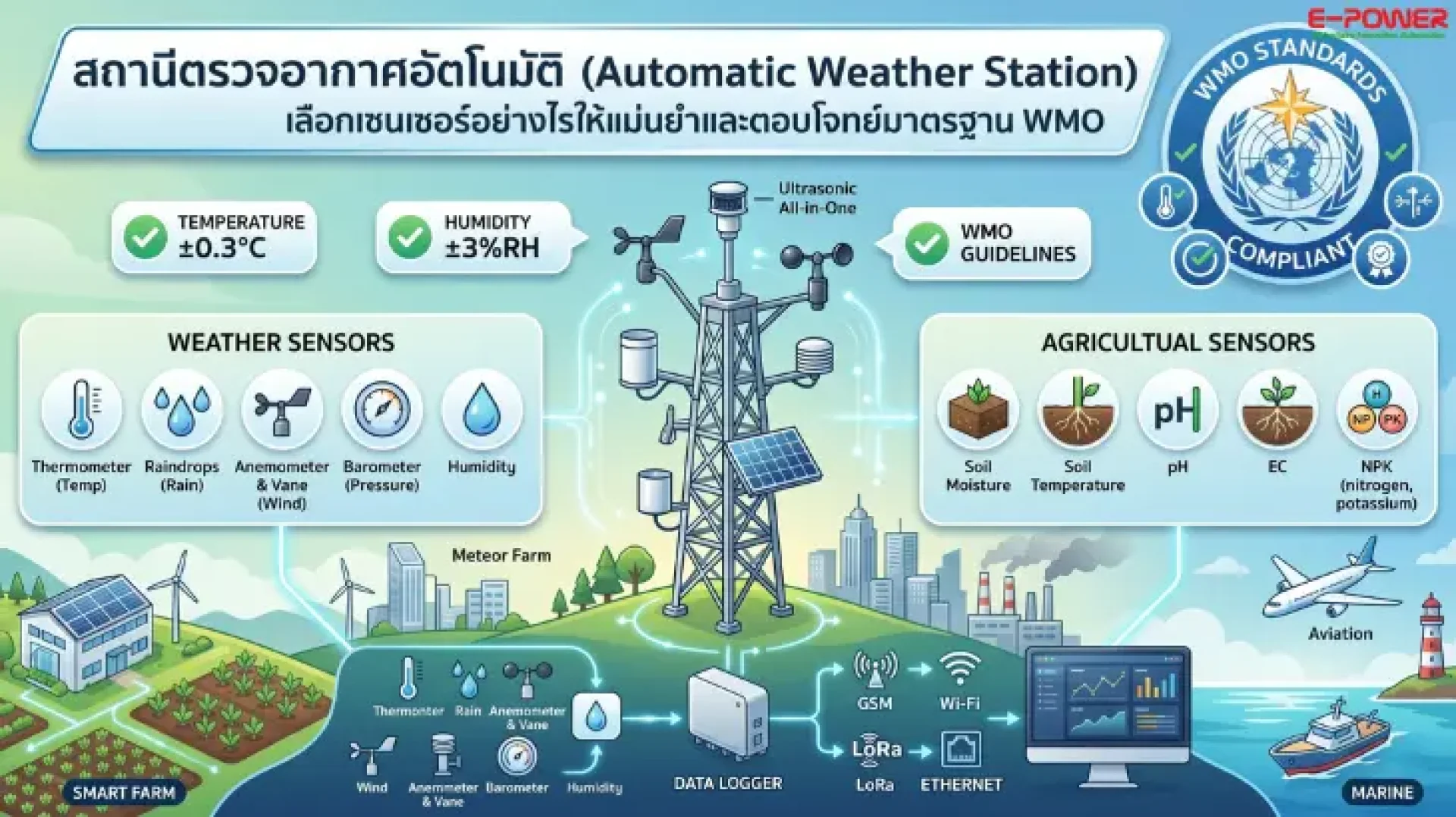
Weather forecasting has evolved from mere observation to high-precision electronic measurement. Modern AWS units can achieve extreme accuracy (e.g., Temperature $pm 0.3°C$, Humidity $pm 3%$ RH). An AWS typically houses sensors for temperature, humidity, wind speed and direction, barometric pressure, precipitation, and UV radiation, transmitting data via wired or wireless connections to a Data Logger.
Types of Automatic Weather Stations (AWS)
Classifying AWS by application ensures the correct sensor selection:
- Meteorological AWS: Focuses on general forecasting with core sensors for wind, temperature, humidity, and pressure, usually installed in open spaces.
- Agricultural AWS: Enhances Smart Farm efficiency by adding Soil Moisture Sensors, soil temperature, pH, EC, and NPK sensors for precision crop planning.
- Aviation AWS: Critical for flight safety, providing Air Traffic Control (ATC) with data to manage takeoffs and landings.
- Marine AWS: Provides wind and wave data for vessel navigation and port operations.
- Industrial AWS: Monitors pollutant dispersion from chimneys to ensure environmental compliance.
Sensor Technology and Measurement
At the heart of an AWS are intelligent sensors utilizing cutting-edge technology:
1.Ultrasonic Automatic Weather Sensor (All-in-one):
Measures multiple parameters without moving parts:
- Wind Speed & Direction: Uses ultrasonic waves to calculate air travel time.
- Temp, Humidity, & Pressure: Utilizes MEMS (Micro-Electrical Systems) to convert physical pressure into electrical signals.
- Precipitation (Rain/Snow): Uses 24GHz radar to detect quantity.
- Solar & UV: Silicon cells convert light into electrical energy to measure intensity.
2. Rain Gauges:
Tipping Bucket: Measures rain in increments (e.g., 0.1mm) by counting mechanical tips.
Radar: Provides high-precision rain and snow measurement without physical contact or high maintenance.
3. Soil Detectors:
- Moisture & EC: Stainless steel probes measure soil electrical properties.
- NPK Sensors: Uses electrochemical methods to analyze primary plant nutrients.
AWS Data Collection Process
For actionable results, an AWS follows these steps:
- Data Acquisition: Receives raw analog signals from various sensors.
- Processing: A microprocessor converts signals into digital formats like RS485 or Modbus.
- Data Logging: Records data with precise timestamps.
- Transmission: Sends data to servers via GSM, Wi-Fi, LoRa, or Ethernet.
- Analysis: Software converts data into visual graphs or reports for easy interpretation.
Precision of the RK900-10 Weather Station
The popular RK900-10 by Rika Sensor provides industry-leading accuracy for diverse applications, ensuring reliable data even in harsh environments.
Conclusion
An Automatic Weather Station (AWS) is an indispensable tool for modern industry. Choosing high-precision sensors and stable transmission systems allows for data-driven decisions. If you are looking for an Automatic Weather Station or high-quality sensors trusted by engineers, visit E-Power Service. We provide expert consultation and system design at www.epower.co.th.