How Visibility Sensors (Visibility Sensors) Enhance Safety and Efficiency in Various Applications
Visibility Sensors (Visibility Sensors) are advanced intelligent devices that play a crucial role in monitoring and assessing atmospheric conditions, enabling precise decision-making amidst volatile weather. In the modern industrial and transportation world, safety and operational efficiency are core priorities that cannot be ignored. "Visibility" is a key natural factor that directly impacts both of these critical areas.
What are Visibility Sensors? And why are they important?
A Visibility Sensor is an industrial measurement device designed to measure Atmospheric Visibility, which refers to the maximum distance an observer can clearly see and identify objects under current weather conditions. Visibility is a fundamental parameter essential in various sectors, including meteorology, aviation, land and rail transportation, environmental monitoring, and industrial plant applications.
Understanding and monitoring visibility in real-time is of paramount importance because it directly affects safety planning, accident risk reduction, the operational efficiency of machinery and personnel, and the maintenance of environmental quality.
Visibility Sensors have become an indispensable tool across industries:
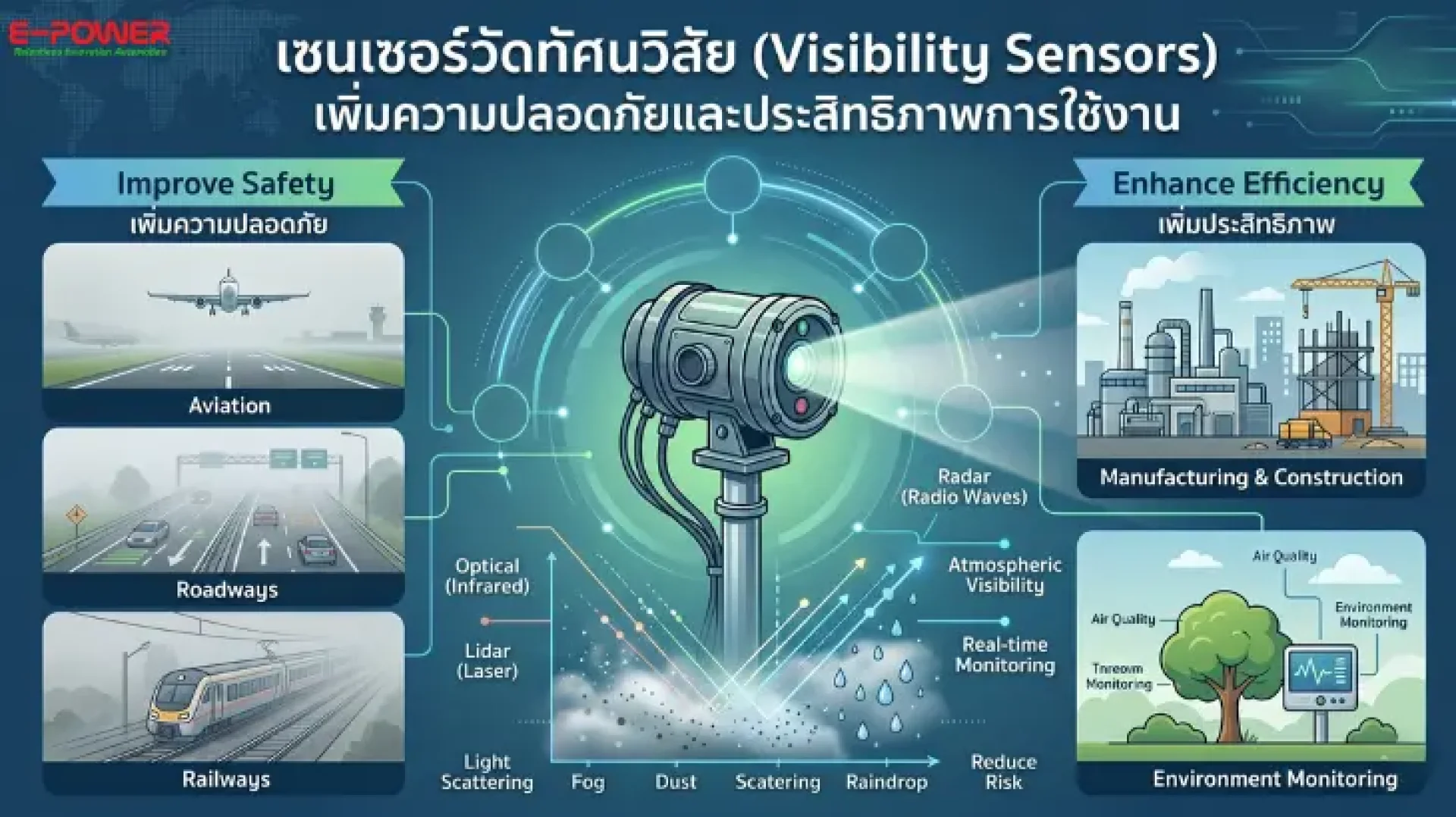
- Aviation: Ensures safety during aircraft takeoff and landing at airports and helipads, assisting pilots in making informed decisions based on real-time visibility data.
- Roadways & Railways: These sensors help manage traffic and elevate road and rail safety by providing data on low-visibility conditions caused by fog, smoke, or heavy snowfall.
- Environmental Monitoring: Contributes to air quality assessments and understanding the dispersion of pollutants.
- Manufacturing & Construction: Helps maintain safe working conditions amidst dust particles or fumes.
Working Principles of Visibility Sensors
Fundamentally, Visibility Sensors operate on the principles of Light Scattering and Detection. The device emits a light source into the atmosphere and measures the amount of light that scatters when it encounters airborne particles, such as dust, fog, smoke, or precipitation. Mathematical algorithms then calculate the detected light intensity into a precise "visibility range".
Types of Industrial Visibility Sensors
To suit a wide variety of applications, visibility sensors come in several types:
- Optical Sensors: The most widely used type, utilizing infrared light to measure visibility. They are versatile and suitable for general visibility monitoring across many sectors.
- Lidar Sensors (Light Detection and Ranging): An advanced technology that uses lasers instead of traditional light sources. This allows for visibility assessment over much longer distances with higher precision, making them indispensable for applications requiring high-resolution data.
- Radar Sensors: Use radio waves to evaluate visibility conditions. Their key strength is operating effectively even in environments with heavy precipitation, such as torrential rain or snow, which might interfere with light-based sensors.
Conclusion
Visibility sensors are an indispensable industrial tool, crucial for safety, efficiency, and environmental monitoring on a global scale. Choosing the right sensor and connecting the data to an efficient monitoring system will create immense added value for your organization.
E-Power Service is ready to be your partner in providing and installing comprehensive visibility sensor solutions and industrial sensor equipment. If you are interested in elevating safety and operational efficiency with IoT technology, contact us at Line Official: @epower.