Water Quality Sensor: The Ultimate Safeguard for Modern Commercial Aquaculture
The ultimate challenge in commercial aquaculture farming—whether cultivating shrimp, barramundi, or high-value economic fish—is the "invisible threat hidden within the water." Because water constitutes the entire environment affecting survival rates and growth, even minor fluctuations in chemical and physical parameters can plunge aquatic livestock into extreme stress, deplete their immune systems, and trigger rapid mass mortality. Transitioning from traditional farm infrastructures to modern smart farm architectures by installing industrial-grade water quality sensors to record and monitor parameters in real-time stands as the definitive proactive strategy to maintain water conditions flawlessly and secure sustainable profitability.
3 Critical Parameters and the Indispensable Industrial Sensors Required
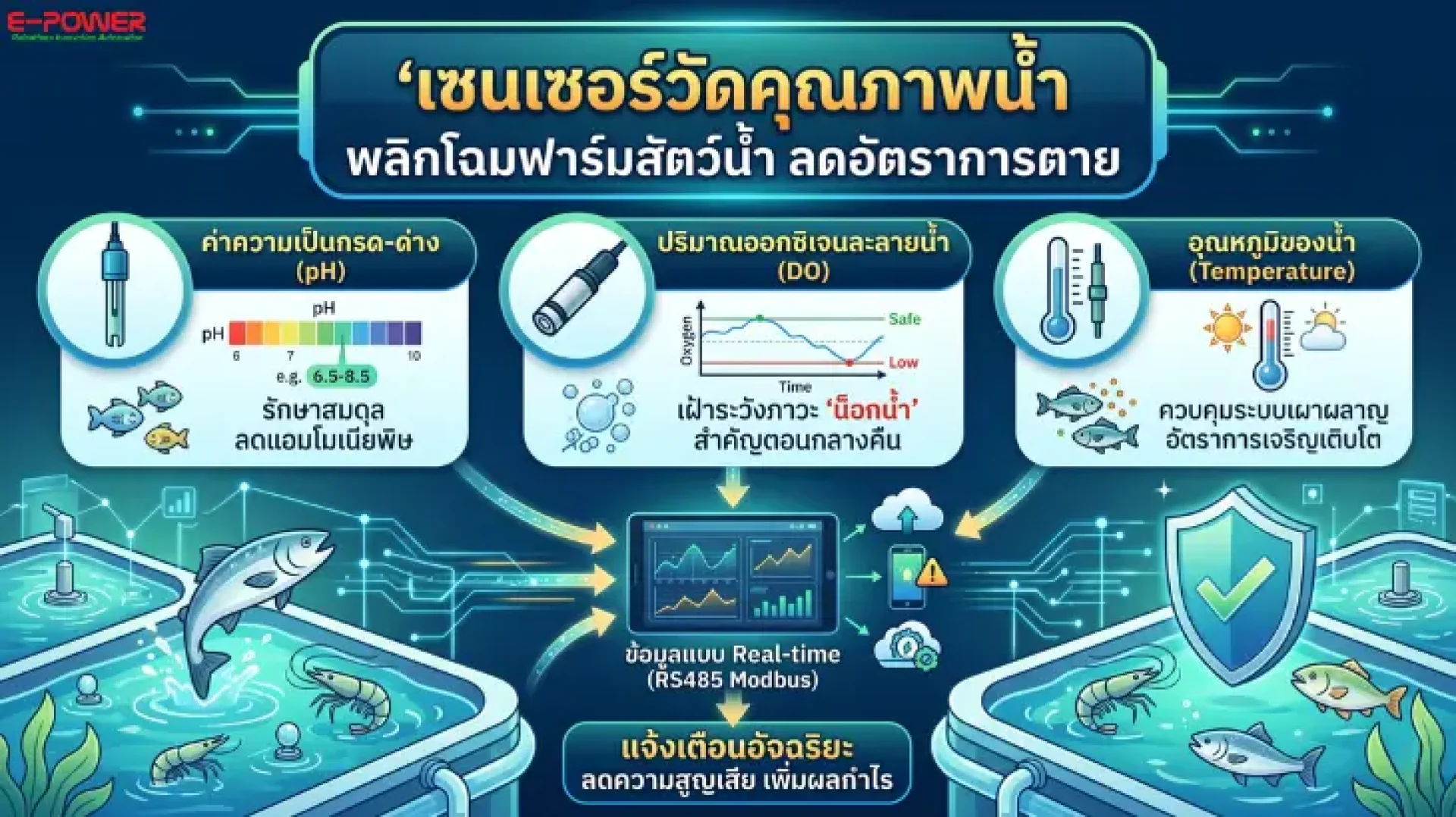
Efficient water management relies entirely on precise data instead of guesswork, utilizing 3 core water quality instruments operating continuously 24/7:
pH Values and Toxic Ammonia Management
The pH balance in aquaculture ponds must remain stable between 6.5–8.5. If the pH shifts by more than 1 unit, the respiratory and blood circulation systems of aquatic animals fail immediately. Furthermore, pH is the critical variable dictating ammonia toxicity. Higher pH levels accelerate the conversion of ammonia into highly toxic un-ionized gas, which rapidly destroys gill structures and causes high mortality rates.
- E-Power Industrial Recommendation: Implement Supmea SUP-PH5011 or Renke RS-PH-* series. These pH sensor sets are specifically engineered to resist algae accumulation and chemical fouling, delivering ultra-stable outputs without signal drift.
Dissolved Oxygen (DO) and Real-Time Hazard Monitoring
The Dissolved Oxygen (DO) level represents the definitive thin line between survival and mortality, with safe thresholds requiring a minimum of 5 mg/L (or 5 ppm). Dangerous oxygen drops often strike abruptly during nighttime hours or sudden overcast weather conditions, rendering manual checks ineffective.
- E-Power Industrial Recommendation: Implement the DO Sensor series, featuring Renke RS-DO-* or Supmea SUP-DM2800. These advanced optical probes (Fluorescence Method) deliver extreme durability over traditional electrochemical systems, completely eliminating the need for frequent electrolyte replacement and massively reducing site maintenance overhead.
Water Temperature as the Metabolic Driver
Aquatic animals are cold-blooded creatures whose biological activities fluctuate directly with water temperature. Excessively high temperatures decrease dissolved oxygen levels while accelerating organic waste decomposition at the pond bottom, generating toxic gases. Conversely, freezing temperatures disrupt metabolism, causing livestock to stop feeding and halting growth rates.
- E-Power Industrial Recommendation: Implement the Renke PT100/PT1000 Temperature Transmitter, or choose the built-in temperature probe integrated into Supmea multi-parameter sensors to consolidate physical and chemical metrics into a single probe, saving installation space within the pond.
Smart Farm System Engineering FAQ
Q: What are the primary operational limitations of using handheld pen-type water quality meters in commercial aquaculture?
- A: Handheld pen-type meters are designed solely for occasional manual spot-checking. Their critical limitation is an inability to continuously monitor or capture sudden parameter emergencies—such as rapid nighttime oxygen drops or intense pH spikes—leaving the farm exposed to extreme crop loss risks.
Q: Why do permanently installed sensors utilizing RS485 Modbus RTU communication deliver superior smart farm results?
- A: The RS485 Modbus RTU protocol allows industrial-grade probes to remain completely submerged, collecting data non-stop 24/7. It transmits a continuous stream of real-time raw data directly to central PLCs or controllers, ensuring the automation architecture identifies water quality shifts second by second.
3. Q: How does a real-time data streaming water quality sensor actively reduce livestock mortality rates in practice?
- A: By feeding real-time data to a central processing unit, engineers can configure the automation architecture to instantly push critical alerts to smartphones the moment parameters breach safe thresholds. Concurrently, the system can autonomously activate paddlewheels and aeration pumps to remediate the water, providing the most effective defense against mass mortality events.
Upgrade to High-Precision Automation with E-Power
Relying on precise sensor metrics requires robust hardware structures and continuous data integration. If your facility aims to deploy a full smart farm ecosystem, E-Power Service Co., Ltd. provides expert consultation alongside premium, heavy-duty water quality instruments engineered explicitly for highly corrosive aquatic environments, featuring high sensitivity to capture rapid chemical shifts.
Farm engineers can seamlessly integrate E-Power’s international-grade pH, DO, and temperature sensors into controllers running world-class CODESYS PLC programming. This configuration establishes closed-loop automation—triggering aerators automatically upon low oxygen detection while uploading telemetry data directly to the cloud-based E-power IoT Platform. This enables comprehensive monitoring from smartphones anywhere in the world and builds historical data logs for long-term trend analysis, minimizing risks, saving energy, and securing stable commercial yields.