How to Choose a Cost-Effective PPFD Sensor : Environmental Instrumentation for Smart Farms and Industry
PPFD Sensor technology plays a vital role in transitioning traditional agriculture into precision agriculture (Precision Agriculture). For modern farming and Smart Farm management—whether in a commercial greenhouse or an indoor vertical farm (Vertical Farming)—every operator and farm engineer knows that "light" is the most critical factor for plant growth. However, relying on a worker's eyes or using standard light meters (Lux Meters) cannot tell you if your crops are getting the correct amount of beneficial light.
With so many options available in the marketplace, how do we select a plant light sensor that offers the best return on investment, long-term durability, and factory-grade data accuracy? Today, E-Power Service has the answers for you.
Get to Know the Basics Before Buying: What Is PPFD and Why Does It Matter?
Before diving into hardware selection criteria, let us break down the science into simple terms. PPFD stands for Photosynthetic Photon Flux Density. In plain English, it means "the density of light particles (photons) hitting a specific area that plants can actually use for photosynthesis."
It counts the exact number of light particles hitting a 1-square-meter area per second within the specific waveband plants use to make food (the PAR band, from 400 to 700 nanometers). It uses the international standard unit: μmol/m²·s.
- If PPFD is too low: Plants grow slowly, developing weak, stretched stems and thin tops, resulting in very low yields.
- If PPFD is too high: (Especially in indoor facilities running heavy grow lights) Leaves will burn, plant cells get damaged, and you waste massive amounts of electricity.
Having an accurate PPFD sensor is like having a trusted health meter for your farm's lighting layout.
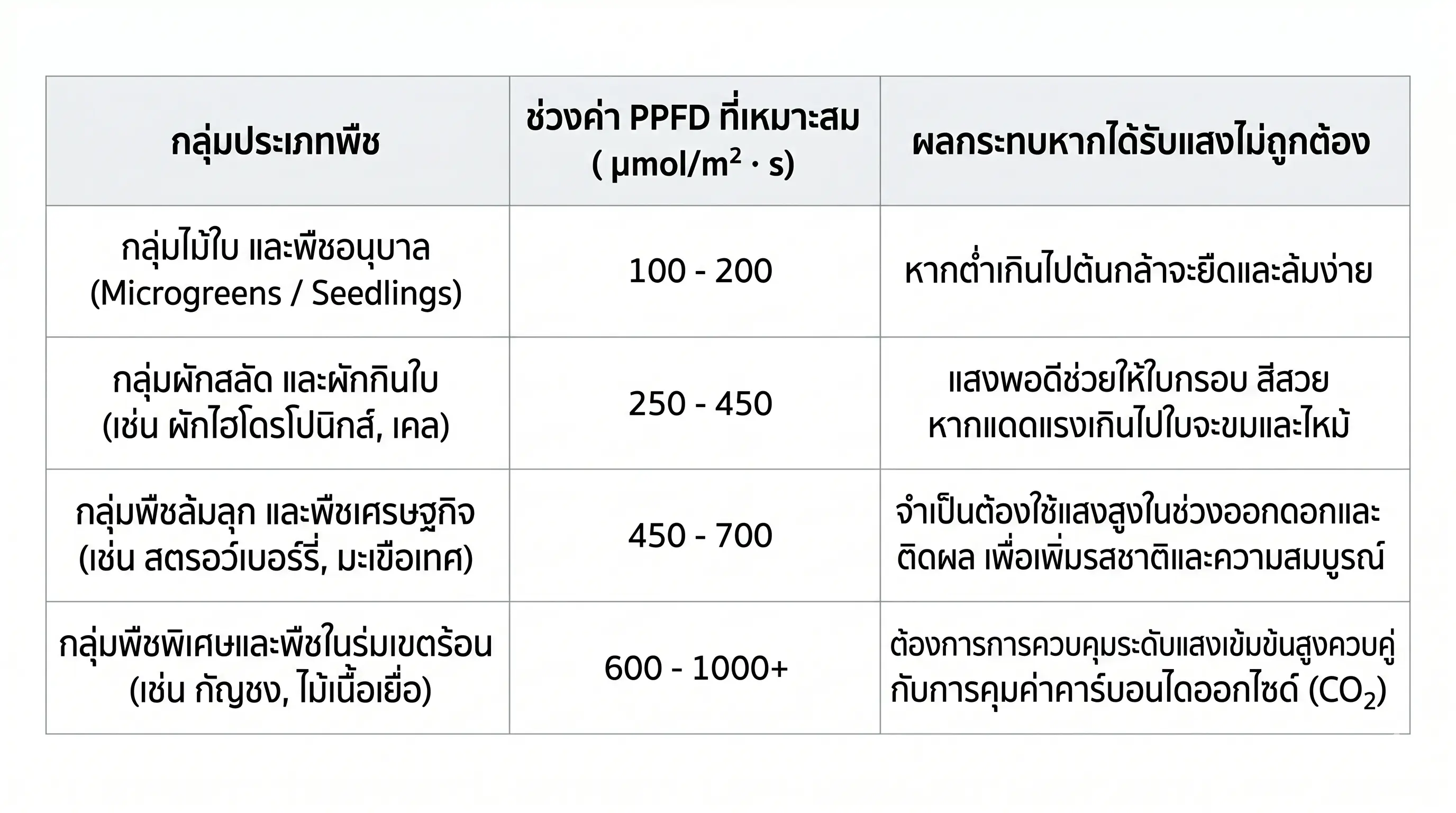
Summary Table: Ideal PPFD Targets for Different Crop Groups
To help your crops thrive without throwing away electricity on over-lighting, you can use these standard PPFD target guidelines as reference values in your farm automation setup
4 Engineering Criteria for Choosing a Industrial Grade PPFD Sensor
If you want your smart farm automation to run stably over many years, look beyond the price tag and focus on these 4 crucial industrial specifications:
1. Pinpoint Spectral Response
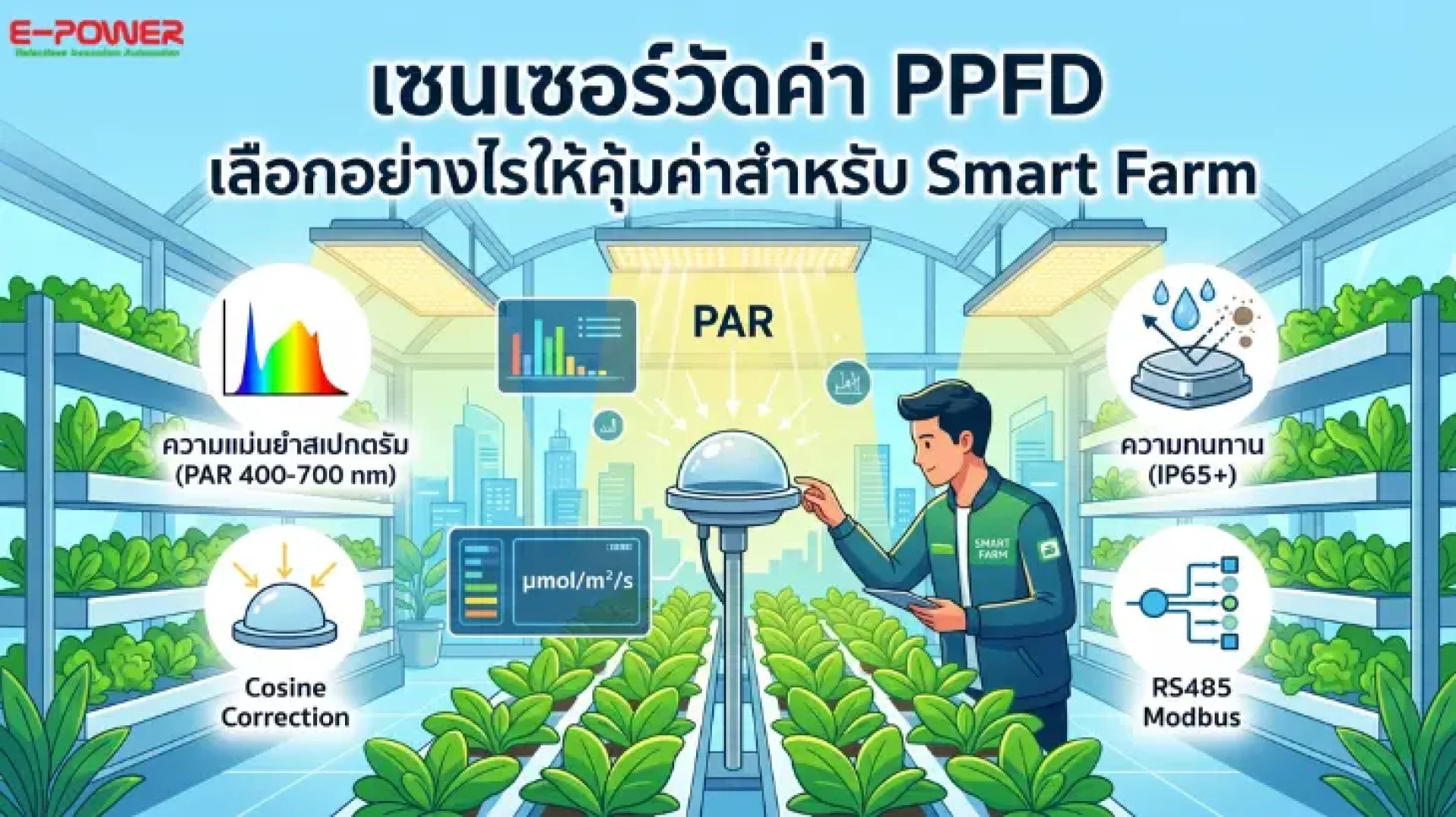
A high-quality sensor must feature a sharp spectral filter. This allows it to isolate and capture light strictly within the 400–700 nm waveband without letting outside heat rays (Infrared/IR) or Ultraviolet (UV) light skew the reading.
2. Weatherproof Protection with a High IP Rating
Because these instruments sit outdoors in soil beds or inside damp greenhouses running heavy misting systems, the hardware body must be built from UV-resistant materials like anodized aluminum. Look for a minimum protection rating of IP65 or higher to prevent internal rust and circuit failure.
3. Optical Glass Dome for Cosine Correction
Industrial sensors should utilize a spherical optical glass dome. This design asset accurately refracts sunlight coming in at sharp angles during early mornings or late afternoons. It also naturally sheds water droplets and dust that might otherwise block the lens.
4. Factory Standard Industrial Interface
For expanding smart farm layouts, choosing a digital output like RS485 Modbus RTU offers the best long-term value. It allows you to run signal lines for up to a kilometer without data loss, resists electrical background noise from heavy water pumps, and wires easily into control boxes.
Highlight Product: Rika RK200-02 PAR/PPFD Sensor from E-Power
If you are looking for a PPFD sensor that hits every single requirement above at a fair price point, E-Power Service Co., Ltd. highly recommends the Rika RK200-02 PAR Sensor. This heavy-duty tool is a trusted choice for top-tier commercial farms.
The Rika RK200-02 uses a highly sensitive silicon photoelectric detector to transform raw photosynthetic active radiation (PAR) into stable, precise PPFD data streams. Encased in a rugged metal shell, it easily handles rain, sun, and dirt while offering an RS485 Modbus RTU interface to keep your control loops fed with real-time, pinpoint lighting metrics.
FAQ: PPFD Sensors
Q: How can we use live PPFD sensor data to automate our farm?
A: You can use real-time data from your sensor to run two major automation loops. 1. In open greenhouses: If natural sunlight gets too hot and the PPFD spikes past a safe limit, the controller triggers shade-net motors to roll out screens and shield the crops. 2. In closed indoor setups: If clouds block the sun and the PPFD drops too low, the system automatically fires up artificial grow lights to make up the difference, keeping daylight levels consistent every single day.
Q: What is the difference between Lux and PPFD? Can I use a Lux meter instead?
A: We strongly advise against using them interchangeably for precision farming. Lux measures brightness based entirely on how human eyes perceive light (our eyes tune into yellow-green waves). However, PPFD measures the actual number of light particles plants absorb to make food (plants favor blue and red waves). A farm using a Lux meter might show high brightness numbers, yet crops can still starve because the light lacks the specific energy wavelengths they need to grow.