What Are the Key Water Quality Parameters for Liquid Cooling Coolant in Data Centers?
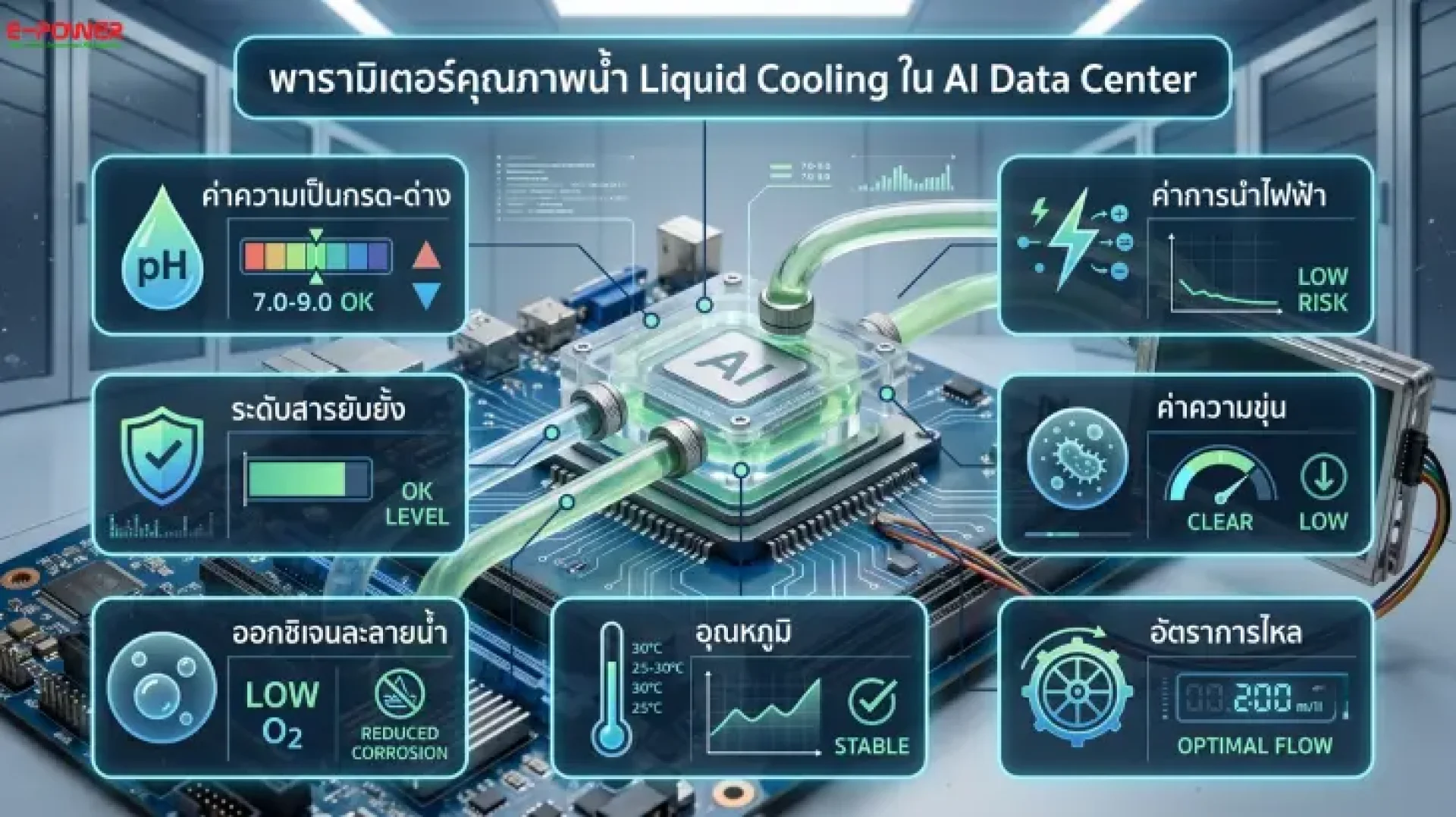
Water quality parameters for coolant are critical factors that are often overlooked in modern data center liquid cooling systems. While most operators concentrate heavily on pumps, cooling distribution units (CDUs), and thermal management hardware, the rapid growth of artificial intelligence (AI), cloud computing, and high-performance computing (HPC) has led to AI servers operating with exceptionally high power densities. This generates far more concentrated heat than traditional air-cooled server infrastructures can handle. Consequently, precise and stable control over coolant water chemistry is the only way to guarantee the safety and operational integrity of these high-value processing assets.
Substandard coolant water quality can rapidly lead to severe operational issues:
- Corrosion of internal loops
- Scaling on thermal interface surfaces
- Microbial contamination and biofouling
- Reduced cooling and heat transfer efficiency
- Premature equipment failure
- Unexpected system downtime
- Expensive hardware replacement and maintenance costs
This is why continuous real-time monitoring of coolant water quality is becoming increasingly critical in liquid-cooled data centers. Industry research demonstrates that cooling infrastructure failures remain a leading cause of unexpected data center downtime. As AI workloads continue to surge, maintaining optimal coolant quality is absolute vital for overall system reliability and optimal Power Usage Effectiveness (PUE).
Why Liquid Cooling Is Becoming the Mainstream Trend in AI Data Centers?
Traditional air cooling systems simply lack the thermal capacity to handle the extreme heat flux densities generated by modern AI GPUs and high-performance accelerators.
AI server clusters utilized for machine learning and Large Language Models (LLMs) consume immense amounts of electricity and produce highly concentrated thermal loads that exceed the physical limitations of conventional airflow-based HVAC systems.
Liquid cooling delivers definitive advantages:
- Significantly higher cooling efficiency
- Superior thermal conductivity and heat transfer performance
- Lower parasitic energy consumption
- Reduced Operational Expenditures (OPEX)
- Enhanced server rack density capabilities
- Improved corporate sustainability metrics
Advanced deployment architectures such as direct-to-chip cooling, immersion cooling, and rear-door heat exchangers are quickly becoming standard implementations in next-generation AI data centers. Because the coolant fluid directly interacts with critical heat-rejection infrastructure, proactive water chemistry management is a primary stability factor.
Why Liquid Cooling Systems Demand Stricter Water Quality Control?
Closed-loop liquid cooling hardware is far more sensitive to fluid chemistry alterations compared to conventional industrial cooling towers or comfort HVAC systems. Even minute changes in coolant composition can trigger severe failures inside precision microchannel cold plates.
- Primary Risks of Substandard Coolant Water Quality:
- High Conductivity: Increases the immediate risk of electrical leakage and component short circuits.
- Low pH: Causes aggressive corrosion on metallic pipes, fittings, and thermal blocks.
- High Turbidity: Leads to suspended debris blockages and reduced coolant flow velocity.
- Dissolved Oxygen: Accelerates internal oxidation and rust formation on metals.
- Biological Contamination: Results in biofilm formation that acts as a thermal insulator.
- Scaling Minerals: Deposits crystalline structures that degrade heat transfer efficiency.
Unlike general industrial water utility loops, AI data center liquid cooling circuits mandate exceptionally stable coolant chemistry, continuous real-time monitoring, rapid anomaly detection alerts, and high-precision instrument sensors. Because a cooling loop failure can instantly compromise multimillion-dollar AI hardware deployments, fluid monitoring is considered a mission-critical operation.
Key Water Quality Parameters for Liquid Cooling Coolant
To maintain a safe, highly efficient, and reliable cooling ecosystem, several water quality parameters must be tracked continuously:
1. pH Level
The pH level scales the relative acidity or alkalinity of the coolant fluid.
- Why It Matters: Deviated pH levels spark aggressive metal degradation and structural component damage. Copper, aluminum, and stainless steel assemblies inside the closed loops are highly sensitive to chemical imbalances.
- Recommended Control Range: Typically between 7.0 and 9.0 (neutral to mildly alkaline), depending on the specific coolant formulation and OEM hardware guidelines.
- Consequences of Exceeding Limits: Low pH levels prompt high corrosion risks, while high pH levels accelerate mineral scaling and sediment deposits.
- Corresponding Sensor: Online industrial pH sensors / heavy-duty pH transmitters.
2. Electrical Conductivity (EC)
Electrical conductivity tracks the total concentration of dissolved ionic particles, reflecting the fluid's capacity to conduct an electric current.
- Why It Matters: Conductivity control is paramount in AI server infrastructure. Elevated EC levels multiply the risks of localized electrical leakage, short circuits, and catastrophic server card destruction.
- Recommended Control Range: Ultra-pure or highly treated coolant formulations demand extremely low conductivity thresholds.
- Consequences of High Conductivity: Accelerated galvanic corrosion, severe electrical risks, and overall fluid instability.
- Corresponding Sensor: Industrial EC conductivity sensors / inline TDS sensors.
3. Turbidity
Turbidity measures the presence of suspended particulate matter and optical cloudiness within the fluid.
- Why It Matters: Spikes in turbidity indicate internal system contamination, such as circulating rust flakes, microbiological blooms, sediment, or loose corrosion debris. These particles quickly accumulate and clog server cold plate microchannels, strangling heat transfer.
- Recommended Control Range: Kept as close to zero NTU as possible.
- Consequences of High Turbidity: Restricted fluid flow, mechanical pump impeller damage, compromised heat transfer, and full channel blockages.
- Corresponding Sensor: Optical turbidity sensors / industrial water quality sensors.
4. Dissolved Oxygen (DO)
Dissolved oxygen quantifies the amount of gaseous oxygen trapped within the liquid medium.
- Why It Matters: Free oxygen serves as a primary catalyst for metal oxidation, pitting corrosion, and rapid structural degradation of inner loop plumbing.
- Recommended Control Range: Strictly controlled at the lowest achievable levels.
- Consequences of High DO: Rapidly accelerated corrosion, shortened component life cycles, and increased unscheduled preventive maintenance requirements.
- Corresponding Sensor: Industrial optical Dissolved Oxygen (DO) sensors.
5. Temperature
- Why It Matters: Coolant temperature directly governs thermal dissipation capacity, approach temperatures, and overall hardware reliability. Uncharacteristic temperature fluctuations serve as early warning signs for underlying loop issues like flow restrictions, pump wear, or heat exchanger scaling.
- Corresponding Sensor: High-accuracy industrial temperature sensors / RTD sensor assemblies.
6. Flow Rate
- Why It Matters: Maintaining a stable, uninhibited volumetric flow rate is mandatory to sustain target server temperatures under variable compute loads. Low flow states cause swift localized thermal hotspots, triggering emergency server throttling or severe processor overheating.
- Corresponding Sensor: Electromagnetic flow meters / non-contact ultrasonic flow sensors.
Conclusion
Liquid cooling has solidified its position as the foundational cooling architecture for contemporary AI data centers due to its unrivaled thermal management efficiency and compatibility with ultra-dense computing arrays. Nonetheless, coolant water chemistry remains a critical, frequently under-evaluated risk vector. Strategic tracking of parameters like pH, conductivity, turbidity, dissolved oxygen, flow rate, and temperature directly dictates cooling reliability, equipment service life, and long-term facility uptime.
Transitioning to continuous, real-time tracking via industrial-grade water quality sensors empowers data center operators to actively intercept corrosion, biological scaling, and short-circuit hazards before they escalate into catastrophic cooling failures. As AI processing infrastructure continues to scale globally, intelligent online coolant chemistry management will remain a vital prerequisite for secure, energy-efficient data center operations.
Frequently Asked Questions (FAQs)
Q1: Is continuous real-time monitoring genuinely required, or is routine manual sampling sufficient?
Answer: Manual grab sampling leaves large data gaps that miss sudden chemical shifts or swift contaminant ingress, which can permanently damage sensitive heat-rejection pathways. Online real-time monitoring ensures immediate anomaly detection and provides instant automated alerts for proactive mitigation.
Q2: What occurs if the pH value of the coolant drops beneath the recommended specification?
Answer: A drop in pH indicates that the fluid is becoming acidic. Acidic coolant significantly accelerates galvanic and uniform corrosion, compromising the structural integrity of manifolds, heat exchangers, pumps, and server cold plates.
Q3: Why is fluid electrical conductivity so critical in AI server liquid cooling?
Answer: Elevated conductivity denotes a high concentration of dissolved ions in the water. Should a microscopic leak or spray event occur, high-conductivity fluids easily initiate electrical tracking, shorts, and catastrophic destruction of high-cost AI computing silicon.
Q4: What does a rise in coolant turbidity imply, and how fast can it degrade the system?
Answer: Rising turbidity points to active corrosion, particle shedding, or raw biological growth within the loop. Because server cold plates feature precision microchannels measured in microns, suspended solids can accumulate and obstruct these paths within days, causing immediate localized thermal spikes.
Q5: What are the long-term financial consequences of NOT monitoring coolant water chemistry?
Answer: Operating a liquid cooling loop blind to water quality exposes the data center to aggressive pipe degradation, catastrophic server component failures, diminished thermal efficiency, costly emergency maintenance overrides, and devastating unscheduled facility downtime.