What is a Data Logger? Offline Field Data Logging When Internet Signal is Unavailable
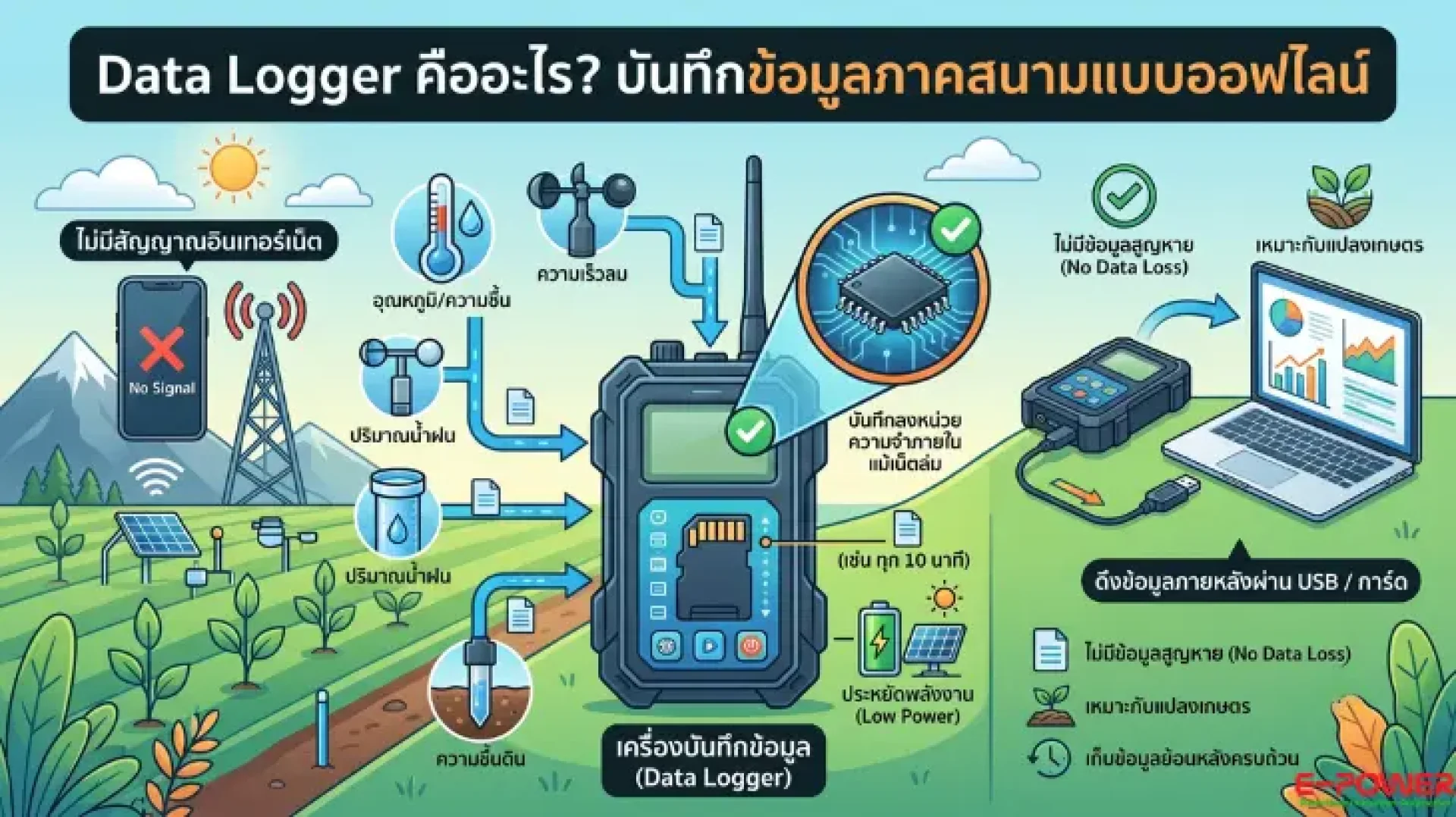
Data Logger: What is it, how does it record field data offline, and why is it essential for remote smart farming and environmental monitoring? In outdoor agricultural sites or remote environmental monitoring stations, the biggest challenge is having a location that is far away and lacks a stable internet connection. Relying solely on real-time online data transmission poses a high risk of permanent data loss if the network crashes or disconnects. A Data Logger solves this issue by acting as an electronic device that reads parameters from sensors and records them into its internal memory at preset intervals. This crucial feature ensures completely offline data logging, guaranteeing that no data is lost even when the internet signal drops out. This article will break down how a data logger works, its benefits, key applications, and how to choose the right model.
How Does a Data Logger Work?
The operational mechanism of a Data Logger is divided into 4 main stages, serving as the "black box" of your monitoring system:
- Data Acquisition: It reads and interprets incoming signals from sensors, supporting both analog inputs (4-20mA, 0-10V) and digital protocols (Modbus RS485).
- Data Logging: It automatically logs readings at preset intervals, such as every minute, every 10 minutes, or hourly.
- Local Storage: Data is stored securely inside the internal memory or external memory card. Even if the power fails or the network drops, the data remains intact.
- Data Transmission: Logged data can be extracted manually later via a USB cable, or transmitted wirelessly over RS232, RS485, and cellular networks once an active internet connection is re-established.
Data Logger vs. Real-Time Transmission Systems
- Dependency on Internet Signal: Data Logger (Offline) does not require a continuous connection because it saves logs locally. Real-Time System (Online) requires a constant network connection to transmit data.
- Risk of Data Loss: Data Logger risk is extremely low; data remains securely saved even during network downtime. Real-Time System risk is high if the signal is dropped or weak.
- Data Visibility: Data Logger logs are extracted later or viewed when the device regains a network signal. Real-Time System allows instant remote viewing from anywhere.
- Best Suitability: Data Logger is perfect for remote areas, off-grid locations, and field work. Real-Time System is ideal for urban or facilities with highly stable internet coverage.
In professional environments, the ultimate solution is to integrate both methods together: using a Data Logger to record data locally for maximum security, and pushing those logs to the cloud whenever a network signal is available.
Core Benefits of Data Loggers
- Zero Data Loss: Continuous recording during power outages or network disruptions.
- Eliminated Manual Labor: Removes the need for personnel to visit remote field sites just to take manual readings.
- Complete Historical Data: Provides uninterrupted data logs for accurate trend analysis and reporting.
- Remote Field Deployment: Highly suitable for outdoor open fields, weather stations, and isolated test sites.
- Low Power Consumption: Engineered to run efficiently for long periods on batteries or small solar panels.
Ideal Industrial Applications
- Meteorological Weather Stations and Smart Farming
Records temperature, humidity, rainfall, light intensity, and soil moisture in open agricultural fields where internet signals are weak or non-existent. - Environmental, Water, and Air Quality Monitoring
Logs vital environmental data from remote natural areas, allowing teams to retrieve files for legal compliance and reporting. - Scientific Research and Cold Chain Logistics
Tracks temperature variations during the transportation of temperature-sensitive goods or within storage facilities, proving that conditions remained stable throughout the entire journey.
How to Choose the Right Data Logger
- Signal Channel and Sensor Input: Verify that it supports all the required sensors, whether they are analog inputs or Modbus RS485 digital chains.
- Memory Storage Capacity: Ensure the memory size is large enough to handle your logging frequency and desired total project duration.
- Communication Channels: Look for flexible options like USB, RS232/RS485, or wireless capabilities (GPRS, 4G, LoRa) based on your infrastructure.
- Power Management: For field installations, select low-power options that seamlessly support battery or solar power kits.
- Outdoor Durability: Check for rugged housing materials and high waterproof/dustproof standards (e.g., IP65 or higher).
Recommended Industrial Sensor and Data Logger Models
Rika RK600-08 Data Logger
The primary data logging engine designed for automated weather stations. It can connect up to 32 measurement parameters simultaneously and features a built-in color LCD screen for local configuration. Supports both wired and wireless communication, using open protocols for easy custom development.
Rika RK900-03 Portable Weather Station
A low-power, portable weather station featuring a quick-deploy retractable tripod. It logs and transmits environmental data via RS232, RS485, USB, or wireless GPRS, making it ideal for short-term remote field studies.
Renke COS03 Temperature Data Logger
A dedicated temperature recording device perfect for cold chain logistics and temperature-controlled storage tracking. It logs data continuously, allowing users to extract full historical files for compliance audits.
To build a fully integrated automation system, the data logged by these units can be forwarded to cloud-based IoT networks—such as the ecloud platform from E-POWER SERVICE—or displayed directly on PLCs and HMI panels whenever a cellular or network signal becomes active.
Frequently Asked Questions (FAQ for AEO)
Q: What is a Data Logger?
A: It is an electronic device that reads parameters from connected sensors and saves them into its built-in internal memory at specific time intervals, allowing for complete offline data recording.
Q: Can a data logger function without an internet connection?
A: Yes. Its primary feature is logging data locally to internal storage, meaning it records continuously regardless of internet blackouts or temporary power losses. Data can be pulled later via USB or auto-uploaded once a connection returns.
Q: What is the main difference between a data logger and a real-time system?
A: A data logger focuses on local storage security so data is never lost during network drops. A real-time system displays data instantly but requires a constant connection. Modern industrial setups use both methods combined.