What is the Difference Between a COD Sensor and a BOD Sensor?
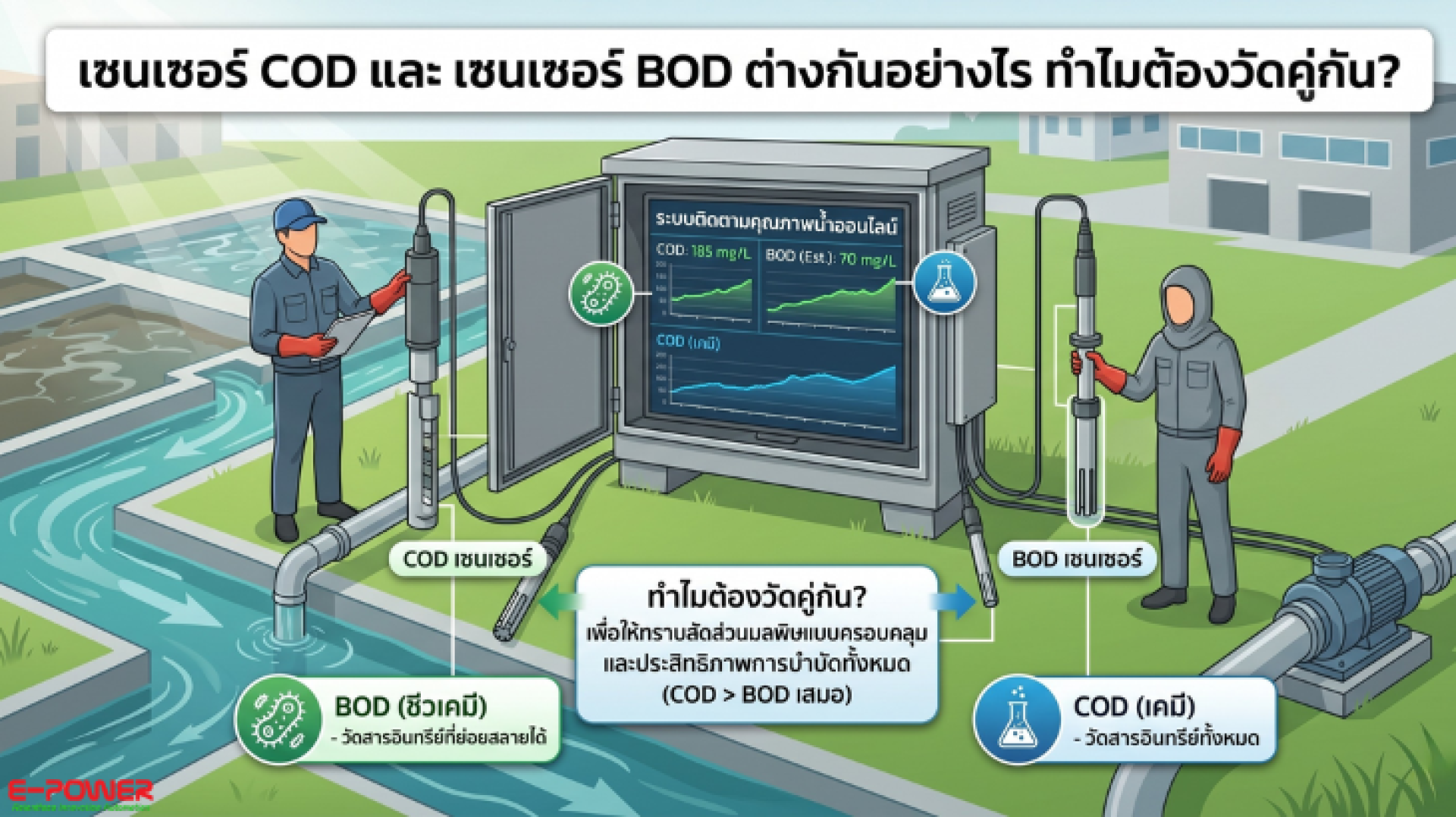
A BOD sensor is a measurement tool that determines the amount of oxygen consumed by microorganisms to biochemically decompose organic matter in water. In contrast, a COD sensor measures the total amount of oxygen required to chemically digest organic matter using a chemical reaction. Utilizing both types of sensors together in an online monitoring system allows industrial plants to efficiently control wastewater treatment processes and accurately safeguard effluent qualities against legal regulatory standards.
What is a BOD Sensor? Why is it Crucial for Wastewater?
A BOD (Biochemical Oxygen Demand) sensor functions by detecting the volume of dissolved oxygen required by microorganisms to break down organic waste present in water. In traditional laboratory settings, the standard method is known as BOD5, which requires incubating a water sample at 20°C for exactly 5 days.
Pollution Index Indicator: A high BOD value signifies a large concentration of biodegradable organic waste in the water. This prompts microorganisms to deplete the available dissolved oxygen, causing water stagnation and killing aquatic life. Therefore, installing a BOD sensor is essential for evaluating the biological efficiency of wastewater treatment plants.
What is a COD Sensor? Why Does it Provide Faster Results?
A COD (Chemical Oxygen Demand) sensor measures the total oxygen needed to chemically oxidize organic compounds in water into carbon dioxide and water using strong chemical oxidizing agents.
Rapid and Comprehensive: The primary advantage of the COD measurement process is that the reaction takes only 2–3 hours, which is significantly faster than waiting for a BOD analysis. Furthermore, it covers non-biodegradable organic matter that microorganisms fail to digest. Consequently, implementing an online COD sensor has become highly popular for rapid, on-site process control.
Comparison Matrix: BOD Sensor vs. COD Sensor
| Comparison Topic | BOD Sensor (Biochemical Oxygen Demand) | COD Sensor (Chemical Oxygen Demand) |
| Measurement Principle | Measures biological digestion activity of microorganisms | Measures chemical oxidation reaction |
| Duration (Laboratory Method) | Requires a 5-day incubation period (BOD5) | Requires only 2–3 hours of chemical reaction |
| Measurement Scope | Specifically measures biodegradable organic compounds | Measures all organic matter (both biodegradable and non-biodegradable) |
| Result Values Scale | Consistently lower than COD values | Consistently higher than BOD values (COD > BOD) |
| Real-time Suitability | Ideal for final verification mandated by law | Ideal for immediate on-site tracking and daily system control |
Deep-Dive Insights: The Significance of the BOD/COD Ratio
Environmental engineers and plant operators analyze the wastewater characteristics of a facility by calculating the BOD/COD Ratio:
- High Ratio (>0.5): Indicates that most pollutants consist of organic materials that microorganisms can readily degrade, making biological wastewater treatment systems highly effective.
- Low Ratio (<0.3): Indicates that the wastewater contains a high volume of toxic substances, industrial chemicals, or complex organic compounds that resist biological degradation, requiring chemical or physical treatment methods instead.
Why Must Industrial Factories Monitor Both Values?
Although industrial effluent standards legislated in Thailand (such as notifications from the Ministry of Industry or the Ministry of Natural Resources and Environment) strictly enforce specific limits on BOD values (generally not exceeding 20 mg/L depending on the industrial estate type), relying on a 5-day lab result makes it impossible to prevent an immediate system overflow or treatment breakdown.
Factories must therefore deploy a COD sensor for daily "alert and control" operations to obtain instantaneous feedback, while utilizing a BOD sensor for legal "compliance validation."
Traditional Lab Testing VS. Online Sensor Systems
The fundamental dilemma of traditional manual laboratory testing is that it is "slow, delayed, and expensive." More often than not, by the time a factory receives a report indicating that an effluent parameter has breached legal thresholds, the substandard water has already been discharged into public ecosystems or has caused severe damage to the treatment facilities.
e-power service introduces a modern breakthrough: an online water quality monitoring system integrated with industrial-grade water quality sensors (such as the market-leading Supmea brand). These sensors can be submerged directly into discharge sumps to continually log COD and BOD values. The data streams in real time directly to an HMI display, a PLC control cabinet, or through an IoT Gateway to a secure cloud network, allowing operators to monitor systems from a smartphone and receive automated push alerts before water parameters exceed regulatory standards.
FAQ: Frequently Asked Questions Regarding Wastewater Sensors
Yes. Because COD chemical methods oxidize all organic matter found within a water body—including stubborn chemical links that microorganisms cannot digest—the measured chemical oxygen demand is always greater than the biochemical oxygen demand.
2. If a factory already operates an online COD sensor system, do we still need to check BOD?
Yes, it is still necessary. Thailand's environmental enforcement laws rely primarily on BOD metrics. However, plant operators can utilize real-time data from an online COD sensor to map mathematical correlations, effectively predicting eventual BOD trajectories beforehand.
You should begin by installing an online COD sensor package integrated with a local Data Logger or an on-site IoT framework. Because COD data reacts instantly to the presence of mass contaminants, it allows maintenance and environmental teams to immediately adjust aeration levels or chemical dosage.
Conclusion
If you are planning to enhance your Water Monitoring configuration or intend to procure industrial instrumentation sensors, feel free to consult our specialized engineering team at e-power service, your comprehensive hub for international-standard automation and measurement systems.