Precision Agriculture vs. Smart Farm: What Is the Difference? A 5-Minute Guide
In an era where technology disrupts every industry, "Agriculture" is undergoing a massive transformation. The terms we hear most frequently are Smart Farm and Precision Agriculture. While many people mistakenly use them interchangeably, they are completely different in terms of technological depth and application.
Although both concepts share the same ultimate goal—maximizing production efficiency—their approaches vary significantly. This article will take you on a deep dive into how these two systems differ and how to choose the right fit for your modern agribusiness.
What Is a Smart Farm?
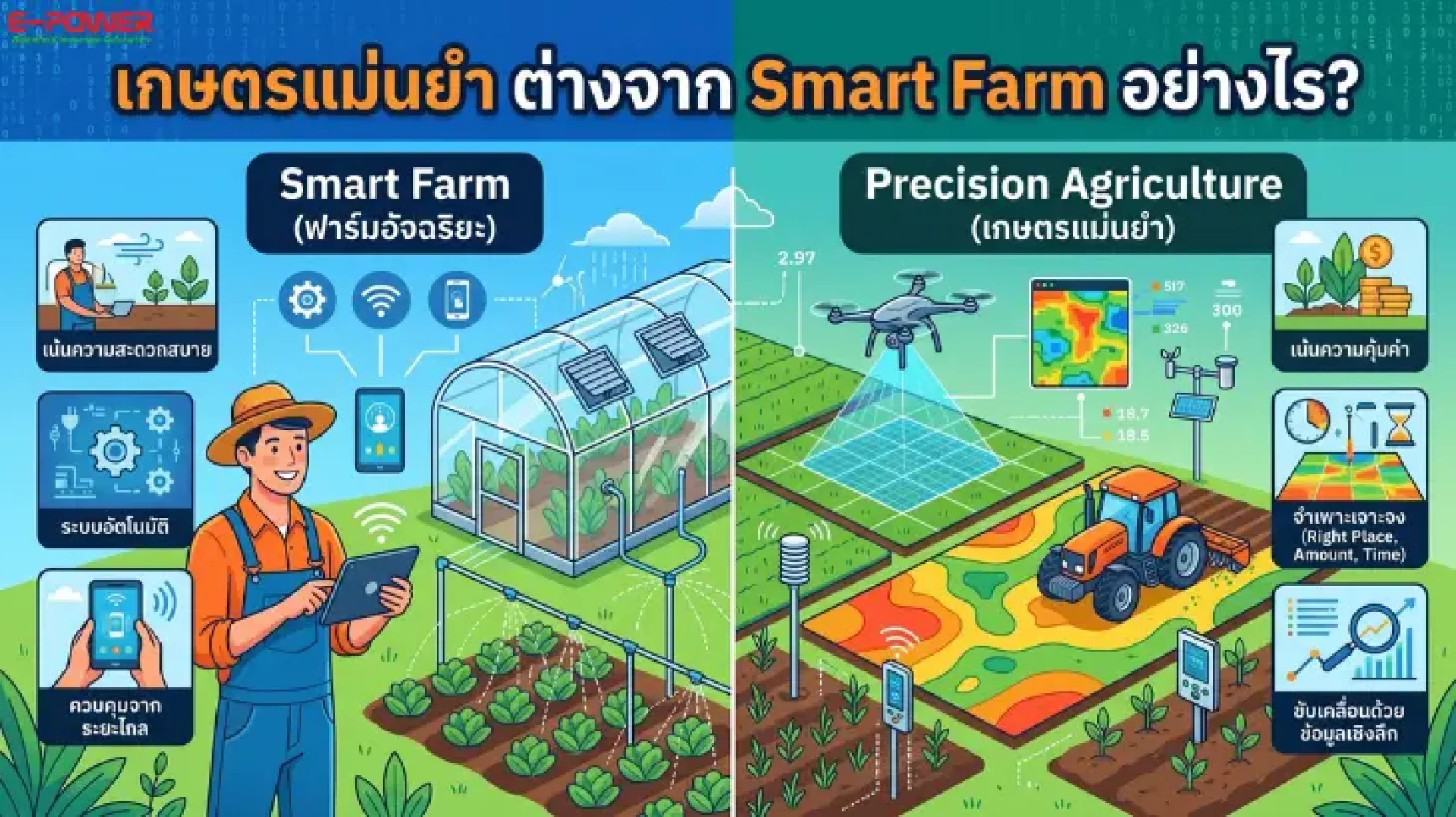
A Smart Farm focuses on farm management through the integration of modern technology and automation systems to enhance convenience and reduce human labor. The core infrastructure of a Smart Farm revolves around the Internet of Things (IoT Agriculture).
For instance, installing Agriculture Sensors to monitor environmental conditions and transmitting that data to a smartphone allows farmers to remotely control irrigation, activate misting systems, or manage a Smart Greenhouse from anywhere.
Key Strength of Smart Farm: Focuses on overall "intelligence and convenience," making farm management effortless from any location at any time.
What Is Precision Agriculture?
Precision Agriculture is an advanced evolution that builds upon the foundation of a Smart Farm. It zeroes in on "accuracy, precision, and specificity (Right Place, Right Time, Right Amount)" driven by deep data analysis (Data-Driven).
Instead of just triggering general automated watering schedules, Precision Agriculture processes data from automated Weather Stations, Soil pH sensors, satellite imagery, and agricultural drones. This data calculates exactly how many liters of water or what specific blend of fertilizer a crop needs down to the exact square meter.
Key Strength of Precision Agriculture: Focuses on "true cost-efficiency and waste reduction," preventing resource depletion while maximizing yield per acre.
Comparison Table: Precision Agriculture vs. Smart Farm
To give you a clearer picture, here is a direct breakdown of how they compare:
| Comparison Points | Smart Farm | Precision Agriculture |
| Core Goal | Enhances convenience, reduces labor, and enables remote control. | Maximizes efficiency, reduces costs, and eliminates resource waste. |
| Operation | Operates based on preset schedules or general environmental conditions. | Operates specifically based on real-time location data and soil/crop insights. |
| Operation | IoT systems, mobile apps, temperature, and humidity sensors. | Weather Stations, high-precision sensors (e.g., PPFD, Soil pH), AI, and GPS tracking. |
| Operation | Turning on sprinklers via a smartphone when the weather gets too hot. | Dispensing fertilizer only in specific zones where the soil lacks nutrients based on sensor data. |
Why Integrating Both Systems Is the Ultimate Solution
In practice, a Smart Farm and Precision Agriculture should work hand in hand. If you want to transform a traditional farm into a highly stable, modern enterprise, automation (Smart) alone isn't enough; you need high-precision data (Precision) to act as the brain behind those automated actions.
The secret to success in modern farming lies in choosing industrial-grade sensors and tools. At E-POWER SERVICE, we are experts in agricultural Automation and IoT systems, offering global-standard innovations to elevate your farm:
- Agriculture Sensors: High-end sensors such as PPFD (Photosynthetic Photon Flux Density) sensors and soil parameters (Soil pH, EC, Moisture) for high-precision farming.
- Weather Station: Essential tools for forecasting and preparing for unpredictable weather shifts.
- Smart Greenhouse: Driven by advanced control technologies to create the perfect environment for your high-value crops.
Whether you want to start a Smart Farm or upgrade to high-level Precision Agriculture, the engineering team at E-POWER SERVICE is ready to consult, design, and install flexible, stable, and future-proof systems to turn your farm data into sustainable profits.
Elevate your agribusiness to ultimate precision with us today: www.epower.co.th
Frequently Asked Questions
Q: What sensors are required for high-precision agriculture?
A: Precision agriculture requires specialized Agriculture Sensors such as PPFD light intensity sensors, soil moisture and nutrient sensors (Soil EC/pH), and automated Weather Stations to deeply analyze microclimate conditions.
Q: How does a Smart Farm help reduce operational costs?
A: A Smart Farm cuts costs by reducing human labor and time through automation. When combined with precision agriculture, it significantly drives down the cost of water, fertilizer, and chemical treatments by preventing overuse.