PAR vs. PPFD vs. Pyranometer: Key Differences and How to Choose the Right Plant Light Sensor
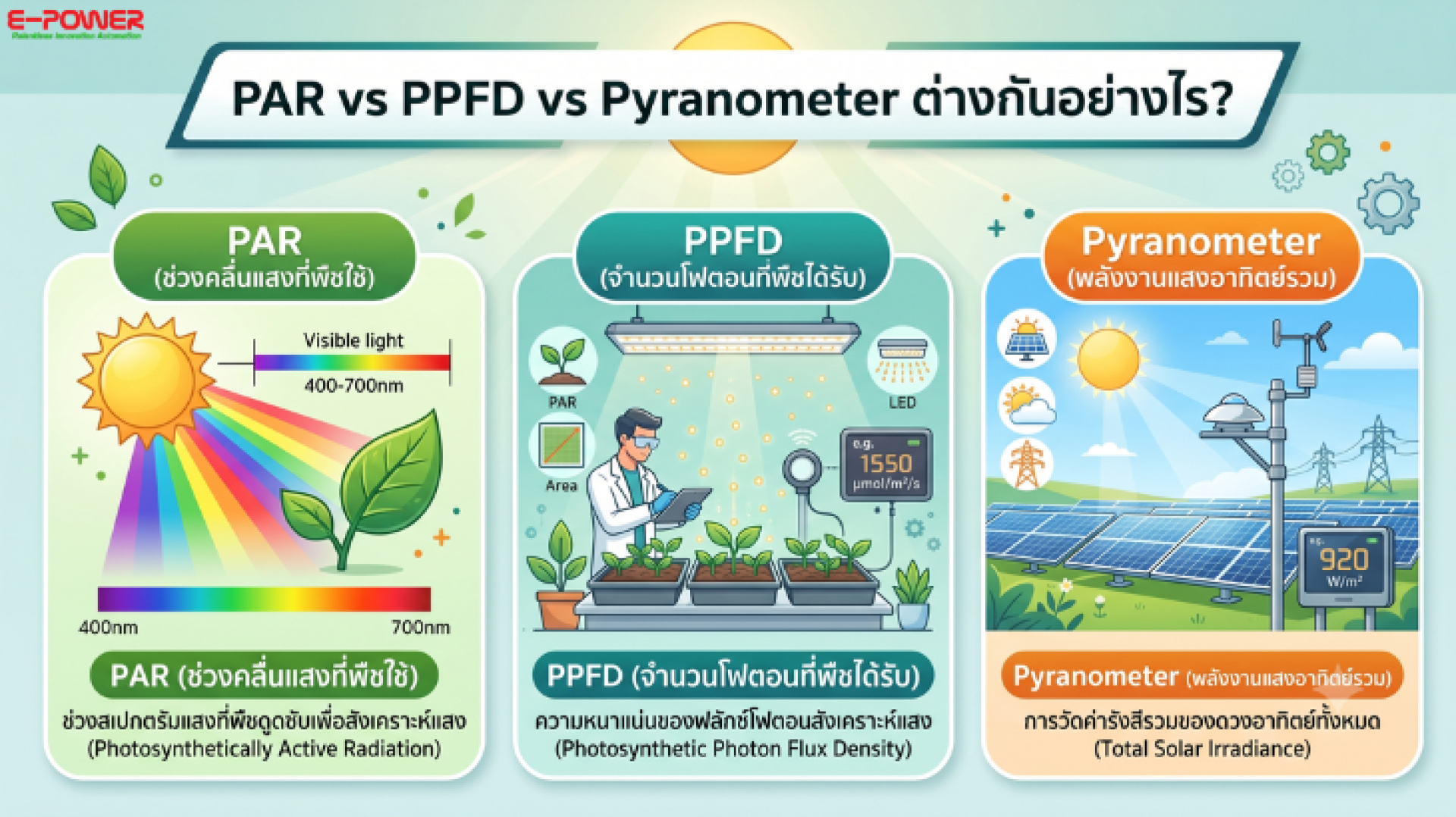
PAR vs. PPFD vs. Pyranometer : What is the difference, and which sensor should you choose for your plant light measurement? One of the most common confusions among Smart Farm operators is how these three terms are used interchangeably. In reality, they measure completely different things. Selecting the wrong sensor can lead to inaccurate greenhouse light evaluations or flawed solar panel yield assessments. This article provides an easy-to-understand breakdown of these tools and guides you to the right choice for your application.
What is PAR?
PAR (Photosynthetically Active Radiation) defines the specific waveband of light that plants utilize for photosynthesis, spanning from 400 to 700 nanometers. This wavelength range is exactly where chlorophyll in plant leaves absorbs light energy to drive growth.
A crucial point to understand is that PAR is a conceptual waveband, not a direct measurable value or unit. When people say they are "measuring PAR," they are actually measuring the intensity of light within this range. The actual numeric value obtained from this measurement is called PPFD.
What is PPFD?
PPFD (Photosynthetic Photon Flux Density) measures the actual number of photons within the PAR waveband that hit a one-square-meter surface per second. It is quantified in micromoles per square meter per second ($mutext{mol/m}^2/text{s}$).
PPFD is the actual data that farmers and greenhouse designers use because it tells them exactly how much usable light the plants are receiving at any given moment, whether from natural sunlight or grow lights. The device used to measure this value is called a Quantum Sensor or PAR Sensor.
What is a Pyranometer?
A Pyranometer is an instrument designed to measure total solar irradiance (total solar radiation energy) hitting a flat surface across a wide spectrum, typically from 300 to 2,800 nanometers. This encompasses both visible and invisible light waves and is measured in Watts per square meter ($text{W/m}^2$).
Unlike a PAR sensor, a Pyranometer measures total thermal energy rather than the specific photon count utilized by plants. Therefore, it is ideal for:
- Assessing the efficiency and yield of solar PV systems.
- Weather stations and meteorological research.
- Calculating Evapotranspiration (ETo) to automate high-precision irrigation.
High-quality pyranometers are classified under the international ISO 9060 standard into Class A, Class B, and Class C (with Class A offering the highest accuracy) to fit various industrial requirements and budgets.
Comparison Table: PAR Sensor (PPFD) vs. Pyranometer
| Feature | PAR Sensor (Measures PPFD) | Pyranometer |
| What It Measures | Photon count within the 400–700 nm range. | Total solar radiation energy across the full spectrum. |
| Unit | µmol/m²/s |
W/m² |
| Key Insights | Usable light energy available for plant photosynthesis. | Total raw solar power hitting the surface area. |
| Best Applications | Greenhouses, LED grow lights, and DLI calculations. | Solar farms, meteorological weather stations, and ETo calculations. |
| Spectral Range | Narrow (plant-specific wavelengths only). | Broad (covers full solar spectrum). |
Can You Use a Lux Meter for Plant Light Measurement?
Using a standard Lux Meter for plant cultivation is highly discouraged. Lux meters are calibrated based on human eye sensitivity, which peaks around 555 nanometers (green light). Plants, however, primarily absorb blue and red light for photosynthesis.
Using a Lux Meter on agricultural grow lights—especially specific-spectrum LED grow lights—results in highly inaccurate readings. For professional crop production, always use a dedicated PAR Sensor that measures actual PPFD.
DLI: The Daily Light Integral for Smart Farms
When you accumulate PPFD readings throughout the entire day, you get the DLI (Daily Light Integral), measured in $text{mol/m}^2/text{day}$. This metric is essential for Smart Farm planning because it indicates the total volume of light delivered to the crop daily, rather than just a single snapshot in time. To optimize your facility design, you can explore more about selecting high-quality PPFD sensors and read other industrial agricultural sensor insights at E-POWER SERVICE.
Summary: Which Sensor Should You Choose?
The selection rule is simple: choose based on your primary measurement goal.
1. For Crop Cultivation / Greenhouses / LED Grow Lights -> Use a PAR Sensor
- Recommended Model: Rika RK200-02 Quantum PAR Sensor — Directly measures PPFD in µmol/m²/s. Specially engineered for modern agriculture and smart greenhouse setups. A true all-in-one choice for Smart Farming.
2. For Solar Farms / Weather Stations / Irrigation Calculations $rightarrow$ Use a Pyranometer
- Recommended Model (High-Precision): Rika RK200-03 Solar Pyranometer — A highly accurate thermopile sensor available in ISO 9060 Class A, B, and C compliance. Ideal for industrial solar applications and professional weather stations.
- Recommended Model (Budget-Friendly): Rika RK200-04 Solar Irradiance Sensor — A cost-effective solution perfect for general solar panel monitoring that does not require laboratory-grade certification.
Find industrial-grade solar and agricultural sensors for your next automation project at: www.epower.co.th
Frequently Asked Questions
Q: What is the difference between PAR and PPFD?
A: PAR is the conceptual waveband of light that plants use for growth (400–700 nm). PPFD is the actual physical measurement of how many photons within that PAR range land on a surface per second.
Q: Can you convert W/m² directly to µmol/m²/s?
A: It can only be roughly estimated. There is no fixed 1:1 conversion ratio because it depends entirely on the light source spectrum (e.g., sunlight, LED grow lights, or HPS lamps have different conversion factors). For accuracy, measure PPFD directly with a PAR sensor.
Q: Which sensor is best for a commercial greenhouse?
A: A professional greenhouse should use a dedicated PAR Sensor like the Rika RK200-02 to track true PPFD, ensuring that the plant light levels are optimal for photosynthesis.