Understanding Water Stress in Plants and Aquaculture – How Smart Sensors Prevent Critical Loss
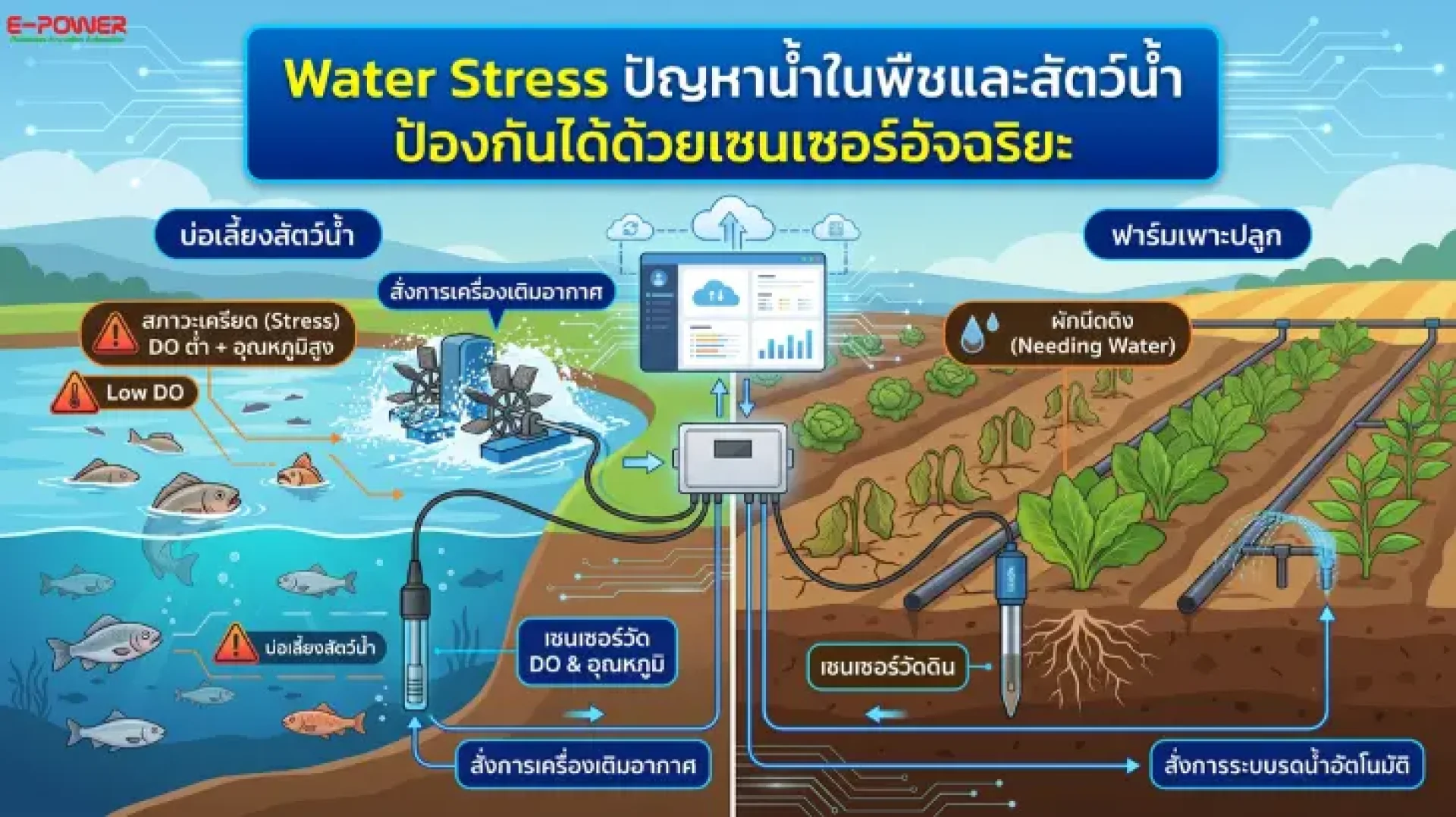
In modern precision agriculture and commercial aquaculture, the most devastating threat is often not a pathogen, but Water Stress. Whether manifested as a critical moisture deficit stalling plant metabolic pathways or shifting environmental parameters suffocating fish populations, water stress operates silently. Left undetected, it causes irreversible biological damage and severe financial loss within hours.
Detecting these critical anomalies before visual symptoms appear is the core pillar of an optimized Smart Farm and automated aquaculture setup. In this technical guide, the automation engineers at E-Power Service break down the mechanics of water stress and demonstrate how industrial sensor matrices isolate and neutralize these hazards in real time.
1. Aquaculture Crises: Low DO + High Temp = Critical Aquatic Stress
For open-pond fish and shrimp farming, water stress is driven by rapid environmental degradation within the pond matrix, typically during seasonal heat peaks:
- Elevated Water Temperature: Higher temperatures structurally decrease the solubility of oxygen in water based on thermodynamics.
- Plunging Dissolved Oxygen (DO) Levels: As oxygen levels fall, aquatic species undergo severe metabolic stress. Behavioral indicators include fish diving to lower thermal boundaries (pond stratification) or gasping rapidly at the surface.
The Automation Response Loop: The exact moment sensors register that Low DO + High Temp = Critical Aquatic Stress, the master controller must trigger the pond's automated aerators instantly. This rapid oxygen injection breaks water stratification and stabilizes the environment before mortality occurs.
2. Crop Cultivation Hazards: Identifying Plant Water Stress Before Wilting
In plant physiology, water stress occurs when transpiration rates outpace the root system's volumetric absorption capacity, lowering internal turgor pressure. The crop displays early physical signaling, entering a critical state of needing water before structural wilting begins.
Waiting for crops to show physical drooping means stress has already impacted the plant, which fundamentally stunts growth rates and reduces yields. Utilizing specialized root-zone instrumentation allows operators to implement proactive drought prevention tactics long before physical degradation manifests.
Industrial Automation Solutions by E-Power Service
Transitioning your facility into a responsive, data-driven ecosystem requires deploying high-stability, low-drift industrial sensor networks:
- Intelligent Dissolved Oxygen (DO) & Water Management Systems: A continuous tracking solution for dissolved oxygen and water temperature parameters. It interfaces directly with smart controllers to sound emergency alerts or activate aerators immediately when DO levels drop below critical parameters.
- Renke Soil Tensiometer (Model RS-TRZL-1-EX): Designed to measure soil water potential directly, mimicking root suction to prevent crop water stress and establish reliable water management parameters. Product Link: Renke Soil Tensiometer
- Renke Soil Moisture Sensor: An IP68 ruggedized 304 stainless steel probe that delivers precision volumetric water content data directly to your automatic irrigation system control loops. Product Link: Renke Soil Moisture Sensor
Technical Conclusion
Early anomaly detection dictates the boundary between optimal yield and total crop failure. Deploying industrial DO sensors and soil probes shifts operations from reactive troubleshooting to true proactive drought prevention. For complete control panel manufacturing and agricultural IoT architectural design, consult the specialized team at E-Power Service.