Turbidity Sensor vs. TSS Sensor: Choosing the Right Water Quality Tool for Industrial Facilities
Turbidity Sensor and TSS (Total Suspended Solids) sensor technologies are essential components in managing wastewater treatment and industrial production processes. However, many organizations remain uncertain about the differences between these two measurement tools. While both are used to evaluate water "cloudiness," their operating principles and applications are fundamentally different. This article by E-Power Service will clarify these differences to help you select the most suitable technology for your system.
Understanding the Difference: Turbidity vs. TSS
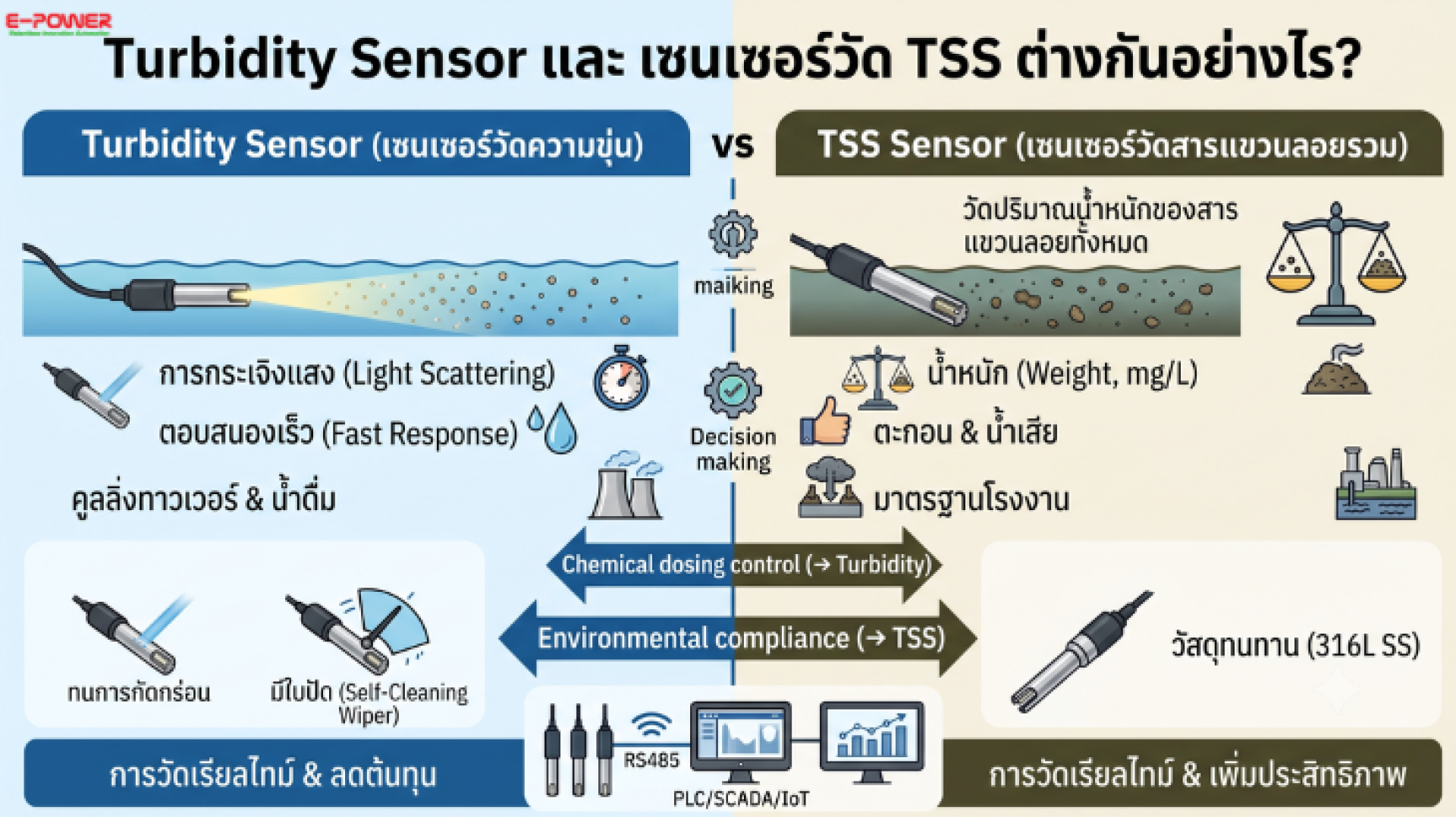
1.Turbidity Sensor
- Definition: Measures light scattering as light passes through a water sample.
- What it measures: The clarity or cloudiness of water caused by very small suspended particles that affect visual transparency.
- Key Advantage: Fast response time, ideal for monitoring water quality in terms of visual appearance or for systems requiring immediate detection of sudden changes.
- Applications: Water treatment plants, drinking water systems, and monitoring water clarity in Cooling Towers.
2. TSS Sensor (Total Suspended Solids)
- Definition: Measures the actual mass of all suspended solids present in the water.
- What it measures: Concentration in units such as mg/L or ppm, based on the actual weight of the particles.
- Key Advantage: Provides more accurate quantitative data regarding pollution loads. It is ideal for engineering processes that must comply with industrial standards and environmental regulations.
- Applications: Industrial wastewater treatment, sludge concentration control, and effluent monitoring.
Online Turbidity Measurement: Why It Matters for Automation
Implementing online turbidity measurement and TSS monitoring using industrial-grade sensors does more than just reduce manual labor—it enables real-time system performance. This data can be integrated via RS485 protocol into PLCs, SCADA, or the E-Power IoT Platform to trigger automatic chemical dosing pumps or filter operations, ultimately minimizing chemical costs and maximizing treatment efficiency.
Selection Criteria for Industrial Facilities
- For Chemical Dosing Control: The Turbidity Sensor is recommended due to its high sensitivity to rapid water quality changes.
- For Legal Compliance/Reporting: The TSS sensor is essential, as it provides mass-based concentration data required by environmental authorities.
- For Wastewater Treatment Plants: A hybrid approach using both sensors provides the most comprehensive data on both water clarity and sediment distribution.
Recommended Sensor Models
At E-Power Service, we recommend high-performance industrial sensors from Rika Sensors:
Turbidity Measurement: Rika RK500-07 Series
- Highlights: Uses ISO7027 light scattering technology. High precision and durability.
- Available Types: Includes options for clean water (Type A), corrosive environments like seawater/acidic water with titanium alloy (Type B), and a self-cleaning model (Type D) to reduce maintenance.
TSS Measurement: Rika RK500-20
- Highlights: Specifically designed for TSS concentration (mg/L) measurements.
- Key Features: 316L stainless steel housing, IP68 protection, and easy integration into automation systems to trigger processes when thresholds are exceeded.
Elevate Your Standards with E-Power Service
At E-Power Service (https://www.epower.co.th/), we specialize in industrial water quality sensor systems. Our engineers are ready to provide end-to-end consulting—from design and sensor selection to IoT system installation—to help your factory transition into a Smart Factory. Contact us today for technical solutions that optimize your wastewater management and reduce operational costs.