Submersible vs. Flow Cell Water Sensors: Which is Right for Your Industrial Application?
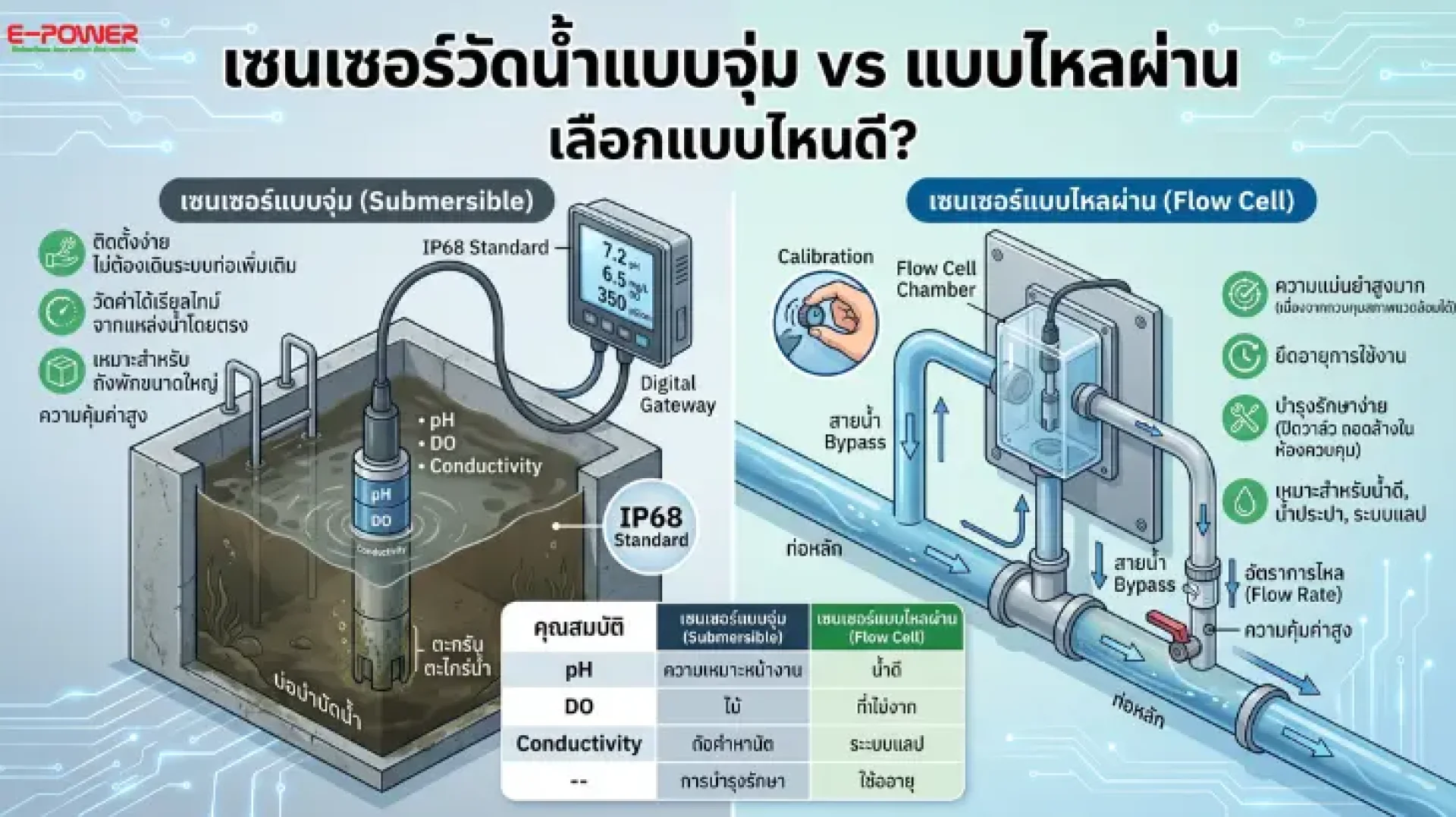
In industrial water management, wastewater treatment, and smart agriculture, acquiring accurate, real-time data is paramount. The core of this data acquisition relies heavily on your Water Quality Sensor. However, a frequent dilemma faced by plant engineers and project managers is: "Should we choose a Submersible Sensor or a Flow Cell (Bypass) Sensor?"
At E-Power Service, we bridge the gap between technology and practical application. Let’s dive deep into the differences, pros, cons, and selection criteria to ensure you maximize your ROI.
1. What is a Submersible (Immersion) Sensor?
Submersible sensors are designed to be directly immersed or suspended into the water source, such as open tanks, aeration basins, or natural water bodies.
- How it Works: Built with high-grade, waterproof housing (typically IP68), the sensor probe stays in constant contact with the process liquid to measure parameters like DO, pH, or Conductivity.
- Pros: * Simple installation with no complex piping required.
- Direct, real-time measurements from the core source.
- Ideal for large, deep tanks and open wastewater basins.
- Cons: Highly prone to biofouling, algae, and chemical scaling, requiring frequent manual cleaning.
2. What is a Flow Cell (Bypass/Inline) Sensor?
A Flow Cell setup involves diverting a small side-stream (bypass line) of water from the main pipe into a specialized sampling chamber where the sensor is housed.
- How it Works: The water flows past the sensor at a controlled, regulated flow rate and pressure, providing a highly stable testing environment.
- Pros:
Maximum Accuracy: Eliminates errors caused by turbulent currents or air bubbles.
Easier Maintenance: Technicians can close isolation valves and calibrate or clean the sensor without shutting down the main process.
Sensor Protection: Shields expensive probes from large debris and physical damage.
Cons: Higher initial setup costs due to auxiliary piping, valves, and sometimes small pumps.
Quick Comparison: Submersible vs. Flow Cell
| Features | Submersible Sensor | Flow Cell Sensor |
| Installation | Plug-and-play into basins/tanks | Requires bypass piping & valves |
| Accuracy Level | High (subject to fluid turbulence) | Extremely High & Stable |
| Maintenance | Manual retrieval from tanks | Easy isolation via valves |
| Probe Protection | Exposed to raw environment | Protected inside a chamber |
| Best Used For | Wastewater basins, open ponds, agriculture | Process water, RO systems, final effluent |
The Verdict: Making the Right Decision
- Go Submersible if: You are monitoring raw wastewater, aeration tanks (e.g., measuring Dissolved Oxygen or Sludge levels), or setting up an outdoor Smart Agriculture sensor network where piping is impractical.
- Go Flow Cell if: Your process demands strict accuracy and regulatory compliance (e.g., food & beverage, pharmaceuticals, cooling towers), or you are measuring relatively clean water like reverse osmosis (RO) permeate and drinking water.
Still undecided on the best configuration for your facility? E-Power Service (epower.co.th) offers comprehensive automation and industrial sensing solutions. Contact our engineering team today to optimize your water monitoring efficiency!